What Exactly Are Stationery Books?
You walk into a shop and see stacks of notebooks. Easy, right? But when you need to order a thousand for a school or office, it’s a different story. That’s where the term “stationery books” comes in. It covers everything from school notebooks to corporate diaries and account ledgers. For bulk buyers, knowing the difference matters. Sri Rama Notebooks has been making these for decades.
At their simplest, stationery books are bound paper products used for writing or recording. They come in various sizes, page counts, and bindings. Most people just grab what’s nearest. But when you’re buying in bulk, every detail adds up. Wrong size? Wasted money. Bad binding? Returns.
Let me give you a quick list of common types:
- School notebooks (single ruled, four ruled, etc.)
- Account books and ledger books
- Corporate diaries and planners
- Drawing books and scribbling pads
- Record books and graph books
Each type has its own specs. And if you’re ordering for a whole institution, you need to get those specs right. Here’s where you can check our range.
Why Bulk Buyers Need to Understand Stationery Book Specifications
I’ve heard enough stories of procurement managers ordering “stationery books” and ending up with the wrong size or poor paper. Not because the supplier was bad, but because the specs weren’t clear. For example, a “Long notebook” in one region might mean something entirely different in another.
Here’s a comparison of common sizes we produce at Sri Rama Notebooks:
| Size Name | Dimensions (cm) | Common Use |
|---|---|---|
| King Size | 23.6 x 17.3 | College notebooks, rough work |
| Long Notebook | 27.2 x 17.1 | School notebooks, classwork |
| Short Notebook | 19.5 x 15.5 | Small notepads, personal use |
| Account Book | 33.9 x 21.0 | Business ledgers, accounting |
| A4 | 29.7 x 21.0 | Office files, company diaries |
| A5 | 21.0 x 14.8 | Portable diaries, pocket notes |
See the differences? Now add in page count, ruling type, and binding. Suddenly, ordering “stationery books” becomes a full checklist. Without a clear spec, you’ll get something you didn’t expect. And returns for bulk orders are a headache you don’t want.
A Real Example: Rajesh’s Mistake
Rajesh, 42, works as a procurement manager for a chain of schools in Vijayawada. Last year, he ordered 5,000 “stationery books” from a different supplier. He just sent the order with no size or ruling type. What arrived? A4 unruled notebooks. Not single ruled. The teachers couldn’t use them. He had to sell them off at a loss. Now he calls us directly and sends a spec sheet. He still laughs about it, but only after the second coffee.
The lesson: don’t assume. Get specific.
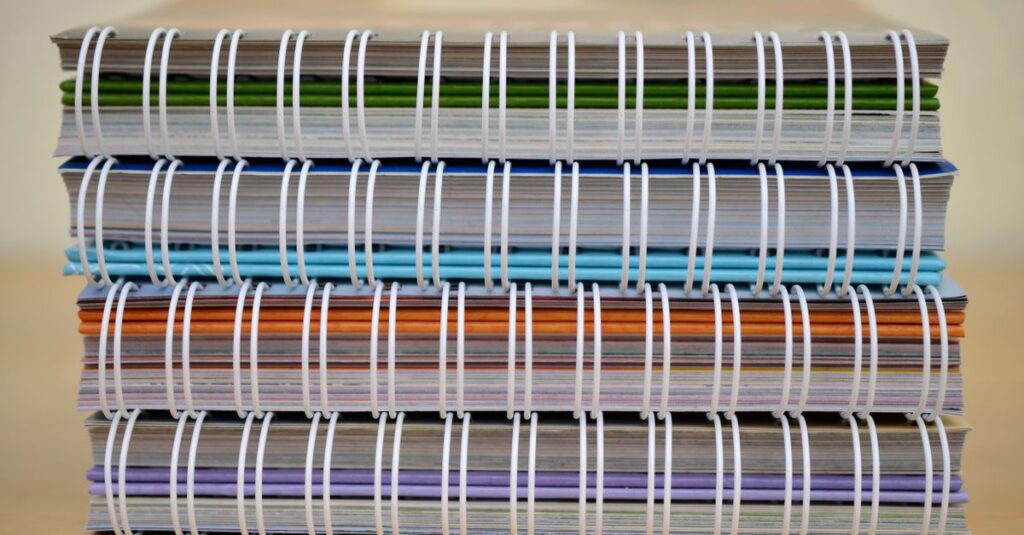
And honestly, that’s not the only mistake I’ve seen. People often overlook binding. Stitched vs spiral vs perfect binding — each suits different usage. A diary meant to last a year? Perfect binding won’t hold up. A school notebook that gets thrown into bags? Spiral might bend. So think about how the end user will actually use the book.
Customization Options for Stationery Books
So, you’ve got the size and binding figured out. Next step: branding. For corporate buyers, customization is the whole point. A diary with a company logo on the cover? That’s a year-long ad. Private label notebooks for schools? Instant brand recall. We offer logo printing, embossing, foil stamping, even custom cover design.
Here’s what you can customize:
- Cover material and color
- Logo placement (front, spine, back)
- Page ruling (single, double, four-line, etc.)
- Binding type (stitched, spiral, perfect)
- Packaging (bulk or individual wrapping)
One thing I’ve noticed: buyers often think custom = expensive. Not necessarily. We produce 30,000–40,000 units a day. The setup cost gets split across large runs. So ordering 10,000 custom notebooks is way cheaper per unit than ordering 500. That’s why bulk ordering makes sense.
Expert Insight
I was at a small factory in Rajahmundry last month — not ours, just visiting a friend’s place. He showed me a batch of “stationery books” that had been sitting in his warehouse for six months. The buyer had ordered them without specifying page count. The books had only 52 pages, but the buyer assumed 200. They couldn’t be returned because the contract wasn’t clear. My friend, a seasoned stationery maker, told me: “Most procurement people don’t know paper weight from binding strength. They just see a notebook.” That stuck with me. If you’re buying in bulk, take twenty minutes to learn the basics. It saves months of regret.
How to Choose the Right Stationery Book Supplier
Not all suppliers are the same. Some focus on retail packs, others on institutional bulk. For stationery books meant for schools or offices, you need a manufacturer with capacity and consistency. Look for:
- Established experience (we’ve been at it since 1985)
- Production volume (30,000+ per day means we handle large orders)
- Customization capabilities (logo, covers, binding)
- Export experience (we ship to Gulf, Africa, USA, UK, Europe, Australia)
- Communication — do they respond in a day or a week?
I’m biased, of course. But I’ve worked with enough suppliers to know that responsiveness matters more than price. A cheap supplier who delays delivery costs you more in the long run.
And here’s something I’ve learned the hard way: don’t go with the first quote. Get samples first. A sample tells you the paper quality, the binding strength, and the exact dimensions. Most reputable manufacturers will send you samples for a small fee or even free. We do.
Frequently Asked Questions
What are stationery books?
Stationery books refer to bound paper products used for writing, recording, or drawing. Common examples include school notebooks, account books, diaries, and scribbling pads. They come in various sizes, page counts, and binding types.
What sizes are available for stationery books?
Common sizes include King (23.6×17.3 cm), Long (27.2×17.1 cm), Short (19.5×15.5 cm), A4, A5, and Account Book (33.9×21 cm). Each size suits different uses — school, office, or personal.
What is the difference between stitched and spiral binding?
Stitched binding involves sewing pages together, making the book durable for heavy use. Spiral binding uses wire or plastic coils, allowing the book to lay flat. Choose stitched for long-lasting school notebooks, spiral for diaries that need to stay open.
Can I get custom logos on stationery books?
Yes. Most manufacturers, including Sri Rama Notebooks, offer logo printing, embossing, foil stamping, and custom cover design. For bulk orders (500+), setup costs are minimal per unit. Just send your artwork or brand guidelines.
How many pages should a school notebook have?
It depends on the subject. Common page counts are 52, 92, 200, and 240 pages. For daily classwork, 92-200 pages is typical. For exam practice or heavy writing, 240+ pages. Check with the school’s requirement first.
The question isn’t whether stationery books matter. It’s whether you’ll get the right ones. Most people don’t think about specs until they’re stuck with a bad order. I don’t have a perfect answer. Probably there isn’t one. But if you’re buying in bulk, take the time to clarify every detail. Your future self will thank you.
Ready to place your next order? Check out Sri Rama Notebooks for quality stationery books that meet your exact needs.