A4 Spiral Notebook 300 Pages – The One That Actually Lasts
Let me be honest – most notebooks in this category are garbage. You flip the cover and the spiral snags. You write on the left side and your hand cramps because the coils dig in. By page 250, half the pages are falling out.
Here's the thing about an a4 spiral notebook 300 pages – it's not an easy thing to make well. The paper has to handle ink without bleeding. The spiral has to flex without breaking. And the spine? It needs to let the notebook lay flat, even when you're on page 297. Trust me, I've been in this industry long enough to know what goes wrong.
If you're buying these in bulk – for a school, a corporate order, or a government tender – you need to know what separates a notebook that works from one that falls apart. I'll walk you through it. If you want to see what a properly made one looks like, we make them at Sri Rama Notebooks, and I'll tell you exactly what to look for.
Why 300 Pages is a Threshold – Not Just a Number
Somewhere around the 200-page mark, notebooks start behaving differently. The paper stack gets thick. The spiral binding has to work harder. And the cover? It can't just be a thin piece of cardboard anymore.
I've seen buyers order a plain A4 spiral notebook with 300 pages and then wonder why the spiral bends out of shape after two months. The answer: because they picked a notebook made for 100 pages and crammed it with cheap paper. The thickness changes everything.
Here's what happens when you push a notebook past 250 pages without proper design:
- The spiral starts to warp because the paper weight pulls on it unevenly.
- Pages near the center get torn out because the binding holes aren't reinforced.
- The cover curls up at the corners – not a cosmetic thing, it actually stops the notebook from closing properly.
But that's only if the manufacturer cut corners. A well-made a4 spiral notebook 300 pages solves all of these. The spiral has to be thicker gauge wire. The paper has to be compressed properly so the stack is uniform. And the cover needs to be at least 300 GSM board, maybe more.
I was talking to a buyer last month – a distributor from Hyderabad. He said his biggest headache was returns. Schools returning notebooks because the spiral broke by mid-term. I told him the fix isn't cheaper pricing. It's picking a notebook designed for the page count.
Paper Quality That Doesn't Lie
You can tell everything about a notebook by how it handles ink. Not by how it looks on the shelf. By how it behaves when someone actually writes in it.
For an a4 spiral notebook 300 pages, the standard paper weight is 54 to 60 GSM. Sounds low, right? But here's the trick – the GSM number matters less than how the paper is finished. A well-calendered 54 GSM paper handles ink better than a rough 70 GSM sheet. I know that sounds backwards, but it's true.
What you're looking for:
- Ink absorption – the ink should sit on top, not soak through like cheap filter paper.
- Opacity – you shouldn't see writing from the other side when the page is closed.
- Tear resistance – 300 pages means the notebook gets heavy use. Pages should tear cleanly, not rip jagged.
Most buyers don't check these things until it's too late. And then they're stuck with a batch of notebooks that bleed through on page one. I've seen it happen more times than I can count.
Expert Insight
I remember once, back in 2018, we got a rush order from a school chain in Andhra. 10,000 notebooks. A4, spiral, 300 pages. The paper we used was 55 GSM – standard stuff. They came back after three months saying the ink was bleeding. I flew down myself. Turns out the students were using gel pens with really wet ink. Not the notebook's fault. But it taught me something: ask about the pen. Because if you don't, no one will tell you until the complaint comes in. And by then, it's too late.
Spiral Binding – The Part Everyone Gets Wrong
Spiral binding looks simple. Coils through holes, holds pages together. How hard can it be?
Harder than you think. Especially at 300 pages.
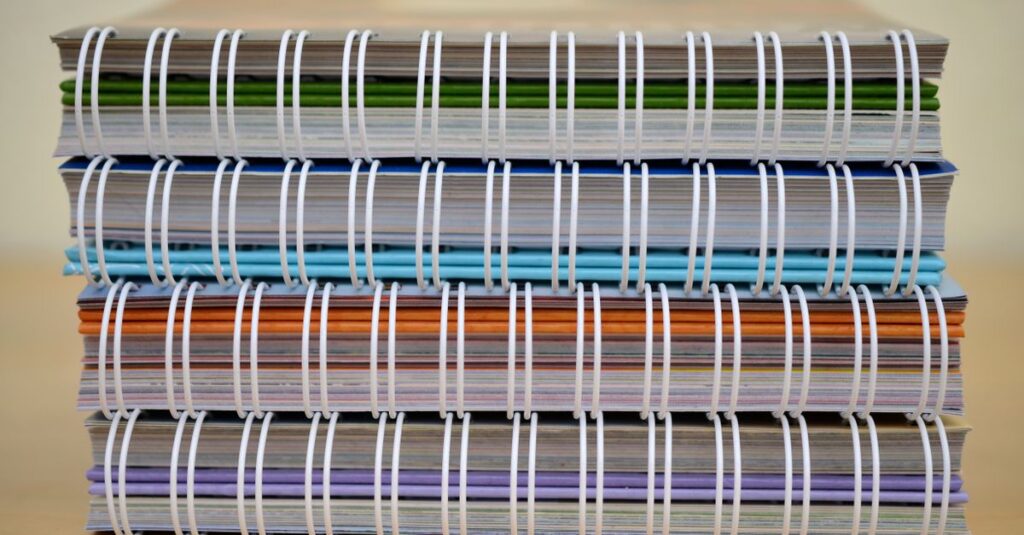
Most spiral notebooks use what's called twin-wire binding – two coils that interlock. For thin notebooks, that works fine. But for an a4 spiral notebook 300 pages, the wire gauge matters a lot. Too thin, and the spiral bends under the weight. Too thick, and the pages don't turn smoothly.
Here's what we use that actually works:
| Feature | Standard Notebook | 300-Page Notebook (Recommended) |
|---|---|---|
| Wire Gauge | 1.2 mm – 1.5 mm | 1.8 mm – 2.0 mm |
| Hole Pitch | 3:1 ratio | 2:1 ratio (stronger) |
| Cover Material | 250 GSM board | 300+ GSM board, laminated |
| Spine Lay-Flat | Partial | Full 180-degree opening |
| Page Reinforcement | None | Reinforced hole stitching |
The reinforced hole stitching is the one nobody talks about. Most spiral notebooks just punch holes through the paper. After 300 turns, the paper around the hole starts to tear. I've seen pages fall out by page 200. With reinforcement – a strip of fabric or plastic around the hole – those pages stay put.
I'll say it plainly: if you're bulk ordering these, ask the manufacturer about hole reinforcement. If they look confused, go somewhere else.
Which brings me to a story.
A Real Conversation That Changed How I Think
Mohan Rao, 42, procurement manager at a government college in Visakhapatnam. He's been ordering notebooks for twelve years. Last August, he called me frustrated. He'd ordered 5,000 A4 spiral notebooks, 300 pages each, from a new supplier. Price was 20% lower than his usual vendor. Seemed like a good deal.
By October, they had complaints. Spirals on the left side were popping open. Pages near the end were tearing out. Students were taping them back together. I asked him one question: did you check the wire gauge? He paused. Said he didn't know there was a difference.
He ended up re-ordering from us. Not because I sold him hard – because the notebooks we sent him didn't fall apart. I think about that call sometimes. One detail, one question, and he would have saved two months of headaches.
(He still sends us orders. Tells everyone in Visakhapatnam about the spiral notebook that actually works.)
What Bulk Buyers Need to Check Before Ordering
I've worked with enough procurement teams to know that most of them don't get to physically inspect samples. They see a spec sheet, a price, and a delivery timeline. They order. They pray.
Don't do that. Not with an a4 spiral notebook 300 pages. Because the price difference between good and bad can be small – but the difference in returns is massive.
Here's a checklist I give to every bulk buyer I talk to:
- Ask for a physical sample. Not a photo. Not a PDF. A real notebook. Open it. Write in it. Fold it.
- Check the spiral at the top and bottom. The ends should be crimped inward, not left sticking out. Those sharp ends catch on clothes, on bags, on skin.
- Count the pages. I know this sounds obvious, but I've seen suppliers claim 300 pages and deliver 280. The difference adds up in a bulk order.
- Test the lay-flat. Open to the middle. Does it stay open? If it springs shut, the binding is too tight.
- Look at the cover lamination. A4 notebooks get shoved into bags, rained on, bent. A matte lamination hides scratches. A glossy one shows every finger smudge.
I realize this sounds like a lot. But I'd rather you spend 15 minutes checking a sample than deal with 3,000 defective notebooks later. I've seen both sides of that equation.
And honestly? Most manufacturers can deliver on these points. The ones who can't – they're the ones who'll cut corners when you're not looking.
Frequently Asked Questions
Frequently Asked Questions
Is an a4 spiral notebook 300 pages heavy to carry?
It depends on the paper. A 54 GSM paper keeps the weight manageable – around 700 to 800 grams per notebook. Heavier paper like 70 GSM will push it past a kilogram. For daily carry, stick with lower GSM unless you need the thickness.
Can I get custom printing on an a4 spiral notebook 300 pages?
Yes. Most manufacturers offer logo printing, cover customization, and private labeling. The minimum order quantity usually starts around 500 to 1,000 units. You can print on the cover, the back, and sometimes the spine if the binding allows.
What type of paper is best for an a4 spiral notebook 300 pages?
54 to 60 GSM writing paper is standard. It's smooth enough for ballpoint and gel pens and doesn't bleed through easily. If you're using fountain pens, go for 70 GSM or higher. Always test with your actual pen before committing to a bulk order.
How long does it take to manufacture 10,000 a4 spiral notebooks?
A factory with decent capacity – like 30,000 to 40,000 units per day – can finish an order of 10,000 within a week. The timeline depends on customization. Simple orders go faster. Embossing or foil stamping adds a few days. Always confirm the timeline in writing.
Do a4 spiral notebooks come in both left-handed and right-handed versions?
Standard spiral notebooks have the coils on the left, which works for right-handed writers. Left-handed versions are made with the spiral on the right side. You have to specifically request this – most manufacturers don't stock them. It's a small but important detail if you're ordering for a classroom.
One Last Thing Before You Order
Look, I'm not going to tell you that every a4 spiral notebook 300 pages is the same. Because they aren't. The difference between a notebook that lasts the school year and one that falls apart by November comes down to five minutes of checking: wire gauge, paper quality, hole reinforcement, cover thickness, and the spiral ends.
I don't think there's one perfect notebook for everyone. Probably there isn't. But if you're ordering in bulk, you deserve one that works. If you want to see what we make, take a look at Sri Rama Notebooks. We've been making them since 1985. I think we've figured out most of the hard parts by now.