Let’s Get Straight to the Point About A5 Paper
You’re probably here because you’re staring at an order form or a product spec sheet. The design team wants A5 diaries for the execs. The school needs quote books for teachers. The procurement officer is asking what size you quoted for the 50,000 custom notebooks. And you need to know — what the heck is an A5 size paper, exactly?
It’s not a minor detail. Get the dimensions wrong, and suddenly your corporate gift notebook looks like a kid’s toy. Or worse, the shipping costs double because your bulk order doesn’t fit the standard pallet. I’ve been in this business for decades — over at Sri Rama Notebooks — and the A5 question comes up more than you’d think. Usually right before a big order needs to be confirmed.
Right. Let’s clear it up.
The A5 Size, in Inches, Centimeters, and Plain English
Forget the marketing fluff. Here are the numbers you actually write down.
A5 dimensions in centimeters: 14.8 cm x 21.0 cm.
A5 dimensions in inches: 5.8 in x 8.3 in (we usually say 6 by 8 inches for simplicity).
A5 dimensions in millimeters: 148 mm x 210 mm.
That’s it. That’s the core specification. Everything else — weight, feel, quality, ruling — is built on top of that. I’ll tell you something: a lot of suppliers will fudge these numbers by a few millimeters. They’ll call a 150x215mm notebook an “A5-ish.” We don’t do that. In manufacturing and for export, those ISO standard numbers matter. It means your notebook will stack neatly, fit into standard packaging, and — this is the big one — feel exactly like what your client expects.
If this sounds familiar, this might be worth a quick look.
Why A5? (And Not A4, or a “King Size?”)
Okay, so you have the size. But the real question is: why choose it? What’s it good for? Let me be direct — A5 is the ultimate Goldilocks size.
Think about an A4 sheet (that’s your standard printer paper). Fold it in half. You get an A5. That’s literally the origin of the “A” series. It’s half of A4. This makes it portable but not cramped; professional but not intimidatingly large.
Here’s what most people don’t realize: the size dictates the function. And the function dictates who you should be selling it to.
Real-World Use Cases for A5 Notebooks
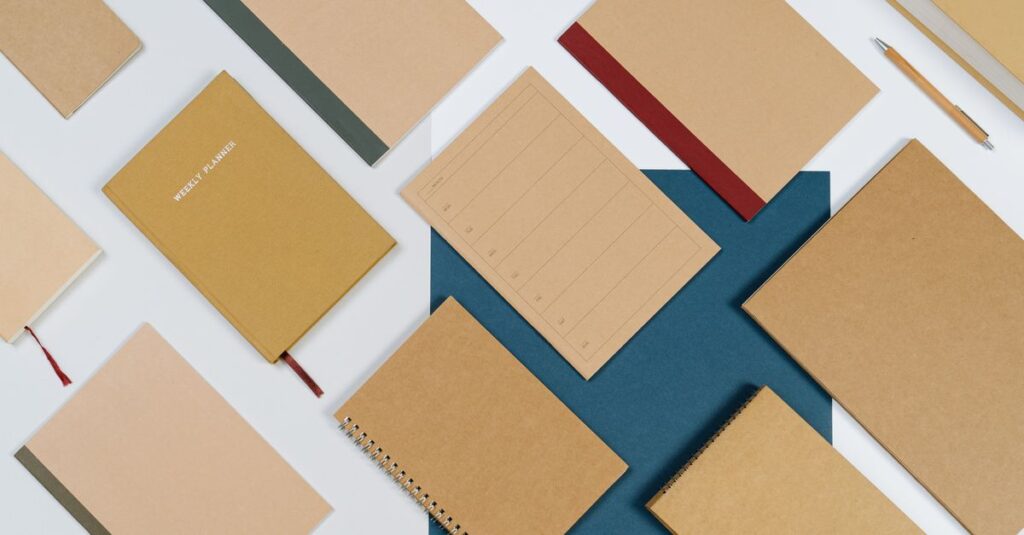
- Corporate Diaries & Planners: This is the sweet spot. It sits nicely on a desk without dominating it, fits in most briefcases and laptop bags easily, and has enough page space for daily to-do lists, meeting notes, and schedules. When we make custom year-end diaries for companies, 70% of the orders opt for A5. It just works.
- Student Subject Notebooks: Especially for higher grades or university. It’s big enough for proper note-taking in a lecture, but you can carry 3-4 of them without breaking your back. For a bulk school notebook order, we’ll often suggest A5 for subjects like Literature or History.
- Professional Journals & Logbooks: Think field engineers, nurses, architects on site. They need something sturdy they can carry around all day to jot down readings, sketches, or observations. A5 is the default for a reason.
- Creative Sketchbooks (Unruled): Artists and designers love it for quick concepts. It’s more intimate than A4, which can feel too blank and daunting.
The question isn’t “What is A5?” It’s “Does A5 solve my user’s problem?”
Seeing It Side-by-Side: A5 vs Other Common Notebook Sizes
Numbers are one thing. Comparing it to what you already know is another. I was talking to a procurement manager from a tech firm in Bangalore last month — over email, actually — and he sent me a photo of three different “medium” notebooks on his desk, asking which was A5. None of them were. They were all different.
To avoid that headache, here’s a simple table. Print this out. Stick it on your wall.
| Notebook Size Name | Dimensions (cm) | Best For | Feel Compared to A5 |
|---|---|---|---|
| A5 (ISO Standard) | 14.8 x 21.0 | Corporate diaries, student notes, professional logs | The benchmark |
| A4 (Larger) | 21.0 x 29.7 | Meeting minutes, ledger books, full-page sketches | Much taller and wider. Feels like official paperwork. |
| King Size (Local Std.) | 23.6 x 17.3 (approx.) | Primary school notebooks, rough work | Wider but shorter. More squat. |
| Long Notebook (Local Std.) | 27.2 x 17.1 (approx.) | School exam pads, writing practice | Significantly taller. Good for lists. |
| A6 (Smaller) | 10.5 x 14.8 | Pocket notebooks, handbag journals, quick memos | Half the size of A5. It’s tiny. |
See the difference? An A5 isn’t just a random medium book. It’s a specific international standard. Knowing this table stops you from accidentally ordering 10,000 “King Size” books when your European client’s branding was designed for A5. That mistake costs real money.
Beyond the Ruler: How Size Affects Manufacturing & Your Order
Here’s the part nobody in sales tells you. The size isn’t just a marketing feature. It ripples through the entire production process. And understanding this makes you a smarter buyer.
Paper comes in massive, parent-sized sheets. For the ISO “A” series, the magic starting size is A0 (1 square meter). The paper is then cut in half each time: A0 to A1, A1 to A2, A2 to A4, A4 to A5. This system — it’s called the ISO 216 standard — is brilliant because it creates zero waste in the cutting process. Every cut uses the whole sheet.
I need to pause here. This is probably the most important practical insight for you if you’re ordering in bulk. When you order a true ISO A5 size from a manufacturer who understands this, your cost per unit is often better. No wasted paper means lower material costs. Some local “standard” sizes, while familiar, cut from different paper sizes and leave trim waste. Someone pays for that waste. Usually, it’s you, hidden in the unit price.
Expert Insight
I was reading a trade journal last month and one line stuck with me. A production manager for a big European stationery firm said the biggest cost saving they ever made wasn’t in ink or labor — it was moving their entire custom notebook line to strict ISO A-series sizing. The efficiency in paper utilization was crazy. He said something like — “We stopped fighting the geometry of the sheet.” I don’t have a cleaner way to put it than that. The paper wants to be cut a certain way. A5 is part of that natural, efficient family.
The Human Side of A5: A Micro-Story
Anita, 34, is a project manager in Hyderabad. Her company, a mid-sized IT services firm, gave out branded A5 notebooks at the last quarterly meet. She took one, thinking it was just another corporate freebie. She tossed it in her bag.
Two weeks later, during a chaotic client call, she ripped it out. She started scribbling timelines, delegating tasks. The size was perfect — it sat on the corner of her keyboard, didn’t get in the way, but had enough space for her messy, urgent diagrams. She kept using it. A month in, she realized she’d filled half of it. She didn’t have to keep flipping pages for a new one. It was all there. She asked procurement where they got them. “We need these for my whole team,” she said.
That’s the A5 moment. It’s not about the specs on a page. It’s about the notebook disappearing and just… working.
Making Your Decision: What to Specify When Ordering A5 Notebooks
So you want to order A5 notebooks. Great. Don’t just say “A5.” You need to build the full spec, or you’ll get a default product that might not suit you. Here’s your checklist:
- Confirm the Exact Dimensions: Ask the manufacturer: “Do you produce to ISO 216 A5 dimensions (148x210mm)?” This filters out the ones who are guessing.
- Page Count (Folio): Common counts are 92, 120, or 200 pages. More pages means a thicker book. A 200-page A5 with a sturdy cover has a nice, substantial heft.
- Paper GSM (Weight): For writing, 70-80 GSM is premium and prevents bleed-through. For standard corporate diaries, 54-60 GSM is common and cost-effective. Ask for a sample.
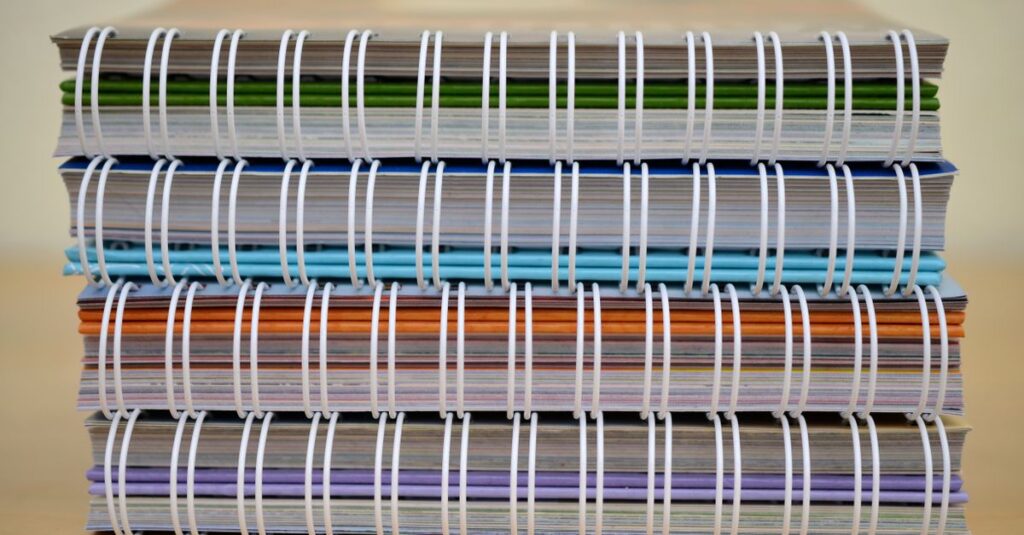
- Binding: Spiral binding lets it lay flat. Perfect binding (glued spine) looks cleaner and more formal. Stitched binding is the most durable for heavy use.
- Cover: Art paper, laminated, hardbound? This is where your branding shines. A good custom printing service can guide you here.
Look, I’ll just say it. If a supplier can’t confidently walk you through these five points for an A5 order, find one who can. Your notebook is an extension of your brand. It shouldn’t feel like an afterthought.
Frequently Asked Questions
Is A5 the same as a half letter size?
No, and this is a common mix-up, especially with US buyers. A5 is 148×210 mm. US “Half Letter” is 140×216 mm. They’re close, but not the same. The proportions are different. For a custom order, you must specify which one you need, because the cutting patterns and covers won’t interchange.
How many A5 sheets fit on an A4 sheet?
Two. Exactly two. That’s the whole logic of the A-series. You can literally print two A5 pages on one standard A4 sheet, cut it in half, and you have two perfect A5 pages. This is super useful for in-house printing of custom A5 notepads.
Is A5 a good size for a school notebook?
It depends on the age. For primary school kids who need bigger spaces to write, a larger size like King Size or Long is often better. For high school and university students, A5 is excellent for subject-specific notebooks — it’s a professional size that doesn’t waste space or bag capacity.
What is the A5 paper size in pixels for designing?
This trips up designers. There’s no single answer because it depends on the DPI (dots per inch) of your image. For print design at high quality (300 DPI), an A5 page is 1748 x 2480 pixels. Always confirm the required pixel dimensions with your printer to avoid blurry logos.
Can you make custom A5 notebooks in small quantities?
Yes, but the economics change. For truly custom work (unique cover, page ruling, branding), manufacturers have a minimum order quantity (MOQ) to make the setup worthwhile. It might be 500 pieces, sometimes 1000. For standard A5 notebooks with just your logo stamped on, MOQs can be lower. You just have to ask.
Wrapping This Up
The size of A5 paper is 14.8 cm x 21.0 cm. It’s half an A4. It’s the go-to for a reason — it balances portability and utility almost perfectly.
But knowing the dimensions is just step one. The real work is understanding what that size enables: efficient manufacturing, predictable costs, and a product that actually works in someone’s hands. Whether you’re a corporate buyer sourcing premium diaries, a school administrator stocking up, or a distributor looking for a reliable product line, get the size right first. Everything else — the feel, the quality, the branding — builds on that foundation.
I don’t think there’s one perfect notebook size for everyone. Probably there isn’t. But if you’ve read this far, you’re not just looking for a measurement — you’re figuring out if A5 is the right tool for the job you need done. And that’s the smartest question you can ask.
If you’re looking at a bulk order and want to get the specs ironed out with someone who’s been doing this since 1985, let’s talk about your A5 project.