


What Actually Goes Into a Science Notebook?
Let me tell you a quick story. A few months ago, I got a call from a science teacher in Visakhapatnam. She was frustrated — her students’ notebooks were falling apart by mid-term. Pages tearing out. Ink bleeding through. Covers curling up like potato chips.
She said something that stuck with me: “I just need a science notebook that survives the year. Is that too much to ask?”
Honestly? No. It’s not. And her problem is more common than most people think.
The thing is — a science notebook isn’t just any notebook. It has to handle diagrams, equations, occasional spills, and daily wear. That’s a different standard than a journal or a notepad. And most buyers don’t realize this until they’re staring at a pile of ruined books.
At Sri Rama Notebooks, we’ve been making notebooks since 1985. I’ve seen what works and what doesn’t. So let’s talk about what actually matters.
Paper Quality — The Make or Break
This is the single biggest mistake I see buyers make. They pick notebooks based on cover design or price per unit. But the paper is doing all the work.
A science notebook doesn’t just hold words. It holds graphs, chemical structures, physics diagrams, and sometimes lab data written in pen. And if the paper is too thin — say below 50 GSM — you’re looking at ghosting, bleeding, and frustration.
What I’ve found works best is 54 to 60 GSM paper. It’s thick enough to handle ballpoint and gel pens without bleed-through. But it’s not so thick that the notebook becomes bulky or expensive.
Now, here’s the part people forget: white paper isn’t always the best choice. Off-white or slightly cream paper reduces eye strain during long lab sessions. I know it sounds like a small thing, but try staring at bright white pages for three hours. Your eyes will thank you.
What to Check Before Ordering
- GSM rating — 54 GSM minimum for regular use, 60 GSM for heavy ink work
- Opacity — hold a page up to light; if you can see through it easily, pass
- Surface texture — too smooth and ink sits on top; too rough and pens drag
- Acid-free — especially if the notebook needs to be stored for years
And if someone tells you paper quality doesn’t matter for a science notebook? Ask them how many times they’ve had to redo lab notes because the ink bled through.
Ruling Types — Why One Size Doesn’t Fit All
Here’s a conversation I had recently with a procurement manager from a college in Rajahmundry. He was ordering notebooks for three departments — physics, chemistry, and biology. And he ordered the same ruling for all of them.
I asked him why. He said, “It’s just paper with lines, right?”
No. No, it’s not.
A biology notebook needs space for drawings — cell structures, diagrams, labeled parts. That’s where broad ruling or even unruled pages work better. A physics notebook? Mostly equations and problem-solving. Narrow ruling or graph paper grids make more sense. Chemistry sits somewhere in between — you need space for chemical formulas and lab observations.
Most buyers don’t realize that you can mix ruling types within the same order. We do it all the time. Front section for notes, back section for diagrams. It costs slightly more per unit, but the usability jump is huge.
Here’s the short version:
| Subject | Best Ruling | Why |
|---|---|---|
| Physics | Single ruled or Graph | Equations and graphs need precision |
| Chemistry | Single ruled with margin | Lab notes and formulas work on ruled lines |
| Biology | Broad ruled or Unruled | Diagrams and labels need space |
| General Science | Single ruled (standard) | All-purpose, good for mixed use |
The lesson? Don’t order blind. Ask your students or teachers what they actually use. It takes ten minutes to figure out, and it saves you months of complaints.
Binding — The Part Nobody Thinks About Until It Breaks
I’ll be honest with you. Most notebook manufacturers use the cheapest binding possible because it keeps the unit cost low. And for a 52-page memo pad, that’s fine. But for a science notebook that gets tossed in a bag, opened flat on a lab bench, and used for a whole semester? Cheap binding is a disaster.
I remember visiting a school in Kakinada a couple years back. The principal showed me a stack of notebooks from another supplier. They were six weeks old and half of them had pages falling out. The binding was just glued — no stitching, no reinforcement.
That’s where stitched binding comes in. It’s not fancy. It’s not new. But it works. The pages are sewn together before being attached to the cover. That means: a. pages don’t fall out, b. the notebook opens flat (important for lab work), and c. it lasts three to four times longer than glued binding.
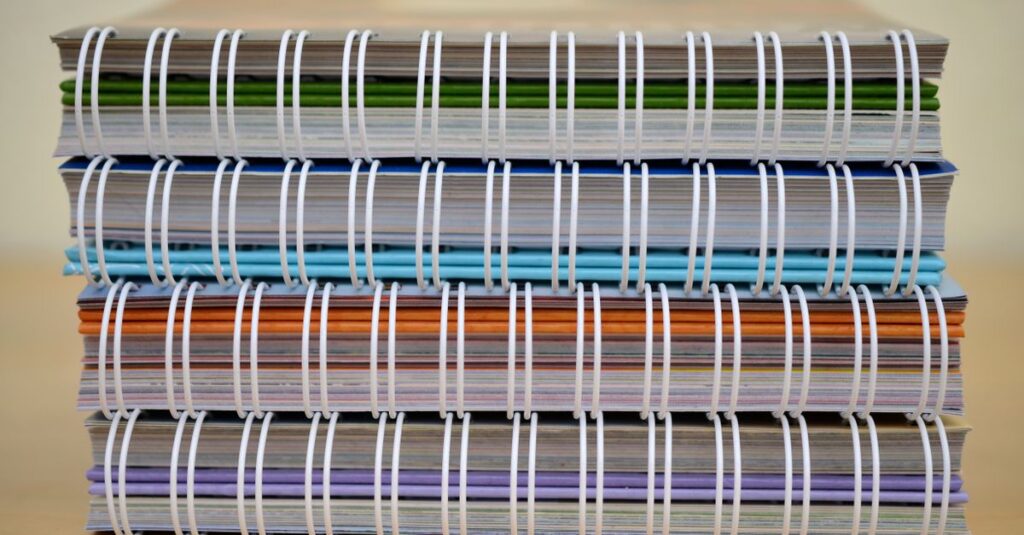
And if you’re buying for a technical or design-focused program? Spiral binding is worth considering. It stays open on its own and you can fold it back. But it’s less durable for rough handling.
Anyway. My point is — don’t assume binding is just binding. Ask what method is used. If they say “perfect bound” for a 200-page notebook, ask if it’s also stitched. If they say no, consider whether you want to reorder in three months.
Cover Durability — It’s Not Just About Looks
I think — and I could be wrong — that people pay too much attention to cover design and not enough to cover material. A glossy cover with a nice print job is great for the first week. But what about week ten? Is it still intact?
A good science notebook needs a cover that can take abuse. Not abuse like dropping it in water, but the daily abuse of being shoved in a backpack, stacked under textbooks, or left on a damp lab bench.
Here’s what we’ve learned after four decades of making notebooks. The best cover for student use is a 200 to 300 GSM board with a polypropylene laminate or a textured paper finish. It bends without cracking. It resists moisture better than raw paper. And it doesn’t peel at the corners.
For corporate or institutional orders, there’s also the option of laminated covers. They’re more expensive per unit, but they last significantly longer. I’ve seen six-year-old laminated notebooks that still look presentable.
The real question is: are you prioritizing appearance or durability? Ideally both. But if you have to pick one, pick the one that survives the semester.
Expert Insight
I was reading through some old manufacturing notes from the 1990s last week — we keep records going back pretty far — and there was a handwritten observation from the senior production manager at the time. He wrote: “The best notebooks we ever made were the ones people didn’t notice. They just worked.”
I thought about that for a while. He was right. A notebook that doesn’t fall apart, doesn’t bleed ink, and opens flat — nobody writes a review about that. But they notice when it fails.
That’s the standard I think about when we produce a science notebook. Not flashy. Not over-engineered. Just reliable enough that the person using it can focus on their work, not on the notebook itself. Which is the whole point, isn’t it?
Bulk Buying — What Changes at Scale
I need to say something that might ruffle some feathers. Buying notebooks in bulk is not the same as buying ten notebooks from a store. The logic changes. The economics change. And sometimes the quality changes too — and not in a good way.
When you’re ordering 5,000 or 10,000 science notebooks for a school board or a university, the stakes are different. You can’t just send a sample back if it’s wrong. You’re stuck with the whole batch.
That’s why you should ask these questions before placing a bulk order:
- Can we get a production sample before the full run?
- What is the paper GSM and where is the paper sourced from?
- Is the binding stitched, glued, or both?
- What is the cover GSM and finish?
- What’s the lead time for custom printing or ruling?
I’ve seen schools order from the cheapest supplier and end up with notebooks that couldn’t survive a monsoon. The savings per notebook was maybe two rupees. But the frustration from teachers and students? Priceless in the worst way.
A reliable manufacturer will answer these questions without hesitation. They’ll tell you what they do well and what they don’t. And they won’t promise something they can’t deliver.
(Earlier I said cheap binding was fine for memo pads. That’s not quite fair — even memo pads need structure. But for a science notebook, there’s genuinely no shortcut.)
Frequently Asked Questions
Frequently Asked Questions
What paper GSM is best for a science notebook?
54 to 60 GSM is the sweet spot for most science notebooks. It handles pens without bleeding, holds up to daily use, and keeps the notebook reasonably priced. For heavy ink or marker use, go up to 70 GSM.
Should a science notebook be ruled or unruled?
It depends on the subject. Single ruled works for general notes and chemistry. Broad ruled or unruled is better for biology diagrams. Graph ruling helps for physics and math. Many schools mix ruling types within the same notebook for flexibility.
How long does a stitched notebook last compared to a glued one?
A stitched notebook can last three to four times longer than a glued one under regular use. The stitching keeps pages from falling out even when the notebook is opened flat or handled roughly. That’s why we recommend it for school notebooks.
Can I get a science notebook with custom printing on the cover?
Yes. Most manufacturers offer custom cover printing, including logo printing, embossing, and foil stamping. For bulk orders, you can also request specific cover designs, color schemes, and even interior page layouts tailored to your curriculum.
What is the minimum order quantity for a custom science notebook?
This varies by manufacturer. At our facility in Rajahmundry, we typically handle orders starting from 500 units for custom notebooks. For larger institutions, we often run orders of 10,000 units or more with full customization.
Wrapping This Up
Look, I don’t think there’s one perfect science notebook for every situation. A university physics lab has different needs than a high school biology class. And a corporate training program has different requirements than a government school supply order.
But the basics don’t change. Good paper. Solid binding. Durable cover. And a manufacturer who actually knows what they’re doing — not just cutting corners to hit a price point.
That teacher I mentioned at the start of this article — she eventually found notebooks that worked. But she had to go through three suppliers first. Three rounds of wasted time, wasted money, and wasted student effort.
I don’t know exactly what you’re looking for. But if you’re in the market for a notebook that actually does the job, Sri Rama Notebooks is worth a conversation.