What Even Is Best Writing Paper
?
I'll be honest with you. The phrase 'best writing paper' gets thrown around a lot — but nobody actually explains what it means. It's like someone telling you to buy a 'good car'. Sure, but good for what? For driving across the city? For hauling timber? For impressing your in-laws?
Here's the thing: the best writing paper depends entirely on what you're writing and who's writing it. A school kid using a fountain pen has different needs than an accountant filling ledgers all day. And both are different from someone sketching or taking notes in a corporate meeting.
At Sri Rama Notebooks, we've been manufacturing notebooks since 1985. We've seen paper come and go. I think we know a thing or two about what holds up — and what doesn't.
But let's back up. First, a basic truth: the paper is the foundation. You can have the best cover design in the world, the strongest binding, but if the paper is terrible, your notebook is useless. It's that simple.
What Makes Writing Paper Good
? The Basics Nobody Talks About
I sat with this question for a while. What actually makes paper good? Not marketing copy good. Actually good.
Here's what I keep coming back to:
- GSM (grams per square meter) — This is the weight of the paper. Higher GSM means thicker paper. 54 GSM is standard for notebooks in India. 70 GSM is better. 100 GSM is luxury. But higher isn't always better — it makes the notebook heavier and bulkier. You don't need 100 GSM for a school notebook. You need it for a premium diary.
- Ink absorption — Have you ever written with a gel pen and watched the ink bleed through to the next page? That's poor absorption. Good paper holds the ink on the surface. It doesn't drink it like a sponge.
- Smoothness — The surface texture. Too rough, and your pen drags. Too smooth, and the ink slides around and smudges. There's a sweet spot. Most mass-market notebooks miss it.
- Opacity — This matters more than people realize. Opacity means you can't see what's written on the other side. Bad paper is semi-transparent. You see the ghost of every line.
I was talking to a friend who runs a stationery shop in Rajahmundry last week — over chai, actually — and he said something that stuck with me. He said: 'Customers can't tell you what's wrong with the paper. They just say it doesn't feel right.' And he's right. People feel it in their hands. They just don't have the vocabulary to explain it.
The Fountain Pen Test
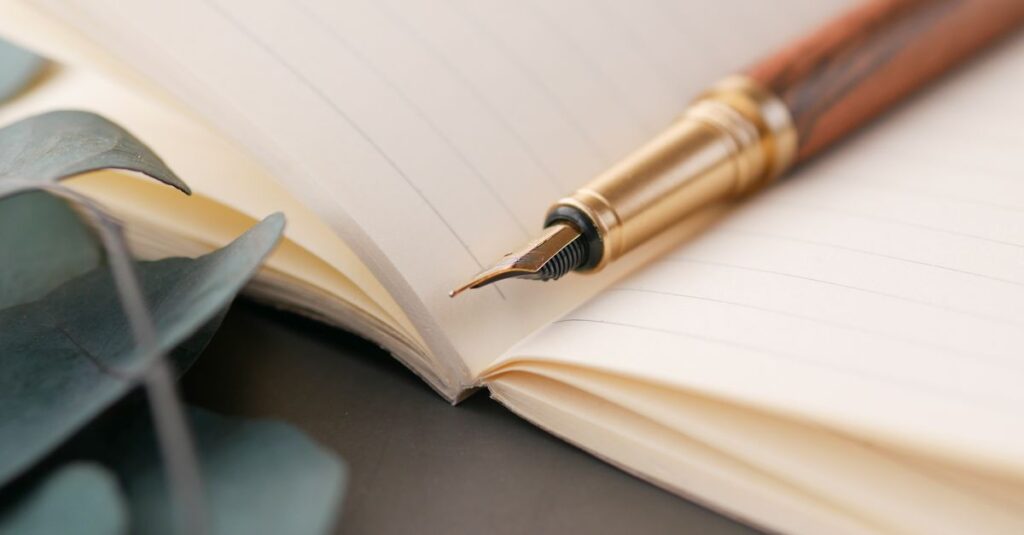
If you really want to know if paper is good, write on it with a fountain pen. Ballpoint pens work on cardboard. They're forgiving. But a fountain pen? It reveals everything. Bleed-through. Feathering. Rough patches. That's the real test.
I keep a fountain pen on my desk exactly for this reason. When a new paper sample comes in — and this happens more often than you'd think — I scribble a few lines. If it bleeds, I know immediately. No need for lab reports.
Why Most Best Writing Paper
Lists Are Misleading
Look, I've read the articles. The ones that claim 'X brand has the best paper' or 'Y paper is perfect for journaling'. Nine times out of ten, they're just repeating the brand's own marketing. They haven't actually tested the stuff.
Don't quote me on this, but I'd say at least half the notebooks sold in India use paper that's barely adequate. It's thin. It ghosts. It pills up under an eraser. And manufacturers get away with it because people don't know what to look for.
I think — and I could be wrong — that the real problem is price competition. Schools and distributors want the cheapest option. And cheap almost always means cutting corners on paper. Some manufacturers use recycled paper that's inconsistent in quality. Others use paper that was meant for packaging, not writing. It's a headache, honestly.
The standard notebooks we produce use around 54 GSM writing paper. It's not the cheapest on the market. It's also not the most expensive. But we test it. Every batch. Because once you stop testing, you start shipping garbage.
Comparison: 54 GSM vs 70 GSM Writing Paper
| Feature | 54 GSM Paper | 70 GSM Paper |
|---|---|---|
| Thickness | Thin, lightweight | Medium, noticeable weight |
| Ink bleed (gel pen) | Occasional ghosting | Minimal bleed-through |
| Fountain pen friendly | No — bleeds and feathers | Yes — holds ink well |
| Erasure resistance | Moderate — pills with heavy erasing | Good — handles erasing better |
| Perceived quality | Standard, acceptable | Premium, feels substantial |
| Best use case | School notebooks, bulk orders | Corporate diaries, journals, premium notebooks |
| Cost per notebook | Lower (budget-friendly) | Higher (10–20% more) |
The choice depends on who's using the notebook. A school kid will lose the notebook before they fill it. Save the 70 GSM for someone who actually keeps their notebooks.
Expert Insight
I was reading something last month — I can't remember the source, maybe a print trade journal — and one line stuck with me. The person writing said something like: 'Paper quality isn't about the number on the GSM label. It's about consistency across the entire reel.' That's the part nobody talks about. You can have 70 GSM paper that's terrible because the fiber distribution is uneven. Or 54 GSM that writes beautifully because it's well-made. The GSM number is just a starting point. The real test is how it behaves in a real notebook, under a real pen, in real humidity. And India has plenty of that.
What to Look for When Ordering Bulk Notebooks
If you're a procurement manager or a school administrator ordering notebooks, you can't test every sheet. You need shortcuts. Here's what I'd recommend:
- Ask for a sample batch. Any manufacturer who hesitates to send samples is hiding something. We send samples within 2 days. If they can't do that, move on.
- Check the paper source. Mills matter. Paper from certain mills in Andhra Pradesh, Tamil Nadu, and Maharashtra is consistently reliable. Question if they can't tell you where the paper comes from.
- Specify the GSM clearly. Don't just say 'good paper'. Say 'minimum 54 GSM, wood-free writing paper'. Be specific. Loose specifications invite loose quality.
- Test for opacity. Take one sheet. Write on it. Look at the back. If you can read the words, reject the batch. This is not negotiable.
- Consider the binding too. Even the best writing paper is useless if the spine cracks and pages fall out. We use stitched, spiral, or perfect binding depending on the product. Paper and binding must work together.
A Real Story: What Happens When You Get the Paper Wrong
Ravi, 42, runs a wholesale stationery supply business in Visakhapatnam. Earlier this year, he ordered 5,000 notebooks from a new manufacturer in Hyderabad. The price was low. The delivery was on time. But three weeks after delivery, a school called him. The paper was ghosting so badly, students couldn't write on both sides. He lost the contract. He's still paying back the credit he took. He told me over the phone: 'I saved two rupees per notebook. Lost two lakhs in business.' That's the cost of bad paper. And it's not a rare story. It happens every year.
I don't say this to scare you. I say it because it's real. Paper isn't cosmetic. It's structural.
Does the Best Writing Paper Exist? Or Is It a Myth?
I don't think there's one single best writing paper. Different things work for different uses. But here's what I know for sure: the paper that works is the one that does its job without you noticing it. You don't think about it while you're writing. You don't fight with it. It just… disappears. That's good paper.
Bad paper, on the other hand, announces itself. It bleeds. It feathers. It ghosts. You adjust your writing. You switch pens. You press lighter. That's a bad experience, and it's completely avoidable.
Earlier I said 54 GSM is standard. That's not quite fair — it's more that 54 GSM is the minimum for acceptable quality. If you can afford the upgrade, 70 GSM is genuinely better. It feels better. It lasts longer. It makes the person using it feel like someone cared about the notebook. And that matters more than people admit.
Frequently Asked Questions
What GSM is best for writing paper in notebooks?
For standard school and office notebooks, 54 GSM is the baseline. For premium notebooks and diaries, 70 GSM or higher is recommended. Higher GSM reduces ink bleed and ghosting. The best writing paper balances weight, smoothness, and opacity for the intended use.
Does higher GSM always mean better writing paper?
Not always. High GSM paper can be rough or poorly finished. The best writing paper depends on fiber quality, surface treatment, and manufacturing consistency — not just thickness. Always test a sample before ordering in bulk.
What's the difference between 54 GSM and 70 GSM paper?
54 GSM is thinner and lighter — suitable for bulk school notebooks. 70 GSM is thicker, more opaque, and handles fountain pens better. The best writing paper for corporate diaries or journals is typically 70 GSM or above.
Can I customize the paper quality in bulk notebook orders?
Yes. Most notebook manufacturers, including us, can source different GSM and paper grades for bulk orders. Specify your requirements clearly. We customize page count, ruling, and paper quality for schools, corporates, and distributors.
Why does ink bleed through some notebook pages?
Ink bleed happens when the paper is too thin or has poor surface sizing. The paper absorbs too much ink. The best writing paper has proper coating and density to keep ink on the surface. This is especially important for gel pens and fountain pens.
Wrapping This Up (Sort Of)
Two things I want you to remember. First: GSM matters, but it's not everything. A well-made 54 GSM sheet beats a poorly-made 70 GSM sheet every time. Second: test the paper before you buy in bulk. One sample notebook can save you from a bad batch of thousands.
I don't think there's a single definitive answer about the best writing paper. Probably there isn't. But if you've read this far, you already know more than most people ordering notebooks. You know what to ask about. You know what to look for. And that's honestly half the battle.
If you want to see what we use — or discuss custom paper specs for your order — reach out to Sri Rama Notebooks. We've been at this since 1985. We probably have a sample you can test.