


The Notebook That Never Gets Old
Here’s something you probably haven’t thought about since you were in school: a three lined notebook. You remember the blue lines, the red margin, and that faint middle line you always ignored. It’s a specific kind of notebook — one that feels outdated, maybe even a little institutional. But you know what? Businesses and schools keep ordering them. In bulk. Thousands of them, every single month.
I was talking to a procurement manager from a college last week. Over WhatsApp, actually — they needed a quote. And they asked, “Can you do the three-lined ones?” Not “notebooks.” Not “diaries.” The three-lined ones. It’s a request that comes in quietly, consistently, from schools, government offices, and even corporate HR departments. It’s not a trendy product. It’s a utility product. And utility doesn’t fade.
What Is a 3 Lined Notebook, Anyway?
Right. Let’s get this straight, because even in the industry, the terms get mixed up. A “three lined notebook” — or “3R” as we often call it in production — isn’t just a notebook with three lines on the page. It’s a specific ruling pattern. You’ve got two bold lines (usually blue) creating a writing space, and a third, finer line (often red or green) right in the middle of that space. That middle line isn’t for writing. It’s a guide. A separator.
Think about it this way. If you’re jotting down two different sets of notes in one class, or tracking expenses versus income in a simple ledger, that middle line creates a natural divide. It’s a built-in organizer. Most people don’t realize that. They think it’s just a design quirk. But it’s a function. A quiet, persistent one.
Who Still Uses These? (And Why)
Look, I’ll be direct. The primary users aren’t individuals buying a fancy journal. They’re institutions buying in volume. Schools use them for specific subjects where students need to compare — like vocabulary lists. Colleges use them for lab notes. But the biggest chunk? Corporate offices.
Corporate diaries, especially the ones given out at the start of the year, often use a three-lined layout. It’s perfect for a Monday-to-Friday layout, or for splitting meeting notes from action items. Procurement managers order the same spec year after year because it’s part of a workflow. Changing it would cause confusion.
The Manufacturing Specs: What You’re Actually Ordering
When you order a three lined notebook in bulk, you’re ordering a combination of specs that matter for daily use. The paper GSM is crucial. We typically use around 54 GSM paper for these. It’s a sweet spot: smooth for writing, durable enough for erasing, and cost-effective for bulk orders.
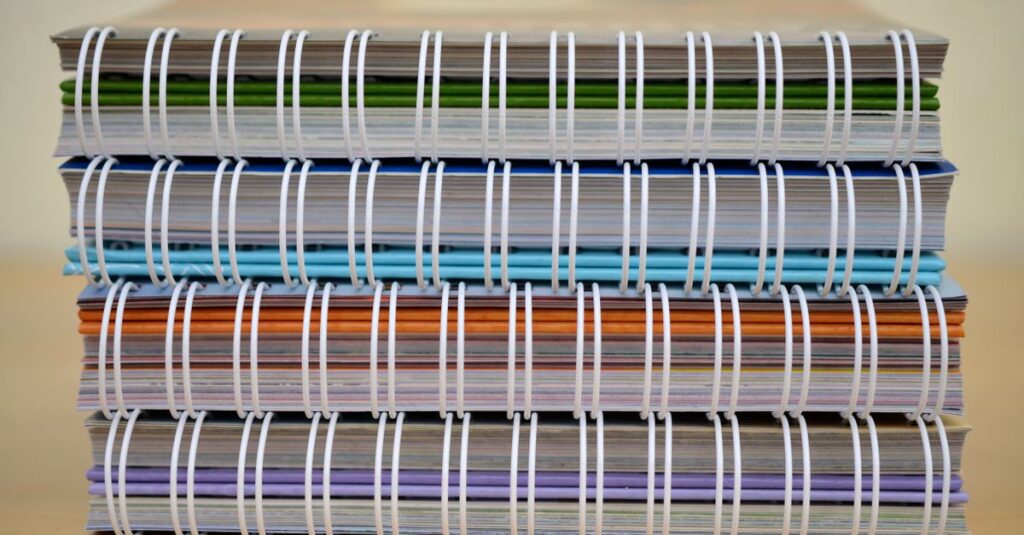
Then there’s binding. Stitched binding is the classic, reliable choice. It lets the notebook lie flat, which is essential when writing on divided pages. The ruling itself is printed using offset machines. The precision matters. Those lines need to be straight, consistent across every page of every notebook in a large order.
3 Lined vs. Other Ruling Types: A Quick Comparison
Most buyers know they need ruled notebooks, but the choice between single ruled, double ruled, and three lined can be confusing. Here’s a simple breakdown.
| Feature | 3 Lined (3R) Notebook | Single Ruled (SR) Notebook |
|---|---|---|
| Primary Use | Split-column notes, comparative lists, basic ledger tracking | General writing, essays, continuous notes |
| Typical Users | Corporate offices, schools (specific subjects), government record-keeping | Schools (general use), students, personal journals |
| Visual Layout | Two bold outer lines, one faint central guide line | Uniform bold lines across the page |
| Bulk Order Frequency | High for institutional, standardized supplies | Very high for general school supplies |
If you need to keep two related sets of information side-by-side, the three lined notebook is the tool. It’s a simple, physical solution to a common organizational problem.