Four Line Notebook Explained: What It’s Actually For
I’ve been talking to primary school principals and teachers for years. And one question that comes up, almost always, is about notebooks for the youngest kids—the ones just learning to write. They’re asking about those notebooks with extra lines on the page. Four lines, in particular. What are they for? And honestly, it’s not just a product code—it’s a tool for teaching. If you’re ordering notebooks in bulk for a school or institution, you’ve probably seen ‘FR’ in a spec sheet and wondered. Let’s talk about what that means.
Here’s the thing: A Four Ruled notebook is designed specifically for children in grades 1 and 2. You need those extra lines—four instead of the standard two—to guide them in forming letters correctly. It’s a scaffolding tool. The ruling tells them where the top of a capital letter should go, where the middle line is, where the base is. It’s structure. I think that’s the biggest reason schools ask for them so consistently. Not because it’s just “ruling”, but because it’s a teaching aid. Right?
Anyway. If you’re sourcing notebooks for a school, looking at the options can be confusing. You’ll see SR (Single Ruled), DR (Double Ruled), and FR (Four Ruled). Each one serves a different grade level. For kindergarten and the first few years, FR is what you’re likely looking for. You can check the specifics here, but let’s break down what it really is.
The Anatomy of a Four Line Notebook Page
Look, I’ll just explain it plainly. A standard single ruled notebook page has two horizontal lines—one top, one bottom—with a margin on the side. That’s for older students and general writing. A four ruled page divides that same writing space into four horizontal lines. The space between these lines is wider than in a double ruled notebook, giving little hands more room to maneuver. The top line is for capital letters. The next line down marks the “middle” zone for smaller letters like “a” or “c”. The third line is another guide, and the bottom line is the baseline. It’s a framework.
Think about it this way: without those guides, a six-year-old’s “H” might stretch across half the page, and their “e” might be a tiny dot. The four lines create a visual grid that teaches proportion and consistency. And honestly? That makes complete sense. It’s not about making the notebook look fancy; it’s about making it functional for a specific, crucial stage of learning.
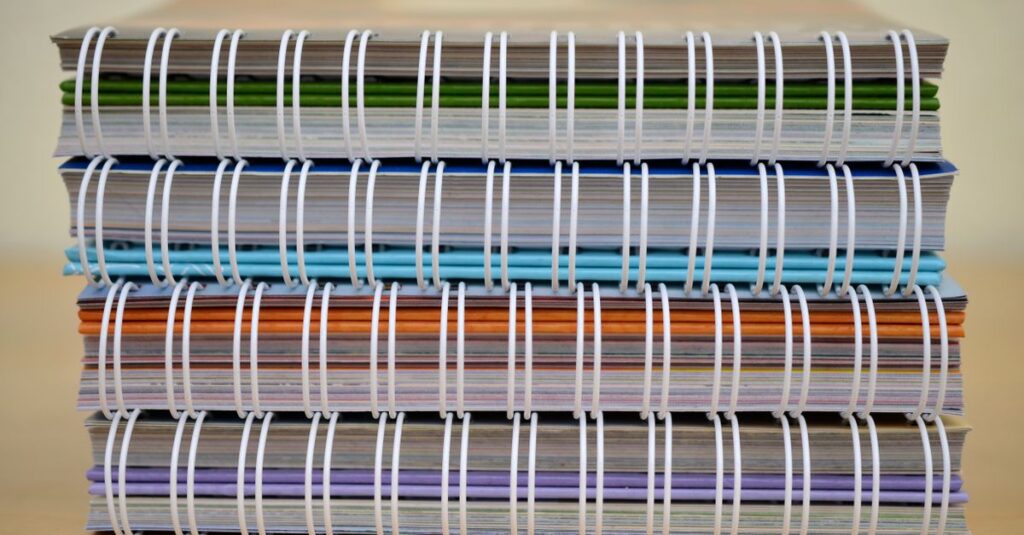
The paper quality matters here too. For these notebooks, we typically use a smoother, slightly thicker 54 GSM paper. It needs to be durable enough for pencil pressure and erasing, but not so thick that it feels intimidating. The binding is usually stitched or spiral, so the book can lay flat on a desk. These are small details, but they’re the ones that decide whether a notebook works in a classroom or just gets returned.
A Real-Life Example
I was visiting a primary school in Rajahmundry last year—just a regular Tuesday, I think—and the teacher, Mrs. Lakshmi, showed me a stack of notebooks from a previous supplier. The ruling was faint. Almost invisible under pencil marks. The kids were struggling to see the lines. She said, “The ruling has to be clear. Dark enough. If they can’t see it, the whole point is lost.” It wasn’t about the notebook brand or the cover design. It was about the clarity of those four lines on the page. That’s the thing most procurement sheets don’t mention—the print quality of the ruling itself.
Which is… a lot to sit with. Because when you’re ordering 5,000 notebooks, you’re not just ordering paper. You’re ordering a tool that has to perform a specific task every day for a year.
Four Line vs. Other Ruling Types: A Buyer’s Table
Most people I’ve spoken to say they just need a list. So here’s a quick table comparing the ruling types we manufacture. It should help you match the notebook to the grade level.
| Ruling Type | Code | Lines Per Writing Space | Primary Use Case | Typical Grade Level |
|---|---|---|---|---|
| Four Ruled | FR | Four horizontal lines | Letter formation, beginners | Kindergarten, Grades 1-2 |
| Double Ruled | DR | Two lines (top & bottom) | General writing practice | Grades 3-5 |
| Single Ruled | SR | One main line with margin | Standard writing, notes | Grades 6+, Adults |
| Broad Ruled | BR | Two widely spaced lines | For larger handwriting | Any age needing space |
| Unruled | UR | No lines | Drawing, free-form writing | Art, creative work |
The question isn’t just which ruling you need. It’s whether you’re ordering the right ruling for the right class. Mixing them up means wasted money and frustrated teachers. I’ve seen schools get a shipment of Single Ruled books for first graders—they can’t use them. It’s a headache, honestly.
Why Bulk Buyers Care About This Spec
For a corporate procurement manager or a school administrator, a notebook is a commodity. But for the teacher receiving it, it’s a piece of the lesson plan. The spec—FR, 52 pages, spiral bound, 54 GSM—isn’t just a list. It’s a set of requirements that the product must meet to be useful. If you’re ordering for a government institution or a chain of schools, getting the ruling wrong means the entire batch is functionally useless. That’s a real risk.
Three things happen when you order the correct four line notebook in bulk: First, the teachers don’t have to complain or request a replacement. Second, the students have the right tool from day one. Third—and this is the part nobody says out loud—you build trust with the end-users. They know you understood what they needed. That matters for repeat orders. It matters more than price, sometimes.
Most bulk suppliers just offer “notebooks.” They don’t explain the ruling options. They don’t ask which grade you’re supplying. Which is a problem. Because if you’re buying 10,000 units, you need to know that every unit will work. That’s where working with a specialized manufacturer makes a difference.
Expert Insight
I was reading something last month from an early education researcher, and one line stuck with me. She said something like—the physical tools we give children to learn are not passive. They either enable the skill or hinder it. A four line notebook enables. A single ruled notebook, for a six-year-old, hinders. I don’t have a cleaner way to put it than that. The design of the tool is part of the pedagogy. It’s not just paper.
And in my experience working with schools across Andhra Pradesh and for export orders, that’s exactly what they confirm. The right notebook reduces the time a teacher spends correcting handwriting posture. It gives the child a visual structure to follow. It’s a small thing. But in a classroom of forty kids, small things add up.
Customizing Four Line Notebooks for Your Institution
Look, I’ll be direct. If you’re a school or a large institution, you might want your logo on the cover. Or a specific color scheme for different grades. Or a particular page count—52 pages is standard, but maybe you want 92 for a longer academic year. That’s where customization comes in.
We’ve done this for schools where the Grade 1 notebooks are yellow covers with four ruling, Grade 2 are blue with four ruling, and Grade 3 shift to green with double ruling. It helps distribution. It helps teachers instantly identify the right stock. And it makes the notebook feel like part of the school’s identity—not just a generic product.
The manufacturing process for custom four line notebooks is the same as for standard ones, but with your design printed on the cover. The ruling is printed on every page before binding. The binding itself can be stitched for durability or spiral for easier flat opening. The thing about—okay, let me rephrase that—the thing about customization is that it’s not just a “service.” It’s a way to solve logistical and identity problems for the buyer. If you’re managing inventory for ten schools, color-coded notebooks sorted by ruling type take the edge off.
Not quite.
Because sometimes the request is even more specific: a four ruled notebook with a margin on the left for teacher comments, or with a header space for the date and subject. That’s possible too. It’s all about the print layout. This is where printing capabilities matter.
Common Mistakes When Ordering Four Line Notebooks
What most people don’t realize is that the ruling spec is just the start. The paper GSM matters. If the paper is too thin (like 40 GSM), pencil marks will tear through, and erasing will smudge the page. If it’s too thick (70 GSM), the notebook feels heavy and expensive, and the pencil doesn’t glide as easily. For primary students, 54 GSM is probably the biggest reason we use it—it’s the balance.
Another mistake: ordering the wrong binding. Stitched binding is more durable for a notebook that’ll be used for a full year. Spiral binding is easier for kids to open flat, but the spirals can bend if mishandled. It’s a trade-off. And for bulk buyers, you need to decide which trade-off makes sense for your students’ age and handling.
I’ve heard this enough times now that it’s not coincidence. A distributor ordered 20,000 four line notebooks with perfect binding (glued). For little kids who press hard, pages started coming loose after a few months. They switched to stitched. Problem solved. It’s a detail. But it’s a real one.
THIS IS THE PART NOBODY SAYS OUT LOUD: When you’re buying in bulk, you’re not just buying a product. You’re buying the manufacturer’s understanding of how that product will be used. If they don’t ask you about the grade level, the binding, the paper weight—they’re just selling you paper. And you probably need more than that.
Frequently Asked Questions
What is the main purpose of a four line notebook?
A four line notebook is specifically designed for young children, typically in kindergarten and grades 1 and 2, who are learning to write. The four horizontal lines provide a visual guide for letter height and proportion, helping students form capital and small letters correctly. It’s a foundational teaching tool, not just a notebook.
Can I get four line notebooks with custom covers for my school?
Yes, absolutely. We regularly print custom covers with school logos, colors, and names for bulk orders. The ruling inside remains the standard four line pattern. This helps with grade identification and school branding. You can specify cover design, page count, and binding type during ordering.
What paper quality is best for four line notebooks?
For primary students, a 54 GSM writing paper is usually the best balance. It’s thick enough to withstand pencil pressure and erasing without tearing, but smooth enough for easy writing. Thinner paper (like 40 GSM) is too fragile, and thicker paper (70 GSM+) can be too stiff and expensive for bulk school orders.
What is the difference between Four Ruled (FR) and Double Ruled (DR)?
Four Ruled (FR) notebooks have four horizontal lines in the writing space, used for detailed letter formation guidance for beginners. Double Ruled (DR) notebooks have just two lines (top and bottom) and are for general writing practice, usually for grades 3 to 5. They serve different stages of learning.
How many pages should a school four line notebook have?
The standard is 52 pages, which suits a single term or semester. For a full academic year, 92 or 104 pages are common. It depends on your curriculum and how much writing work the students do. We can manufacture any page count you need—just specify it when you place the bulk order.
So, What Should You Do Next?
If you’re procuring notebooks for a school, institution, or as a distributor, the ruling type is your first filter. For the youngest grades, it’s Four Ruled (FR). Then look at the paper GSM. Then the binding. Then the page count. It’s a checklist. Missing one item means the notebook might not work.
I don’t think there’s one perfect answer for every school. Probably there isn’t. But if you’ve read this far, you already know what you’re looking for—you’re just figuring out if the supplier understands it too. And that’s the real question.
Getting the right four line notebook in bulk isn’t complicated, but it requires attention to specs that generic suppliers often ignore. If you need notebooks that actually match your students’ needs, it might be worth a conversation.