Why Most Corporate Notebook Orders End Up in a Drawer
I’ve seen it happen more times than I can count. A company orders five thousand notebooks. Branded covers. Nice paper. Everyone gets one at the annual conference. And then — nothing. They sit in drawers. Under desks. In the back of a cupboard somewhere.
That’s the thing about corporate branded notebook printing services for large companies. If you do it wrong, it’s waste. If you do it right, people actually use them. And there’s a difference between a notebook that gets carried around for months and one that gets thrown out after the event.
Most procurement managers I’ve spoken to don’t think about this. They think about cost per unit. Delivery timelines. Logo placement. Those things matter — sure. But the real question is: will anyone actually write in this thing? Sri Rama Notebooks has been making notebooks since 1985, and I can tell you — that question doesn’t get asked enough.
What Actually Makes a Corporate Notebook Usable
Let me tell you about Ramesh. He’s 42. Works in procurement for a manufacturing company in Hyderabad. Two months ago, he ordered 3,000 branded notebooks for their annual dealer meet. Standard specs: A5 size, spiral bound, logo on the front. Nothing fancy.
He called me last week. Not happy. “Nobody’s using them,” he said. “They look good. But the paper feels cheap. Pages start coming out after a week.”
And here’s the part that bothers me. He spent good money. But he didn’t ask the right questions upfront.
So what makes a notebook actually usable? Three things:
- Paper that doesn’t bleed — 54 GSM is the minimum. 60–70 GSM is better if people write with gel pens or markers.
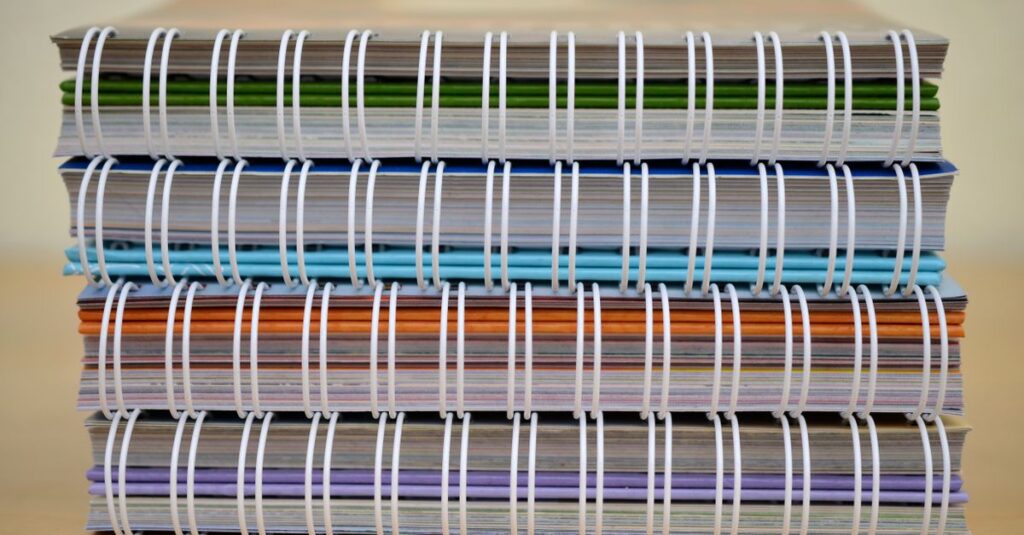
- Binding that stays flat — Spiral binding is great for desks. Stitched binding lasts longer in bags. Make sure the factory knows how you’ll use it.
- Cover that doesn’t curl — Thick enough to protect the pages. Thin enough to slip into a bag.
I think Ramesh learned this the hard way. But he’s not alone. Most people ordering in bulk don’t realize that a good notebook is about the inside, not just the outside.
The Customization Trap — What Most Brands Get Wrong
Here’s something I’ve noticed over the years. Companies love customization. Foil stamping. Embossed logos. Custom endpapers. And sure — those things look great in the sample you get in the mail.
But here’s the thing nobody tells you: over-customization kills usability.
I remember a client from Dubai — logistics company, about 800 employees. They wanted a leather-like cover, gold foil logo, ribbon bookmark, and a custom inner layout with their mission statement on every page. I tried to talk them out of the mission statement thing. Didn’t listen. They ordered 5,000 units.
Six months later, I got a call. “Can we reorder? People want plain versions.” The mission statement was annoying them. Every time they opened the notebook, they felt like they were being marketed to. By their own company.
The lesson? Customize the cover. Customize the binding. Maybe add a nice back pocket. But leave the inner pages alone. Let people write what they want. That’s what makes them use the notebook every day quarant.
Here’s What Actually Works in Customization
- Logo on front cover — standard, predictable, effective
- Company name on spine — useful for bookshelves
- Custom endpaper color — subtle, professional
- Inside front pocket for business cards — actually practical
Anything beyond that? Ask yourself: is this for the person using it, or for the person who approved the budget?
Bulk Orders — The Hidden Problems You’ll Face
I’ve worked with enough corporate buyers to know that the real headaches start after the order is placed. Delivery delays. Quality inconsistency. Communication gaps. It’s not always the factory’s fault — sometimes it’s the buyer who didn’t specify things clearly.
Take Priya, for example. She works at a bank in Mumbai. Needed 10,000 diaries for a New Year campaign. She ordered in October. Expected delivery in November. The factory confirmed. Everything looked good.
Then November came. And the diaries arrived — but with the wrong ruling. She’d ordered ruled pages. They sent plain. The factory said she’d approved a sample with plain pages. She said she hadn’t noticed. Ten thousand blank diaries. No time to reprint.
| Specification | What to Check | Common Mistake |
|---|---|---|
| Page ruling | Single, double, plain, or custom | Approving sample without checking ruling |
| Paper GSM | 54–70 GSM for writing; 100+ for premium | Assuming all paper is the same quality |
| Binding type | Stitched, spiral, or perfect bound | Choosing based on price, not usage |
| Cover material | Art card, leather finish, or hardbound | Not testing durability for daily carry |
| Color accuracy | Pantone matching for logo | Relying on screen colors instead of physical swatches |
| Delivery timeline | Buffer of 2 weeks minimum | Ordering too close to event date |
I don’t say this to scare you. I say this because I’ve seen smart people make avoidable mistakes. And a good manufacturer will guide you through these decisions — if you let them.
Expert Insight
I was talking to a production manager at our factory last month. He’s been doing this since 1992. He told me something that stuck: “The biggest problems aren’t technical. They’re communication problems. The buyer assumes we know what they want. We assume the buyer has told us everything. Both sides are wrong.” He said it with a sort of tired smile. I think about that a lot — how many orders go sideways because nobody asked the obvious questions.
How to Pick a Printing Partner Who Won’t Let You Down
Look, I’ll be honest. There are a lot of notebook manufacturers out there. Some good. Some okay. Some that’ll take your money and deliver something that looks nothing like the sample.
So how do you pick? I’ve narrowed it down to five things I’d check. And I’ve seen enough factories to know which ones matter.
- Ask about their production capacity — If they can’t handle your volume, you’ll face delays. Our factory does 30,000–40,000 notebooks a day. That’s a number you want to hear.
- Check their export experience — If they export to Gulf, Africa, USA, UK, or Australia, they know how to handle specifications and shipping. That matters.
- Request a physical sample — Not a digital proof. Not a photo. A real sample in your hand. Feel the paper. Open and close the binding. Write on a page.
- Ask about their customization process — Do they do logo printing? Embossing? Foil stamping? Private label? A factory that offers multiple options knows their craft.
- Talk to someone who’s actually in production — Not just the sales person. The person who runs the machines. They’ll tell you what’s realistic and what’s not.
I know this sounds like a checklist. But I promise you — a factory that can answer all five questions confidently is worth your time.
Frequently Asked Questions
What is the minimum order quantity for corporate branded notebooks?
Most manufacturers require a minimum of 500–1,000 units. At Sri Rama Notebooks, we work with bulk orders starting from 1,000 units. For larger companies ordering 5,000 or more, we offer better pricing and faster turnaround.
Can I get a sample before placing a bulk order?
Yes. Always request a physical sample before committing to a bulk order. We send samples with your logo and chosen specifications so you can check paper quality, binding, and print accuracy before production begins.
How long does delivery take for a bulk notebook order?
For orders of 1,000–5,000 notebooks, typical production takes 15–20 working days. Larger orders may require 25–30 days. We recommend placing orders at least 30 days before your event or deadline to account for shipping.
Do you offer private label or OEM services?
Yes. We manufacture notebooks under your brand name. You provide the design, logo, and specifications. We handle production, quality control, and packaging. Your brand appears on the cover and inside pages as if you made it yourself.
What binding types work best for corporate diaries?
Hardbound and stitched binding give a premium feel and last longer. Spiral binding is practical for desk use and lies flat when open. The choice depends on how the diaries will be used — daily carry or desk reference.
One Last Thing About Corporate Branded Notebooks
I don’t have a neat conclusion for this. Not everything wraps up perfectly. But I think the main takeaway is this: a corporate notebook isn’t just a marketing expense. It’s a tool people use every day. If you treat it like one — if you care about the paper, the binding, the usability — people will keep it on their desk. They’ll write in it. They’ll remember your brand not because the logo was shiny, but because the notebook actually worked.
The other thing? Don’t overthink it. Get a good manufacturer. Ask the right questions. Trust your instincts. And if something feels off during the process, say something early. Not after 10,000 notebooks arrive with the wrong ruling.
If you’re looking for Corporate Branded Notebook Printing Services for Large Companies, we’ve been doing this since 1985. We know what works. And we’re happy to help you figure out what fits your needs.