What Actually Drives the Price?
You've probably been there. You call five printers, ask for a quote on 10,000 notebooks, and get five wildly different numbers. One says Rs. 25 per piece. Another says Rs. 60. Nobody explains why. And the worst part? You still don't know what's fair.
I've been in this business since 1985 — not as a salesman, but as someone who actually runs the presses. So let me tell you straight: commercial printing cost in India depends on a handful of things. Ignore any quote that doesn't ask about these first.
Paper quality. That's the biggest lever. Standard 54 GSM writing paper vs. higher GSM or map litho — the difference can be 30% or more. Then there's quantity. Printing 1,000 units vs. 50,000 — the per-unit cost drops like a stone after a certain point. Binding matters: stitched is cheapest, spiral adds maybe 15–20%, perfect binding can double the cost. And of course, color. Full color cover vs. single color — huge gap.
If this sounds familiar, here's how we handle pricing at Sri Rama Notebooks. No surprises. Just straight numbers.
A Quick Breakdown of Typical Costs
Look, I hate giving blanket numbers because every job is different. But to give you a rough idea — for a standard A4 notebook, 200 pages, stitched binding, single color cover — you're looking at somewhere between Rs. 35 and Rs. 55 per piece for a run of 5,000. Drop the quantity to 1,000, and you're closer to Rs. 60–80. Go up to 20,000, and it might come down to Rs. 28–35.
Offset vs Digital Printing – Which is Cheaper?
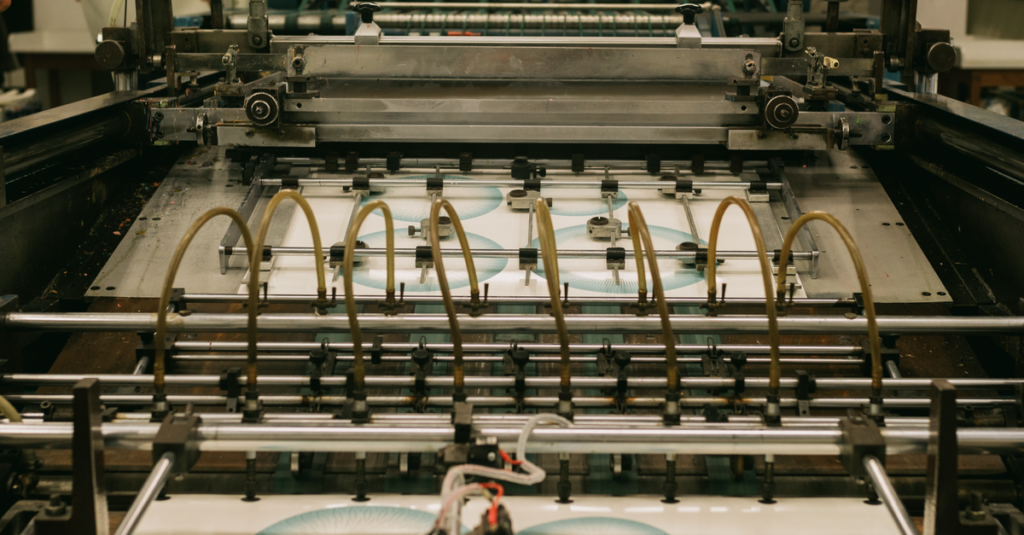
Here's where people get confused. Offset is cheaper per unit once you cross a threshold — usually around 500 copies. Digital is better for short runs and variable data. But most commercial printing in India still runs on offset for notebooks and diaries because the volume justifies it.
| Factor | Offset Printing | Digital Printing |
|---|---|---|
| Best for quantity | 500+ units | Under 500 units |
| Per-unit cost at 5,000 | Low (Rs. 30–50 typical) | High (Rs. 50–80) |
| Setup charges | Higher (plates, make-ready) | Minimal to none |
| Color accuracy | Excellent after calibration | Good but less consistent |
| Customization per piece | Not practical | Easy (variable data) |
So if you're ordering corporate diaries for 200 employees, digital makes sense. If you're procuring notebooks for 10,000 students, offset wins. Hands down.
The Hidden Costs Nobody Talks About
I remember a call from a procurement manager in Pune — let's call him Ravi. He had a quote for Rs. 32 per notebook. Sounded great. Then came the extras: plate charges, lamination, die charges for embossing, packaging, delivery. The final invoice was Rs. 45 per piece. He was furious, but the fine print was there.
Here's what often gets added after the initial quote:
- Plate making / die charges (one-time, but can be Rs. 2,000–10,000)
- Lamination (matte or gloss — adds Rs. 2–5 per piece)
- Embossing or foil stamping (Rs. 3–8 per piece)
- Custom packaging (corrugated boxes, shrink wrap)
- Transportation — especially if you're outside the city
And there's another hidden cost: time wasted on bad prints. If the printer uses cheap paper or poor binding, you end up with returns. I've seen schools burn Rs. 50,000 because the notebooks fell apart after a month. That's not cheap — that's expensive.
A Real Example: Notebook Printing for a School
Let me tell you about Sunita. She's 38, a school coordinator in a private school in Vijayawada. Every year she orders 5,000 custom notebooks with the school logo. One year she went with the lowest quote — Rs. 28 per notebook. They came in three weeks late. Paper was so thin you could see the writing on the other side. Binding broke before midterms. She had to reorder. Total cost? Closer to Rs. 60 per notebook when you factor in the headache.
She called me the next year. We quoted Rs. 38. She hesitated. But I said — “Look, I'll send you a sample first. You test it. If it fails, don't pay.” She took the risk. The notebooks lasted the whole year. She's been ordering from us for four years now.
That's the thing about commercial printing cost in India — the cheapest number isn't always the real cost. The real cost includes your time, your reputation, and whether the product does its job.
Expert Insight
I was reading something last month — I forget the exact stats — but it said roughly 40% of corporate buyers regret choosing the lowest bidder within the first six months. That matches what I've seen. People don't account for the cost of failure. A notebook that falls apart means angry students, angry parents, or in corporate gifting, a bad impression on your client. That's a cost you can't put on a spreadsheet — until it hits you.
How to Get the Best Deal (Without Getting Cheated)
So how do you actually get a fair commercial printing cost in India? I'll tell you what I tell every buyer who calls me.
- Ask for a sample before you commit. Any printer who refuses is hiding something.
- Get a full itemized quote. Not just per-piece. Everything — paper, binding, ink, lamination, packaging, delivery.
- Check the paper GSM. 54 GSM is standard for notebooks. Anything below 50 is trouble.
- Negotiate on quantity breaks. The sweet spot is usually 5,000–10,000 units for notebooks. Above that, costs drop by 10–15%.
- Don't ignore turnaround time. A printer who promises 2 weeks for 20,000 notebooks? Be suspicious. Good work takes time.
And here's a trick most people don't use: ask about private label or OEM. If you're okay with a standard size and paper, custom branding can be done without redesigning the whole product. That keeps costs low.
We do this all the time at Sri Rama Notebooks. You bring the logo, we handle the rest. No hidden charges.
Frequently Asked Questions
What is the average cost per notebook for bulk printing?
For a standard A5 or long notebook, 200 pages, stitched binding, in quantities of 5,000–10,000, expect Rs. 30–50 per piece. Higher GSM paper or full color cover will push it to Rs. 45–70.
Does the quantity affect the commercial printing cost in India?
Yes, significantly. Per-unit cost drops as quantity rises because setup costs get spread. For example, 1,000 notebooks might cost Rs. 70 each, while 50,000 could come down to Rs. 20–25. Always ask for tiered pricing.
How much extra does custom logo printing add?
Logo printing (e.g., embossing, foil stamp, or screen print) adds about Rs. 3–8 per piece depending on the method and number of colors. Offset printing a logo on the cover usually adds minimal cost if already doing a full cover print.
What is the cheapest binding type for notebooks?
Stitched (saddle stitch) binding is the cheapest. Spiral binding costs about 15–20% more. Perfect binding (glued spine) is usually the most expensive for notebooks, adding 25–40% over stitched.
How can I reduce my commercial printing costs?
Standardize the size and paper. Use a single color cover instead of full color. Increase the order quantity. Avoid rush orders. Choose stitched binding. And always ask for a sample to ensure quality — reprints kill your budget.
I don't think there's one magic number for commercial printing cost in India. The honest answer is: it depends. But now you know what it depends on. You know what to ask for. And you know that the cheapest quote is rarely the cheapest in the end. That's the part nobody tells you — until you've learned it the hard way.
If you want a real quote — no games, no hidden fees — talk to us at Sri Rama Notebooks. We've been doing this since 1985. We know what works and what doesn't.