Let’s get straight to the point
You’re probably here because you’re in charge of ordering notebooks for your company, your school, maybe an entire district. And someone — a teacher, an accountant, a procurement guy — just put “long size notebooks” on the list. You type it in. And now you’re staring at a screen wondering: What the hell does “long size” even mean?
You get a million different answers. Some websites show A4. Some show something else. None of it makes sense when you’re about to spend company money on five thousand units. I’ve seen this exact confusion for, well, decades now. It’s the number one question I get from new buyers who’ve been told to just “order the long ones.”
Right. So here’s the thing. In the notebook manufacturing world, especially here in India, “Long Size” isn’t just a vague term. It’s a specific, standardized dimension that wholesalers, schools, and corporate offices have used forever. It’s the workhorse. The default. The one you reach for when you don’t need anything fancy, you just need something that works for hours of writing. And if you’re looking to order in bulk, knowing this one size inside out is probably the most important thing you’ll learn today. We make a few million of them a year, so I might know a thing or two.
What is a “Long Size” notebook, really?
Forget the international paper sizes for a second. When an Indian manufacturer says “Long Size,” we are talking about a notebook that measures 27.2 cm in height by 17.1 cm in width. That’s roughly 10.7 inches by 6.7 inches.
Now, why this specific, slightly odd measurement? It’s not random. This dimension became the standard because it’s the perfect middle ground. It’s taller than a “Short” notebook (which is 19.5 x 15.5 cm), giving you more lines per page. But it’s not as bulky or unwieldy as a full-blown Account Book (33.9 x 21 cm). It fits in a standard school bag, sits neatly on an office desk, and provides enough writing space for everything from lecture notes to meeting minutes.
Here’s the part nobody says out loud: a huge chunk of the notebook market runs on this single size. If you walk into any stationery wholesaler in Rajahmundry, or Mumbai, or Delhi, and ask for notebooks, the first thing they’ll show you is a stack of Long Size notebooks. It’s the backbone of the industry. And nine times out of ten, when a school sends out a tender, this is the size they’re specifying.
The workhorse in action: where long notebooks shine
I was talking to a procurement manager from a big college in Vizag last month. He was telling me how they evaluate notebooks. It wasn’t about fancy covers. It was about cost-per-page, durability, and utility. The long notebook won on every count. That’s its whole purpose.
Think about it this way. The extra height gives you more ruled lines. For a student, that means fewer page turns during a long class. For an office, it means more notes fit on one page before you have to flip to the next one. It sounds small, but when you’re writing for hours, it matters. It feels substantial without being intimidating. A blank short notebook can look like a chore to fill. A blank long notebook looks like an opportunity.
Main users of Long Size notebooks:
- Schools & Colleges: The absolute biggest market. From 5th standard up through university, this is the prescribed size for most subjects.
- Corporate Training & Offices: For in-house training sessions, workshop notes, and general office memo pads. They’re professional without being overly formal.
- Coaching Institutes: They buy in staggering volumes. The long size is their default because it’s the most economical for the writing space provided.
- Government Institutions: Tenders for stationery almost always include specifications for long notebooks. It’s about standardization across departments.
Anyway. The point is, if your order is for more than a hundred pieces, you’re almost certainly in this world. You’re not buying a notebook; you’re buying a tool.
Long vs. Short vs. A4: Cutting through the confusion
This is where everyone gets lost. You’ll see “Long,” “Short,” “A4,” “Legal,” “Crown”… it’s a mess. Let me simplify it. In our manufacturing lane, we’re usually talking about three core sizes for everyday writing.
The “Short” notebook (19.5 x 15.5 cm) is for younger students. Less intimidating, fits smaller bags. The “Long” (27.2 x 17.1 cm) is for everyone else. Then you have “A4” (29.7 x 21.0 cm), which is bigger. It’s used, but it’s less common for bulk school orders because it’s more expensive — more paper, bigger cover, higher shipping cost per unit.
Most people don’t realize this: A Long notebook is NOT the same as A4. It’s close, but it’s not the same. An A4 sheet is taller and wider. That difference matters when you’re designing covers, setting up binding machines, and calculating per-unit costs for an order of 50,000. Getting this wrong means your beautifully printed covers won’t fit. I’ve seen it happen. It’s a costly headache.
| Feature | Long Notebook | Short Notebook | A4 Notebook |
|---|---|---|---|
| Dimensions (cm) | 27.2 x 17.1 | 19.5 x 15.5 | 29.7 x 21.0 |
| Primary Use | High school, college, offices, bulk orders | Primary school students | Official reports, presentations, specific client work |
| Feel in Hand | Substantial, standard workhorse | Compact, lightweight | Formal, spacious, more premium |
| Cost (Bulk) | Most cost-effective for the space | Lowest cost | Higher cost (more paper/cover) |
| Binding Commonality | Very high – all types | Very high | Common, but less so for mass school supply |
Expert Insight
I was reading an old production ledger from the 90s the other day. The most common order code wasn’t for anything fancy. It was “L-92-SR.” Long size, 92 pages, Single Ruled. Nothing has changed. The researcher in me — okay, the factory owner in me — sees that and thinks: the market tells you what it needs. And for decades, it’s been asking for a reliable, spacious, affordable notebook. That’s the long notebook. It’s not glamorous. It’s just right. And in manufacturing, “just right” is the hardest thing to get consistently. It’s why buyers stick with a supplier for 20 years once they find one who gets it right.
Specifying your bulk order: Don’t just say “long notebook”
Here’s my direct advice. If you’re sending an RFQ (Request for Quotation) or talking to a manufacturer, you need to specify more than just the size. Size is just the box. You need to say what’s in the box. Otherwise, you’ll get a dozen different quotes that don’t match.
You need to lock down three things beyond “Long Size”:
- Page Count: 52 pages? 92? 200? This is the biggest cost driver after size. A 200-page long notebook is a completely different product from a 92-page one.
- Ruling Type: Single Ruled (SR) for general writing? Four Ruled (FR) for language practice? Unruled (UR) for drawing or freeform notes? This dictates the printing setup.
- Paper GSM: 54 GSM is standard writing paper. It’s smooth, doesn’t bleed, and is cost-effective. For heavier use or better quality, you might go to 70 GSM. But that increases weight and cost fast.
Let me give you a real-life example. Meet Arjun. He’s 28, a procurement officer for a chain of coaching centers in Hyderabad. His boss told him to “get long notebooks for the new batch.” His first quote was for 52-page, single-ruled notebooks. The teachers saw the sample and said the pages were too few; kids would run out mid-term. His second quote was for 200-page books. The price was way over budget. The third time, he specified: Long Size, 92 pages, Single Ruled, 54 GSM paper, stitched binding. He got five comparable quotes the same day and placed the order.
The detail is everything. It turns you from a browser into a buyer.
The manufacturing view: Why this size is a favorite
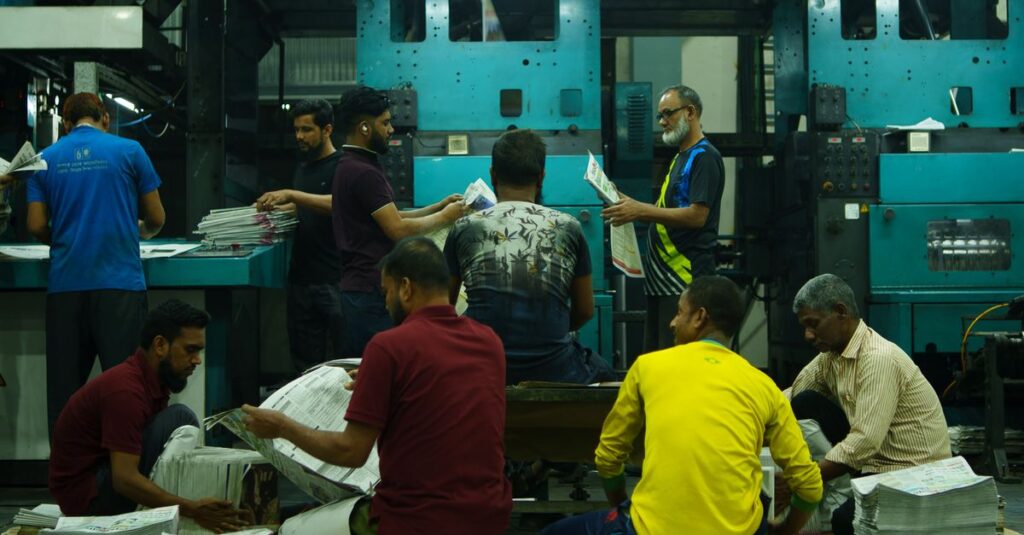
From this side of the factory floor, the long notebook is a beautiful piece of engineering. Not in a tech way. In a practical, rhythmic way. The paper rolls we use are cut to maximize yield for this dimension. The stitching machines are calibrated for its thickness. The binding lines run smoothest when they’re pumping out long notebooks for eight hours straight.
I think — and I could be wrong — that’s a big part of why it’s so affordable in bulk. The entire industry’s machinery is optimized for it. When you order custom printed notebooks in this size, you’re plugging into a system that’s already running at peak efficiency. Your per-unit cost goes down because we’re not retooling for some oddball size.
Also, the proportions are just right for the binding. Too square, and the spine doesn’t hold well. Too tall and narrow, and it flops over. The long notebook’s 27.2 x 17.1 cm ratio gives it a spine that can be stitched, perfect-bound, or spiral-bound with equal strength. It sits flat when open. It’s a small thing that makes a huge difference when you’re actually using it.
Common mistakes bulk buyers make (and how to avoid them)
Look, I’ll just say it. We see the same errors every single week.
Mistake 1: Assuming size is the only spec. (It’s not. See above.)
Mistake 2: Not asking for a physical sample before the full order. Always, always get a sample. Check the paper feel, the ruling alignment, the cover stiffness. What looks good on a spec sheet can feel cheap in your hands.
Mistake 3: Prioritizing absolute lowest price over everything. The cheapest notebook often uses the lowest GSM paper. It ghosts, it tears, it feels terrible to write on. And then the users complain to you. Your savings evaporate in bad feedback.
Mistake 4: Forgetting about packaging. How are 5000 notebooks going to be delivered? In loose bundles? In cartons of 50? This affects freight costs and the condition they arrive in. It needs to be part of the quote.
If you avoid these, you’re already ahead of 80% of buyers.
Frequently Asked Questions
Is a Long Size notebook the same as Legal Size?
No, not at all. Legal size paper is longer and narrower (around 35.6 x 21.6 cm). A Long notebook is shorter and wider. They’re used for completely different things. Legal is for legal documents. Long is for everyday writing and notes.
What is the most common page count for a Long Size notebook?
For schools and bulk business orders, 92 pages is probably the most common. It’s the sweet spot between having enough pages to last a term/semester and keeping the cost and weight reasonable. 52-page books are used for shorter projects or younger kids.
Can I get Long Size notebooks with custom printed covers?
Absolutely. In fact, it’s one of our most requested services. Corporate logos, school crests, motivational quotes — you can print anything on the cover. The Long Size is a perfect canvas for branding because it’s large enough to be visible but standard enough to keep printing costs low.
What binding is best for a Long Size notebook?
For most uses, side-stitched binding is the best. It’s durable, lies flat, and is very cost-effective for bulk. Spiral binding is great if the notebook needs to fold back on itself completely (like for artists). Perfect binding (like a paperback book) gives a very clean, professional look for corporate gifts.
How many Long Size notebooks come in a standard carton?
It depends on the page thickness, but typically, for a 92-page notebook, you can fit 50 to 60 pieces in a standard shipping carton. Any reputable manufacturer will give you the exact packing details with your quote. This is crucial for calculating shipping and storage.
Wrapping this up
So, the long size notebook. It’s not mysterious. It’s 27.2 by 17.1 centimeters of pure utility. It’s what the education system and a huge part of the corporate world run on. Knowing its exact specs turns you from someone who’s just filling an order into someone who’s making a smart procurement decision.
You’re not just buying paper bound together. You’re buying the right tool for the job. And for millions of students, clerks, managers, and teachers, the long notebook is the right tool. The question isn’t whether you need it. You probably already know you do. It’s whether you’re ready to specify it correctly and find a manufacturer who understands that this workhorse needs to be built right. I don’t think there’s one perfect supplier for everyone. Probably there isn’t. But if you’ve read this far, you already know what to look for — you’re just figuring out who to trust with the order. Sometimes, a quick conversation is the easiest next step.