Here’s The Thing About Notebook Sizes
You open a catalog. You see a dozen names for notebook sizes — Crown, Long, Short, King Size, Account. You need to order a thousand for your school, or five hundred branded notebooks for a conference. And right now, none of it makes sense.
I was talking to a procurement manager last week — over WhatsApp, actually — and she said, “I just need to know what I’m ordering.” That’s it. She’s not looking for industry jargon. She needs to know if the notebook she’s buying fits in a student’s bag, or looks professional on a corporate desk.
The problem with terms like magazine sizes — which is what a lot of people search for when they mean notebook sizes — is that they’re old trade names. They come from the paper and printing industry from decades ago. And they’ve stuck around, confusing everyone who isn’t in the factory every day. If you’re buying notebooks in bulk, you shouldn’t need a decoder ring. You should get a straight answer. That’s what this is.
If this whole sizing headache sounds familiar, seeing how we break it down for clients might save you some time.
Why These Old-School Names Still Exist (And Drive You Crazy)
Look, the notebook industry — at least in places like Rajahmundry where we’ve been making them since 1985 — runs on habit. A “Long” notebook isn’t just long. A “Crown” size has nothing to do with royalty. These are names that got stamped on cutting machines forty years ago and never left. They’re shortcuts for the factory floor.
For you, the buyer, it creates a weird gap. You think in practical terms: “Will this fit in a student’s backpack?” “Will it look cheap on an executive’s desk?” The catalog answers with: “Crown Size – 23.6 x 17.3 cm.” Which means… what, exactly?
It means nobody translated the factory language into human language. And that’s the real job here — not just listing dimensions, but telling you what those dimensions do. A Long notebook (27.2 x 17.1 cm) is great for detailed subject notes — science, math. A Short notebook (19.5 x 15.5 cm) is perfect for a pocket diary or a quick pocket-sized memo book. The names are almost useless. The use case is everything.
Most people don’t realize the size directly affects the binding strength, the paper grain, even how many pages you can realistically staple without it falling apart. That’s the part nobody says out loud.
The Real-World Size Guide (Forget The Names)
Let’s cut through the noise. Here’s what you’re actually getting, in order from most common to most specialized.
The Everyday Workhorses
These are the ones schools and colleges order by the truckload.
- Short Notebook (19.5 x 15.5 cm): The pocket rocket. Fits anywhere. We sell these by the millions to schools for younger grades. Lighter, cheaper to ship in bulk. The paper feels different — more portable.
- Crown Size / King Size (23.6 x 17.3 cm): Okay, this is the standard. Think of it as the “A4” of the traditional Indian notebook world. It’s the default. Balanced. Fits most school bags, good for general writing. When someone says “notebook,” this is probably what they picture.
- Long Notebook (27.2 x 17.1 cm): Taller, narrower. Gives more lines per page. This is what you want for subjects where you write a lot — essays, history notes. It has a more “serious” feel to it. College students prefer this.
The Specialists
These are for specific jobs. You don’t order them by accident.
- Account Notebook (33.9 x 21 cm): This is a beast. It’s large format, almost like a ledger. The name gives it away — it’s for accounting, large spreadsheets, project planning. It’s not for carrying around. It sits on a desk. When corporations order custom notebooks for their finance teams, this is the size they pick.
The question isn’t which size is “best.” It’s which size disappears and lets the work happen. You know?
How to Choose The Right Size for Your Order (Stop Guessing)
I’ve seen this mistake a hundred times. A school orders the “standard” Crown size for all grades, only to find the little kids in Class 1 struggle with the big pages. A company orders sleek, slim Short notebooks for executive diaries, and the pages feel cramped for meeting notes.
Here’s a simpler way to think about it. Ask three questions.
- Who is using it? (Small hands? A desk-bound professional? A college student with a backpack?)
- What are they writing? (Single-line answers? Detailed diagrams? Financial tables?)
- Where does it live? (In a pocket? A locker? On a boardroom table?)
Let me give you a real-life example. Not a case study — just something that happened.
Meera, 42, procurement officer for a chain of private schools in Hyderabad. She was ordering notebooks for the new academic year. She’d always gone with Crown size for everything. Last year, she tried something different. She ordered Short notebooks for Grades 1-3, Crown for 4-7, and Long notebooks for 8-10. The feedback from teachers was instant. The younger kids weren’t overwhelmed by empty page space. The older kids liked the extra lines for longer answers. The cost difference was marginal. The practicality difference was huge.
She didn’t need a fancy consultant. She just needed someone to explain what the sizes were actually for. That’s the gap we’re filling.
Seeing the actual product range with these use cases in mind changes how you buy.
Notebook Size Comparison: Crown Size vs. Long Notebook
These two cause the most confusion. They’re both common, but they’re for different people. Here’s the breakdown.
| Factor | Crown Size / King Size | Long Notebook |
|---|---|---|
| Dimensions | 23.6 cm x 17.3 cm | 27.2 cm x 17.1 cm |
| The Feel | Standard, balanced, familiar. The “default” notebook. | Taller, more lines, feels more “academic” or formal. |
| Best For | General schoolwork (Grades 4-7), everyday office notes, journaling. | Subject-specific notes (Science, History), college students, detailed project notes. |
| Portability | Fits easily in most standard school bags and satchels. | Might stick out the top of a smaller bag. Better for backpacks. |
| Binding Consideration | Easier to bind sturdily due to more balanced page proportions. | The longer spine can be a weak point if page count is very high and binding is cheap. |
| Custom Printing | Great for logos and covers – classic canvas. | Offers a taller, more prominent space for branding on the cover. |
Earlier I said the names are useless. That’s not quite fair — they tell the factory what to cut. But for you? This table is what actually matters.
The Binding & Page Count Secret (It’s Not Just Size)
Okay, here’s something that trips up even experienced buyers. The size decides the first thing. But the page count and the binding type decide if that notebook will last a month or a year.
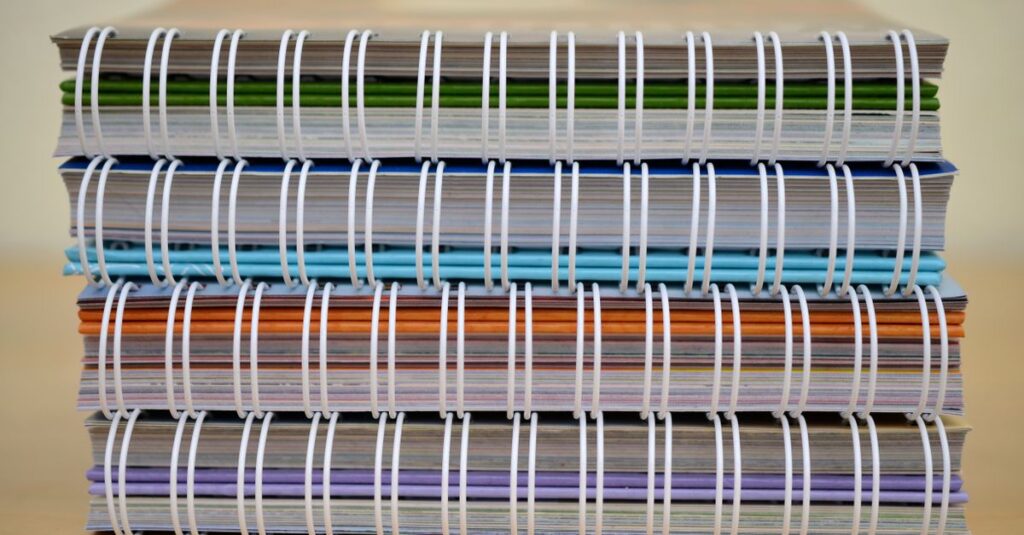
You can’t have a 700-page Short notebook with simple side stitching. It’ll fall apart. The physics don’t work. A thick, heavy page block needs a spine that can hold it — like perfect binding (where pages are glued at the spine) or a strong spiral coil.
I think about this a lot when we get custom orders. Someone wants a super-slim, elegant corporate diary — but they also want 320 pages. Those two things fight each other. You either get a thick, chunky “slim” diary, or you use ultra-thin paper that might ghost ink. The size, page count, and binding are a three-legged stool. If one leg is off, the whole thing wobbles.
Expert Insight
I was reading an old printing manual from the 90s last month, and one line stuck with me. It said, “The paper grain must run parallel to the spine for longevity, or the book will always fight to close.” It’s a technical thing — but the principle applies to everything. When the fundamentals (size, grain, binding) are aligned, the notebook just works. It lies flat. It feels good. It doesn’t fight the user. Most complaints about “bad quality” notebooks come from this misalignment, not from cheap materials. Don’t quote me on that being the only reason, but it’s a big one.
It’s not about the fanciest cover. It’s about the hidden engineering.
FAQs: The Questions We Actually Get Asked
Frequently Asked Questions
What is the most common notebook size for schools in India?
Hands down, it’s the Crown Size or King Size (around 23.6 x 17.3 cm). It’s the workhorse. It’s familiar to parents, teachers, and students. It fits the standard curriculum needs and school bag dimensions. For bulk school notebook orders, this is usually the default unless specified otherwise.
Are ‘magazine sizes’ and ‘notebook sizes’ the same thing?
In common search terms, yes — people often use “magazine sizes” when they’re looking for notebook or paper dimensions. But in the actual trade? Not really. Magazine sizes can refer to specific printing sheet sizes before they’re cut. For buying finished notebooks, you should focus on the final product dimensions (like Long, Short, Crown), not the press sheet names.
What size notebook is best for corporate branding?
It depends on the use. For a premium executive diary, the Crown Size is a classic, professional choice. For a pocket-sized giveaway at a conference, the Short notebook is perfect. For a large desk pad or planning notebook, the Account size makes a statement. Think about where the notebook will be used more than anything.
How does notebook size affect the price in bulk orders?
Larger sizes (like Account) use more paper, so they cost more per unit. But the bigger cost factor in bulk is often the binding and page count. A 700-page Long notebook costs more to bind securely than a 52-page one. For large school orders, the price difference between Crown and Short is often minor; the volume is what brings the cost down.
Can I get custom notebook sizes made?
Yes, absolutely. That’s a big part of our custom printing services. But there’s a caveat. Creating a totally new size requires a new cutting die, which has a setup cost. It’s usually more cost-effective for very large runs (think tens of thousands). For most businesses, choosing from standard sizes and customizing the cover and interior is the sweet spot.
Final Thoughts
Choosing a notebook size shouldn’t feel like solving a riddle. It’s a practical decision with practical consequences. Forget the archaic names for a second. Think about the hand that will hold it, the bag it will go in, the words it will hold.
The goal isn’t to become an expert in paper grain. It’s to order with confidence, knowing that what arrives will actually work for the people using it. That’s the whole point of this guide — to translate forty years of factory floor terms into something you can use on a purchase order.
I don’t think there’s one perfect size. Probably there isn’t. But if you’ve read this far, you’re not just looking for dimensions. You’re looking for a solution that doesn’t come with a headache. And that’s what we’re here for.