Paper Cover Sizes: It’s More Than Just a Sheet of Paper
Here's the thing — you’ve got a notebook in front of you. It works. But when it comes time to order 10,000 custom ones for your company or school, you get a quote that includes 'paper cover size' and the price suddenly makes no sense. Why does a bigger cover cost that much more? And what size do you even need?
Most procurement managers I talk to start here. They just want a durable, good-looking notebook. The cover seems like the last thing to worry about. But that's backwards. The cover is the first thing anyone sees. It’s your brand's handshake. And getting the size wrong? That's a headache, honestly. It means wasted paper, weird-looking notebooks, and a budget that looks like you weren't paying attention.
Look, paper cover size isn't about the page size inside. It's about the physical piece of paper that wraps around everything and holds it together. It needs to be bigger. Always. But how much bigger? That's the real question. If this sounds like a familiar puzzle, seeing how manufacturers calculate it might clear things up.
Why Paper Cover Size Actually Matters (A Lot)
Think about it this way. You buy a shirt. The tag size is one thing, but the fabric that wraps around your shoulders and back is something else. If the cover is too small, the notebook feels cheap, the edges of the pages stick out, and it starts to fray after a week. If it's too big, you're paying for paper you don't need and the notebook feels bulky and awkward to carry.
For schools buying in bulk, a poorly sized cover means notebooks that fall apart before the semester ends. For a corporate client, it means a branded diary that looks sloppy on an executive's desk. The math is simple but nobody talks about it: the cover size = internal page size + spine width + wrap-around margins (the parts that fold inside). Miss one of those, and you've got a problem.
I was talking to a procurement manager from a college in Hyderabad last week — over a very rushed phone call, actually — and he said they'd been using the same supplier for years. The notebooks were fine. Then they decided to add a few more pages for a new syllabus. The supplier just used the old cover size. The result? Covers that were too tight, cracking at the spine within a month. They had to reorder the whole batch. It wasn't the supplier's fault, not entirely. The college never specified the new page count. But it was a costly lesson.
Which is… a lot to sit with. The cover is the one thing you can't fix after printing.
The Standard Sizes (And What They’re Good For)
Okay, let's get practical. In notebook manufacturing, we don't usually talk about A4 or A5 for covers. We talk about the finished notebook size, and then work backwards to the flat sheet of cover paper needed. Here’s how it breaks down for the most common types.
Long Notebook Covers: The flat cover sheet for a standard Long notebook (27.2 cm x 17.1 cm) needs to be significantly wider. You need to account for the front, the back, the spine (which depends on page count and paper thickness), and a bit of extra to tuck inside. For a 200-page book, the cover sheet might need to be around 58 cm wide before it's folded and glued. This is the workhorse — schools, universities, general office use.
Short & Crown Size Covers: Smaller, more portable. The cover sheet for a Short notebook (19.5 cm x 15.5 cm) is, well, shorter. But the principle is the same. These are great for quick notes, handouts, or pocket diaries. The smaller size often means a lighter-weight cover paper can be used, which changes the cost.
Account Book Covers: Bigger, heavier-duty. An Account notebook (33.9 cm x 21 cm) has a large internal page, so the cover sheet is large. It also needs to be sturdier — often a thicker paper stock or even laminated, because these books get handled a lot. The spine is thicker too, for 700 pages or more. The flat paper size here is substantial. This is for ledgers, client records, architectural notes. Things that stay on a desk.
And then there's custom everything. Which is where most of the confusion lives. You want your company logo centered perfectly? That art file needs to be designed for the flat cover sheet size, not the final folded size. If your designer sends art for an A5 diary, but we're printing on the larger flat cover sheet, the logo will end up in the wrong place. I see this maybe… 40% of the time? It's not a small number.
A good printing service will catch this and ask for the right file. A rushed one will just print it, and you'll be disappointed.
Expert Insight
I was reading an old industry manual last month — one of those thick, dusty ones — and one line stuck with me. It said the cover isn't a container; it's a constraint. The whole manufacturing process is built around its dimensions. The cutting, the folding, the gluing, the packing. Get the cover paper size wrong at the start, and every machine downstream is just amplifying that mistake. I don't have a cleaner way to put it than that. The more automated the factory, the more expensive a small cover size error becomes.
The Raw Numbers: A Quick Comparison
It helps to see it side-by-side. Let’s compare two common orders: a standard school notebook and a corporate diary. The difference isn’t just the logo.
| Factor | Standard School Notebook (92 pages) | Corporate Branded Diary (240 pages) |
|---|---|---|
| Internal Page Size | Long (27.2 x 17.1 cm) | King Size (23.6 x 17.3 cm) or A5 |
| Typical Cover Paper GSM | 250-300 GSM (Thicker, for durability) | 200-250 GSM (Smoother, for print quality) |
| Approx. Flat Cover Sheet Size | ~56 cm x 27.5 cm (varies by binding) | ~52 cm x 24 cm (varies by binding) |
| Key Consideration | Durability against daily wear & tear. | Premium look & feel; precise color printing. |
| Cost Driver | Volume of paper (GSM & sheet size). | Paper quality + complexity of custom printing. |
See? The corporate diary might have smaller final dimensions, but the flat cover sheet isn't that much smaller because of the thicker spine. And the paper quality spec is different. It's not better or worse — it's for a different purpose. The school notebook needs to survive a backpack. The corporate diary needs to impress on a boardroom table.
Binding Type Changes Everything
This is probably the biggest reason quotes vary so much. The way you bind the notebook dictates the cover size and construction. It's not just an aesthetic choice.
Perfect Binding: Think paperback book. The spine is flat. The cover is glued directly to the spine of the page block. Here, the flat cover sheet is one piece: front, spine, back. The spine width has to be calculated to the millimeter. Too wide, and you get a gap. Too narrow, and the cover wrinkles. This is common for thicker corporate diaries and annual reports.
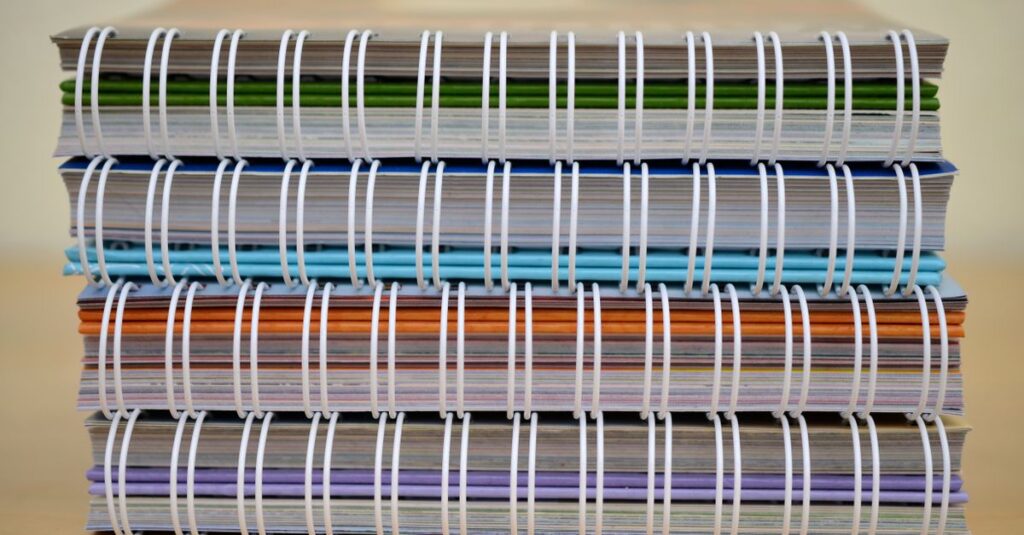
Spiral Binding: The pages are punched, and a plastic or metal coil goes through. The cover is usually two separate pieces — a front and a back. They are the same size as the internal pages, plus a little extra for the punching margin. The cover size here is simpler, but the material needs to be punchable without cracking. Laminated covers can be tricky.
Stitched Binding: The classic notebook. Pages are stitched together in the middle, then the cover is wrapped around and glued to the first and last page. The cover sheet is one piece that wraps around the outside. It needs extra width for the folds that tuck inside. This is the most common for school and standard office notebooks. It’s durable and cost-effective for bulk.
So when you're asking for a quote, "paper cover size" is the wrong first question. The first question is: "How will this notebook be used, and how do you want it bound?" The cover size flows from that answer.
How to Get It Right (Without the Headache)
Look, I'll be direct. You're not supposed to be an expert in this. That's our job. But to make the conversation smoother and avoid surprises, here's what actually helps.
- Start with a Sample: Find a notebook you like. The size, the feel. Send it to us. We can measure it, reverse-engineer the cover, and give you a quote based on that real object. It's the fastest way to get on the same page.
- Know Your Page Count: This is non-negotiable. 52 pages and 320 pages need radically different cover spines. Decide this before you talk cover size.
- Think About Finish: Just a plain cover? Lamination? Soft-touch coating? UV spot logo? Each of these can affect how the paper behaves when folded and might require a slight size adjustment or a different paper stock.
- Ask for a Dummy: A good manufacturer will make a blank dummy — an unprinted notebook with the correct paper, cover, and binding. It costs a little, but it saves you from a costly misprint. Ask for one.
Most people I've spoken to skip the dummy to save time. Nine times out of ten, they regret it. The tenth time, they got lucky.
Anyway. The goal isn't to know everything. It's to know enough to ask the right questions. And to work with someone who will guide you through the rest. After four decades in this, I can tell you the best orders come from a short conversation, not a fifty-page specification document. It starts with knowing what's possible.
Frequently Asked Questions
Is 'paper cover size' the same as the notebook size?
No, and this is the key confusion. The notebook size (like A5 or Long) is the dimensions of the closed book. The paper cover size refers to the dimensions of the flat sheet of paper before it is folded, glued, and wrapped around the inner pages. The cover sheet is always larger to account for the spine and wrap-around flaps.
How much bigger should the cover paper be than the pages?
There's no single answer — it depends on the binding and page count. For a standard stitched notebook, the flat cover sheet width is roughly: (Page Width x 2) + Spine Width + (about 2-3 cm for inner flaps). A manufacturer calculates the spine width based on the number of pages and paper thickness (GSM). Always provide final page count for an accurate quote.
Does a thicker cover paper (higher GSM) affect the size needed?
Indirectly, yes. Thicker paper doesn't fold as tightly. The scoring and folding process might require a slight adjustment to the flat sheet size to ensure clean edges. Also, a thicker spine (from more or heavier pages) directly increases the required width of the cover sheet. The GSM of the cover paper itself is more about feel and durability than size.
Can I use an A4 cover for an A4 notebook?
Absolutely not. If you glue an A4 sheet directly onto an A4 block of pages, you have no spine allowance and no material to fold inside for strength. The cover would be flush with the pages, providing no protection for the edges, and the binding would be weak. The cover must be larger than the internal pages.
Who determines the correct paper cover size for my order?
A reputable manufacturer should. Once you specify the internal page size, page count, ruling, paper quality, and binding type, the manufacturer's production team will calculate the exact flat paper cover size required. Your job is to provide accurate specifications; their job is to translate that into a manufacturable product.
Wrapping This Up
Paper cover size. It seems like a tiny, technical detail stuck in the middle of a big order. But it's the linchpin. Get it right, and the notebook feels solid, looks professional, and lasts. Get it wrong, and everything else is just decorating a problem.
The takeaway isn't to memorize dimensions. It’s to understand that the cover is a calculated part of a system — page, spine, binding, finish. And the best way to navigate it is through clear communication with your supplier. Tell them what you need the notebook to do. Show them an example you like. The rest should be their expertise.
I don't think there's one perfect size for every job. Probably there isn't. But if you've read this far, you're not just looking for a measurement — you're looking for a partner who gets the details right so you don't have to. That's a conversation worth starting.