Here’s the thing — when you’re ordering thousands of notebooks for a school term or a corporate event, you don’t get to be wrong about size. The difference between A4 and A5 paper isn’t just a few centimeters. It’s the difference between a student’s backpack feeling manageable and a sales rep’s notepad fitting in their jacket pocket. And trust me, people notice. I’ve seen orders where someone picked the wrong size, and the feedback is instant. Annoying, expensive, and totally avoidable.
Most of the procurement managers and school principals I talk to aren’t paper nerds — they just need the right tool for the job. And that’s exactly what this is about. If you’re trying to figure out whether your next bulk notebook order should be A4 or A5 size, let’s just talk it through. We’ve been making both for decades, and the choice usually comes down to three things: what the thing is for, who’s using it, and honestly, your budget.
First Off: What Are A4 and A5 Paper Sizes Anyway?
Let’s get the technical stuff out of the way quickly, because nobody remembers numbers. A4 paper is that standard printer paper size you’ve seen a million times. It’s 21.0 cm wide by 29.7 cm tall. A5 is literally half of that — you fold an A4 sheet in half, and boom, you get A5. So A5 dimensions are 14.8 cm by 21.0 cm.
It’s an ISO standard, which means it’s consistent everywhere. An A4 notebook in Rajahmundry is the same size as an A4 notebook in London. That’s important for businesses and schools ordering in bulk, because you don’t want surprises. The whole system is based on a simple ratio, so everything scales neatly. A4 to A5 is the most common jump people make.
But here’s the part nobody says out loud: knowing the dimensions is one thing. Understanding how they feel to use is another. That’s where we get into the real differences.
The A4 Notebook: When You Need the Real Estate
A4 notebooks are the workhorses. They’re for when you need space — lots of it. Think about an accountant logging entries all day, a student taking detailed science notes with diagrams, or a project manager mapping out timelines. The extra width and height matter.
I remember a conversation with a college administrator from Vizag last year. She was ordering notebooks for their engineering departments. “We tried A5 for a semester,” she told me. “The students just started using two pages for one diagram. Total waste.” They switched back to A4 the next term.
Use cases where A4 almost always wins:
- Accounting & Record Books: Spreadsheets, ledgers, financial logs. You need the columns.
- Technical Drawing & Architecture: Even rough sketches need room.
- University & College Note-taking: Especially for STEM subjects.
- Corporate Meeting Minutes: When multiple people might need to see the page at once.
- Legal Pads & Official Documentation: It just looks — and feels — more substantial.
The trade-off? They’re bigger. Heavier. And yes, more expensive. You’re using more paper, more cover material, more of everything. For a bulk order, that cost adds up fast.
The A5 Notebook: Portable, Practical, and Pretty Efficient
Okay, so A5 is the smaller one. But don’t think of it as “less than.” Think of it as focused. It’s the size you grab for quick notes, to-do lists, journaling, or carrying around all day without it being a burden.
Three things happen when you go A5. First, portability shoots way up. Fits in a handbag, a blazer pocket, a small backpack pouch. Second, the cost per unit comes down — you’re literally using half the paper of an A4 sheet per page. And third, psychologically, people tend to fill them faster. A blank A4 page can feel daunting. An A5 page feels manageable. That’s a real thing I’ve observed from our own notebook sales data.
Perfect scenarios for A5:
- Corporate Diaries & Personal Planners: Executives carrying them to meetings.
- Field Sales Reps: Client notes on the go.
- School Students (Younger Grades): Lighter bags for smaller kids.
- Conference & Event Giveaways: More cost-effective for large batches.
- Personal Journals & Creative Writing: That classic, intimate feel.
Look, I’ll just say it. Most general office work? A5 is more than enough. The obsession with A4 is sometimes just habit.
A Real-Life Example
Let me tell you about Priya. She’s 34, a regional manager for a pharmaceutical company based in Hyderabad. Her team of 50 medical reps needed new notepads. They were using these bulky, custom A4 pads that never fit in their sample bags. She called us, frustrated. “They just leave them in the car,” she said. We suggested a switch to A5, spiral-bound, with their logo. Just a simple change in size. Six months later, she told me usage had doubled. Because they actually had them in hand when talking to doctors. The size changed the habit.
Anyway. Back to the comparison.
A4 vs A5 Paper: Side-by-Side Breakdown
Let’s put this in a table. It’s easier to see the trade-offs when they’re right next to each other.
| Feature | A4 Paper / Notebooks | A5 Paper / Notebooks |
|---|---|---|
| Dimensions | 21.0 cm x 29.7 cm | 14.8 cm x 21.0 cm |
| Best For | Detailed work, accounting, technical notes, official records. | Portability, daily tasks, meetings, personal use, giveaways. |
| Typical Users | Accountants, engineers, university students, legal professionals. | Sales teams, managers, school students, conference attendees. |
| Feel & Use | Substantial, formal, allows for expansive layouts. | Compact, casual, encourages concise note-taking. |
| Cost Implication | Higher. More paper, heavier shipping, larger covers. | Lower. More economical for bulk orders and promotions. |
| Binding Consideration | Often needs sturdy binding (stitched or perfect bound) due to size/weight. | Works well with all bindings, including simpler spiral or staple. |
| Perception | Professional, official, comprehensive. | Agile, modern, personal. |
The question isn’t which is “better.” It’s which is better for your specific need.
How to Choose: A Quick Guide for Bulk Buyers
If you’re a procurement manager staring at a quote for 10,000 notebooks, here’s my blunt advice. Ask these three questions.
1. What’s the primary action? Is the user mostly writing (A5 is often fine), or are they drawing, tabulating, needing wide formats (lean A4)?
2. Where will it live? On a desk 90% of the time? A4 is comfortable. In a bag, moving between locations? A5 starts to make a lot more sense.
3. What’s the budget per unit? This is the real-world decider. A5 gives you more notebooks for the same money, or lets you upgrade paper quality or binding within the same cost. For schools and corporations counting every rupee, that’s not a small thing.
And honestly? Don’t be afraid to mix. We do orders all the time where a company gets A4 ledger books for the finance team and A5 notepads for the sales floor. One size does not fit all.
Expert Insight
I was reading an article last month — can’t remember where — about how physical objects shape work habits. The author made a point that stuck with me: we often choose tools based on tradition, not task. A4 became the “office standard” decades ago for printing documents, so it became the notebook standard by default. But the way we work has changed. We’re more mobile, more concise. The tool should fit the new habit, not the old one. I don’t have a cleaner way to put it than that.
Beyond the Size: Paper Quality, Binding, and Customization
Right. So you’ve picked a size. Good. But your job’s only half done. The paper inside that size matters just as much. A beautiful A5 notebook with paper so thin the ink bleeds through is useless.
For most writing, you want a paper GSM (grams per square meter) that feels substantial and doesn’t ghost. We standardize around 54-70 GSM for our writing notebooks. It’s a sweet spot — durable enough, good to write on, but not so thick it makes the notebook a brick. For A4 notebooks that might see heavier ink or markers, you might bump that up.
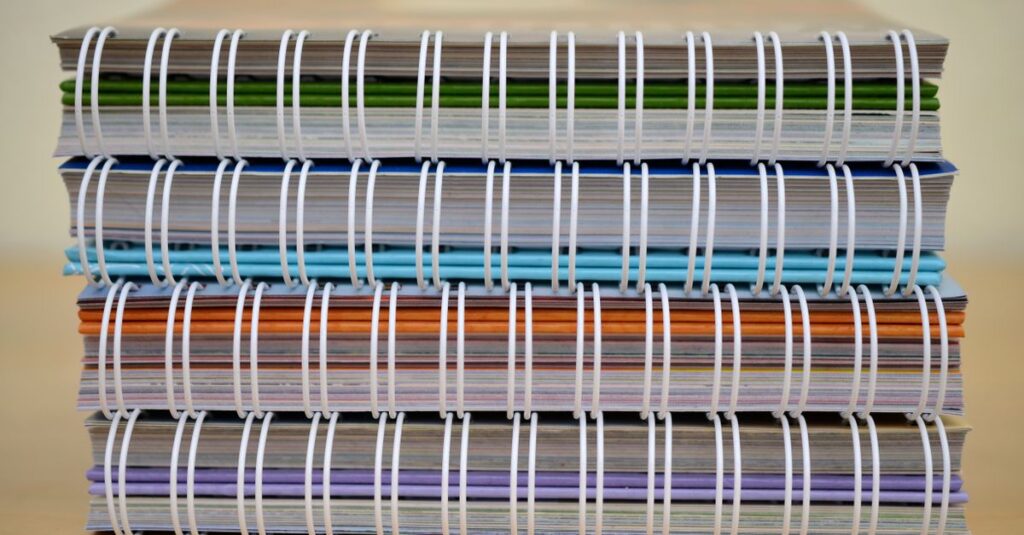
Binding is next. A thick A4 notebook with 200 pages? It needs a stitched binding or a strong perfect bind. A slim A5 notebook for quick notes? Spiral binding is fantastic — lays flat, easy to tear pages out. This is where talking to your manufacturer helps. A good one won’t just sell you a product; they’ll ask about the use case. Like we do with our custom printing clients.
And then there’s ruling. Single-ruled? Double-ruled? Unruled? Dot grid? This is where customization for your audience pays off. A school might want four-ruled notebooks for younger kids learning to write. A design firm might want unruled A5 notebooks for sketches.
The details are where the real fit happens.
FAQ: Your A4 and A5 Questions, Answered
Frequently Asked Questions
Is A4 or A5 better for school notebooks?
It depends on the grade and subject. For primary school students, A5 is often better — lighter bags, easier to handle. For high school or college students taking dense, detailed notes (especially in science or commerce), A4 provides the necessary space. Most schools we supply use a mix.
What is more cost-effective for bulk corporate gifts: A4 or A5 diaries?
A5, almost always. You use less paper and materials per unit, so your budget goes further. You can often get a higher-quality cover or better binding on an A5 diary for the same price as a basic A4 one. For giveaways at conferences or for client gifts, A5 is the practical choice.
Can you print custom logos on both A4 and A5 notebooks?
Absolutely. We do it every day. The process is similar, though the print area is obviously smaller on an A5 cover. The key is clean, scalable artwork. Whether it’s a school crest or a corporate logo, both sizes work perfectly for custom printing.
Are A4 notebooks always more professional than A5?
Not anymore. That’s an old perception. While A4 still dominates formal reporting, A5 is widely accepted and often preferred in modern, agile business environments. It signals efficiency. It’s about choosing the right tool for the job, not the most imposing one.
What binding is best for an A4 notebook versus an A5?
For thicker A4 notebooks (200+ pages), stitched or perfect binding offers durability and a clean look. For thinner A4 or most A5 notebooks, spiral binding is great for lay-flat use and portability. It really comes down to page count and how the notebook will be used.
Wrapping This Up
Look, at the end of the day — and I see this all the time — people overthink this. They get lost in the specs and forget the person who has to carry the thing, use the thing, fill the thing.
The best notebook size is the one that gets used. If an A4 ledger sits on a shelf because it’s too cumbersome, it’s wrong. If an A5 notepad gets filled every month because it’s always at hand, it’s right. It’s that simple.
For procurement managers and bulk buyers, the decision is part logistics, part psychology, and part pure math. Consider the user, consider the task, and run the numbers. Sometimes the answer is a blend of both. And that’s okay.
I don’t think there’s one universal answer here. Probably there isn’t. But if you’ve read this far, you’re not just buying paper — you’re buying a tool. And you already know what you need the tool to do. You’re just figuring out the right size to make it happen.
If you’re still torn between A4 and A5 paper for your next big order, talking to someone who’s made millions of both can help. We can walk you through samples, costs, and what other schools or companies in your sector are doing. Just reach out.