Okay, let’s clear this up
Here’s the thing — everyone who buys notebooks in bulk uses the term ‘academic notebook.’ But I’ve been in this industry for over 40 years at Sri Rama Notebooks, and nine times out of ten, what a procurement manager means and what a factory floor produces can be two different things. It leads to that specific kind of headache where an order arrives and someone says, ‘This isn’t what I pictured.’
That gap is almost always about expectation. You’re thinking about durability, cost-per-unit, ruling precision. You need things to last a semester, survive a backpack, and not bleed ink. The term ‘academic notebook’ isn’t just a product name; it’s a set of unwritten rules for what a student or institution actually needs. And most of the problems come from those rules not being spelled out.
If you’re ordering for a school district or a university bookstore, you’re not just buying paper. You’re buying a tool. And tools need to work. This is where the details matter.
What people *actually* mean by “academic notebook”
It’s not one thing. That’s the first trap. When someone says ‘academic notebook,’ they could be picturing anything from a basic single-ruled exercise book for a fifth grader to a thick, graph-paper lab notebook for an engineering student. The common thread isn’t the product — it’s the use case: organized, sustained learning over time.
Think about it this way. A corporate diary has dates and maybe a logo. A personal journal might have fancy paper. An academic notebook? It has a job. Its job is to hold notes, diagrams, equations, and revisions without falling apart. Its job is to be affordable enough to order by the thousand, but good enough that a student isn’t fighting the paper to write clearly.
I was talking to a procurement head from a private school last month — over a very rushed coffee, actually — and she put it perfectly. ‘I need it to be invisible,’ she said. ‘The notebook shouldn’t be the thing the student ever has to think about. It should just work.’
The Real-Life Test
Take Meena, 28, a stationery distributor in Hyderabad. She gets an order for 5,000 ‘academic notebooks’ from a coaching institute. She sends standard 92-page, single-ruled books. The institute calls back, furious. They needed 200-page books for their year-long courses; the 92-page ones will run out mid-term. A simple spec mismatch. But it cost her the client. The term was too broad. The conversation wasn’t specific enough.
Anyway. Where was I.
The core specs that actually matter (and the ones that don’t)
Look, I’ll be direct. You can get lost in paper weights and glue types. Let’s cut through that. From where I sit, running a factory that makes tens of thousands of these a day, here’s what separates a product that gets re-ordered from one that gets complained about.
First, paper quality. Not just GSM. Everyone talks about 54 GSM, 70 GSM. The real test is opacity and smoothness. Can a student write on both sides without the ink ghosting through? Does the paper have a tooth that grips a pen, or is it so slick a ballpoint skids? We use a specific 54 GSM writing paper that’s engineered for this — it feels light, but it doesn’t show through. That’s a manufacturing choice, not just a number.
Second, ruling precision. This is a big one people miss. The lines on the page need to be crisp and consistently spaced. If the ruling is faint or wobbly, it strains the eyes. It looks cheap. For younger students, broad ruling (BR) is essential. For university notes, single ruled (SR) or double ruled (DR) is standard. The ruling dictates the notebook’s entire function.
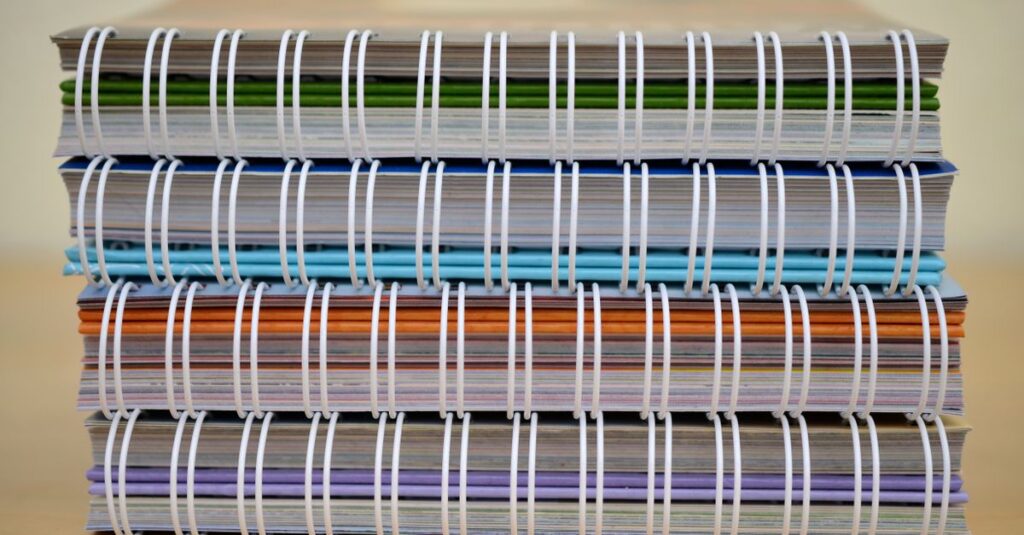
Third, and this is probably the biggest reason for returns: binding integrity. A stitched binding is the gold standard for academic use. It lays flat. Pages don’t fall out. You can’t say that for all perfect-bound books. A spiral binding is great for art or lab books where you need to fold it back on itself, but for a standard notebook that gets shoved in a bag, those spirals bend. And then the book won’t close.
Page count is the final, silent deal-breaker. A 52-page book is a short-term project pad. A proper academic notebook for a semester? You’re looking at 92 pages minimum. For a full year, 200 or 240. It’s not just about thickness; it’s about matching the academic timeline. That’s the kind of insight you get from doing this for decades.
School vs. College vs. Professional Use: It’s not the same book
Earlier I said the term was broad. Let me complicate that. It’s not just broad — the needs are completely different depending on who’s holding the pen. Buying for a primary school is a different universe from buying for a medical college.
| Feature | Primary/Secondary School Notebook | University/College Notebook |
|---|---|---|
| Primary Size | Long (27×17 cm) or Short (19×15 cm). Easy for small hands and standard school bags. | King Size (24×17 cm) or A4. More writing space for dense lectures. |
| Ruling Type | Broad Ruled (BR) or Four Ruled (FR) for handwriting practice. Clear, spacious lines. | Single Ruled (SR) or Double Ruled (DR). Sometimes Unruled (UR) or Graph for STEM. |
| Binding Priority | Durability. Stitched binding survives rough handling. Cover must be sturdy. | Function. Lays-flat binding for writing comfort. May prefer spiral for specific subjects. |
| Page Count | Often 92 pages. Matches a term or semester. Lighter weight for the bag. | 200 pages or more. For year-long courses. Heavier but fewer books to carry. |
| Cover Design | Bright, colorful, often with educational themes or school logo customization. | Simpler, more professional. Solid colors. Often custom-printed with university/department logo. |
See? The ‘academic’ label fits both, but the specs diverge. A wholesale buyer supplying government schools needs to stock the left column. A supplier to private colleges needs the right. Mistake one for the other, and you’ve got a warehouse full of the wrong product.
Expert Insight
I was reading a trade journal last month and one line stuck with me. An old-school stationer from Delhi wrote something like — ‘The notebook is the cheapest piece of infrastructure in education, but it’s the one every student touches every day.’ I don’t have a cleaner way to put it than that. We’re not making fashion items. We’re making the baseline tool for thought. And the more capable the student, the more you notice when that tool gets in the way. That’s the pressure. And that’s why the boring details — the stitch, the paper grain, the ruling alignment — aren’t boring at all.
The bulk buyer’s checklist (before you place that PO)
So you’re responsible for ordering 10,000 notebooks. Don’t just ask for ‘academic notebooks.’ That’s a recipe for confusion. Here’s what you need to specify, point by point. Get this list right, and your supplier will either meet it or tell you they can’t — which is valuable information in itself.
- Size & Format: King Size, Long, Short, A4? Be precise.
- Page Count & Ruling: 92 pages? 200? Single Ruled (SR) or Broad Ruled (BR)? This is non-negotiable.
- Paper Specification: Ask for the GSM, but also ask about opacity. Can you do a ‘show-through’ test?
- Binding Method: Stitched, Spiral, or Perfect Bound? For academic bulk, I always recommend stitched.
- Cover Stock: 250 GSM art card? Laminated? This determines scuff resistance.
- Customization: School logo? Class schedule on the inner cover? This is where a good printing partner shows their value.
- Packaging: How are they bundled? 10s? 50s? Shrink-wrapped? This affects your storage and distribution.
And honestly? The best suppliers will ask you these questions before you even think of them. If they just say ‘yes’ to a vague order, be wary. They might be planning to ship you whatever they have in stock.
Why sourcing from a specialized manufacturer changes everything
You can buy notebooks from a general paper trader. You can import them cheaply from a catalog. But here’s the catch — when you need consistency across an order of 50,000 units, or you need a custom page layout for your institution, that’s when a dedicated manufacturer becomes the only option.
I think about this a lot. Our factory in Rajahmundry runs because we control the process. From the paper reels coming in, to the precision cutting, the ruling, the stitching, the packing. When a school principal wants a special margin for corrections, we can do that. When a corporate training center needs their branding on every cover and a specific chart printed on the inner back page, we can do that. A trader can’t. They can only sell you what someone else already made.
The question isn’t whether you need a notebook. It’s whether the notebook you’re getting is built for the exact job you need it to do. For bulk institutional buyers, that distinction isn’t a luxury. It’s the whole point of the purchase.
Frequently Asked Questions
What is the most common size for an academic notebook?
In India, the ‘Long’ size (27.2 cm x 17.1 cm) is the classic school notebook standard. For higher education, ‘King Size’ (23.6 x 17.3 cm) and A4 are increasingly popular for their extra writing space. It really depends on the institution’s syllabus and bag size.
What page count is best for a full school year?
For a full academic year, 200-page notebooks are the safe bet. They prevent students from running out of pages mid-year and needing a second book for the same subject, which keeps things organized. Many schools opt for 92-page books per term, requiring two per year.
Is spiral or stitched binding better for students?
For general use, stitched binding is more durable. It survives being thrown in a bag better, and pages won’t get torn out on the spiral wire. Spiral is great for specific uses like art or music where you need to fold the book completely flat, but it’s less robust for everyday hauling.
Can we get our school logo printed on academic notebooks?
Absolutely. Most dedicated manufacturers, like us, offer custom printing. You can have your logo, school name, and even specific information (like a calendar or moral pledges) printed on the cover and inside pages. This is standard for bulk orders and builds institutional identity.
What does GSM mean for notebook paper?
GSM stands for Grams per Square Meter. It’s a measure of paper weight and thickness. Standard academic notebooks use around 54-60 GSM paper—light enough to keep the book portable, but thick enough to prevent ink bleed-through. Heavier GSM (70+) is for special uses like drawing.
Wrapping this up
An academic notebook is a promise. A promise to the student that their work will be held securely. A promise to the buyer that the value matches the price. A promise to the institution that it supports, not hinders, learning.
The details are where that promise is kept — or broken. The right paper. The tight stitch. The clear ruling. It’s mundane until it’s wrong, and then it’s all anyone can talk about.
I don’t think there’s one perfect notebook. Probably there isn’t. But if you’ve read this far, you’re not just looking for paper. You’re looking for a reliable tool, sourced from someone who understands that distinction. That’s the part of the conversation worth having with your supplier.
If you’re figuring out specs for a bulk order and want to talk to a manufacturer directly, it might help to start a conversation. No vague quotes — just specifics.