It’s Not Just About Finding a Printer. It’s About Finding a Partner.
Here’s the thing you don’t realize until you’re halfway through a bad print run: a local printing shop isn’t just a service provider. It’s a partner you have to trust with your brand’s look, your deadlines, and a decent chunk of your budget. You, the procurement manager, the school administrator, the distributor — you’re not just looking for ink on paper. You’re looking for someone who won’t mess up 10,000 custom diaries three days before your corporate gifting deadline. I’ve seen the panic. I’ve fielded the calls. It’s not pretty. If you're searching for a “near by printing shop,” you're probably already past the “just browsing” phase and into the “I need someone who can actually do this” phase. I get it. The sheer number of options is exhausting, and the fear of getting it wrong is real.
For businesses ordering in bulk — whether it's corporate diaries for your sales team or custom notebooks for an entire school district — the stakes are different. The wrong paper choice, a smudged logo, a binding that falls apart in a month… it reflects on you. It’s your name on the purchase order. This is the part nobody says out loud: finding a good local printer is as much about risk management as it is about printing. If this sounds like the headache you're trying to avoid, understanding what a specialized manufacturer actually does might be worth a look.
What You’re Actually Buying (And It’s Not Just Notebooks)
When you type “near by printing shop” into Google, you're hoping for a simple solution. But the commercial printing world isn't simple. There are shops that do wedding invites, others that do large-format banners, and a few that actually know how to handle the specific, fiddly demands of bound stationery. Notebooks and diaries are a different beast. They require a specific sequence: precise printing, accurate cutting, consistent binding, and then packaging that doesn't destroy the work. Miss a step, and the whole batch is off.
Think about it this way. You need 5,000 A4-sized corporate notebooks, 200 pages each, with a double-sided printed logo on the cover and your brand colors on the inside cover. A general print shop might see that as a “big print job.” A notebook manufacturer sees it as a standard Tuesday. They think in terms of grain direction of the paper (it affects how the book opens), the tensile strength of the binding thread, the opacity of the paper so ink doesn't bleed through. That's the expertise you're shopping for, even if you don't know the technical words for it yet.
Expert Insight
I was talking to a procurement head from a college in Visakhapatnam last month — over the phone, just comparing notes — and he said something that stuck with me. He said, “We used to choose the printer with the lowest quote. Now we choose the one who answers the phone at 7 PM when we realize we forgot to include the semester schedule on the back cover.” I don't have a cleaner way to put it than that. The real value isn't in the unit price; it's in the headache prevention. The capability to handle a last-minute change without theatrics is what separates a vendor from a partner.
The Common Mistakes Everyone Makes (And How to Spot Them)
Look, I'll be direct. Most people evaluate a printing shop based on three things: price, samples, and promised turnaround time. And those matter. But they're the surface stuff. The mistakes happen in the assumptions.
Mistake 1: Assuming “printing” means “manufacturing.” A shop that prints flyers can print your logo on a pre-made notebook cover. But can they source the right paper in bulk, rule the pages, bind them, and then print? That's manufacturing. If you need customization beyond a stamp on a standard product, you need a manufacturer with printing capabilities, not the other way around.
Mistake 2: Not asking about capacity on a bad day. Anyone can promise a 15-day delivery when the machines are idle. Ask them, “What's your realistic delivery time during your peak season, say before the academic year starts?” The hesitation in their answer tells you everything.
Mistake 3: Overlooking the bind. Seriously. The binding is everything. A perfect print job is ruined by a spiral coil that snags on everything or perfect binding that cracks and sheds pages. You need to know what you're getting: stitched binding for durability in school notebooks, spiral for corporate notepads that need to lay flat, perfect binding for sleek diaries.
Let me tell you about Ananya. She's a 42-year-old operations manager for a stationery distributor in Hyderabad. She switched to a new, cheaper printer for a line of graph notebooks. The samples were fine. The first production batch? The paper weight was inconsistent — some notebooks felt flimsy. The ruling was slightly misaligned on about 30% of the books. Not enough for the average customer to complain, but enough for her discerning clients to notice and question her quality control. She spent six months rebuilding that trust. The savings weren't worth it.
Local vs. National: The Real Trade-Off Nobody Talks About
There’s a big push to find suppliers online, nationally. Sometimes that’s the right call. But for printed, custom stationery? Having a “near by printing shop” — or at least one in your region — has advantages that get glossed over.
Three things happen when your printer is geographically close:
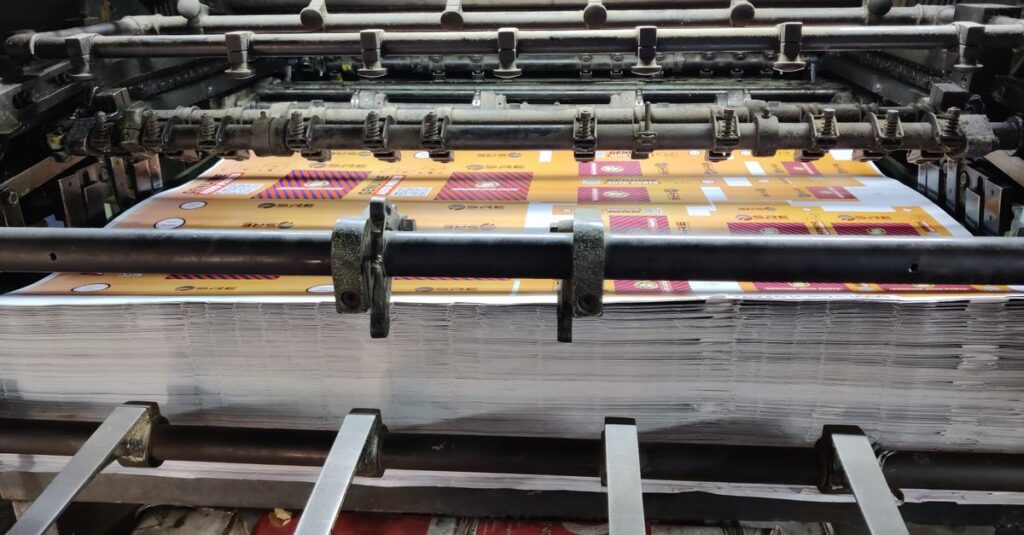
- You can do a press check. You can literally stand there as the first sheets come off the machine, check the color match under real light, and approve it before they run 10,000 covers. This is impossible with a supplier 2000 km away unless you want to fly there.
- Logistics get simpler (and cheaper). Transporting heavy paper and finished notebooks is a major cost. Shorter distances mean lower shipping costs, less risk of damage in transit, and faster replenishment if you need a top-up order quickly.
- The communication loop is tighter. You're in similar time zones. You understand local market nuances — like the specific ruling styles preferred by schools in your state, or the paper quality expectations for corporate clients in your city.
But — and this is crucial — local only works if the local shop has the right scale and skill. A tiny local shop might be great for passion, but if your order is for 50,000 units, you'll swamp them. You need a local partner with industrial capacity. That's the sweet spot. Someone like us, based in Rajahmundry, where we can serve all of South India and beyond without losing that proximity advantage for many clients. It means we can offer the scale of a large manufacturer but still have the owner pick up the phone when you call.
| Factor | General Local Print Shop | Specialized Notebook Manufacturer |
|---|---|---|
| Core Expertise | Flyers, brochures, business cards | Paper, binding, long-run notebook production |
| Customization Depth | Print on existing products | Full product creation: size, paper, ruling, binding, cover |
| Paper Knowledge | Knows standard paper types | Understands paper grain, opacity, GSM for writing feel |
| Scale for Bulk | May outsource or struggle with 10k+ units | Built for 30k-40k notebooks/day; bulk is standard |
| Binding Options | Likely limited to basic staples or pre-made spirals | Stitched, spiral, perfect binding in-house |
| Problem Solving | May hit a wall on technical issues | Has in-house expertise for paper, machinery, binding fixes |
Your Checklist Before You Sign a PO
Okay, so you've shortlisted a couple of places. What now? Don't just ask for a quote. Have a conversation. Use this as a script.
- Ask for a plant visit. Even a quick one. A confident manufacturer will say yes. Look for organization, maintenance of machines, and how they handle waste. Is it chaotic? Or is there a system?
- Ask for client references in your sector. Don't just take the glossy brochure. Ask, “Can you connect me with a school district you supplied last year? Or a corporate client for branded diaries?”
- Be specific about your nightmare scenario. Say, “Walk me through what happens if the color on page 50 is inconsistent. How do you catch it, and what's the protocol?” Their answer reveals their quality control process.
- Understand their paper sourcing. Where does their paper come from? Is it consistent? Can they provide mill certificates? Paper is 70% of your notebook. If they're vague here, walk away.
- Talk about timelines backward from your deadline. “I need these by October 1st. What is your latest possible date for final artwork approval to guarantee that?” Build in buffer for your own approvals.
This isn't about being difficult. It's about being professional. You're making a business decision that will affect your brand, your budget, and your stress levels for the next quarter. A good partner will respect these questions, not resent them. They'll have answers. Probably detailed ones.
Why the “Near By” Part Still Matters in a Digital World
Earlier I said local matters for press checks and logistics. That's true. But it's more than that. It's about accountability. In a world of digital transactions and faceless portals, there's something about working with a team you can visit, whose reputation is built in the same regional business community as yours.
They can't ghost you as easily. They have a literal address you can show up to. That creates a different kind of responsibility. When you buy from a specialized manufacturer, you're also buying into their ecosystem — their relationships with paper mills, their bindery team's skill, their driver who knows the route to your warehouse. It's a network, not just a transaction. And for something as tangible and detail-oriented as printed notebooks, that network is your safety net. It’s why companies that do this for the long haul, like ours, invest in the relationships as much as the machinery. We have to live with the results, too.
Frequently Asked Questions
What should I look for in a printing shop for bulk school notebooks?
Look for a manufacturer, not just a printer. They need to understand paper durability (kids are rough), binding strength (stitched is best for textbooks), and ruling precision. Ask if they regularly supply schools — it means they know about seasonal rushes and standard requirements like four-ruled or broad-ruled pages.
How can I verify the quality of a local printing shop before a big order?
Ask for physical samples of past work, ideally for a similar product. Request a small factory visit. And most importantly, ask for a reference you can call — a previous client with a similar order size. Listen for comments on reliability and problem-solving, not just price.
What is the main advantage of using a nearby notebook manufacturer?
Control and communication. You can approve physical proofs quickly, reduce shipping costs and damage risk, and have faster turnaround on reorders or corrections. There's also the benefit of supporting and being accountable to a local business network, which often leads to better service.
What’s the difference between custom printing and custom manufacturing for notebooks?
Custom printing is putting your logo on a pre-existing notebook. Custom manufacturing is creating the notebook from scratch: you decide the size (like A4 or Long), page count (92, 200, 320), paper quality (GSM), ruling type, binding style, and cover design. It's a complete product built to your specs.
How far in advance should I contact a printer for a bulk corporate diary order?
For a fully custom order, start the conversation at least 90 days before your hard deadline. This allows time for sampling, design revisions, paper sourcing, production, and buffer for unforeseen delays. For standard items, 45-60 days is safer. Last-minute orders are possible but limit your options and increase cost.
Wrapping This Up
Finding a reliable “near by printing shop” for your business notebooks boils down to a shift in perspective. Stop looking for a printer to execute a task. Start looking for a manufacturing partner to solve a problem — the problem of getting a high-quality, custom, printed stationery product into your hands, on time, and without drama.
The checklist, the questions, the emphasis on local capacity — it's all about de-risking your purchase. The cheapest quote often carries the highest hidden cost: your time, your reputation, your peace of mind. I don't think there's one perfect answer for every business. Probably there isn't. But if you've read this far, you already know the difference between a simple vendor and a real partner. You're just figuring out how to find one.
Sometimes, the right partner isn't the closest in miles, but the closest in understanding what you actually need. If you want to see how a 40-year-old manufacturer approaches these problems from the ground up, our story might give you a useful benchmark.