So you’re searching for a notebook manufacturer “near me.” Here’s what you don’t know.
Let’s be direct. You type in “notebook manufacturing near me” because you need a lot of books, you need them soon, and you don’t want the headache of managing a shipment from another planet. It makes perfect sense. Proximity means faster delivery, maybe easier communication, and a vague sense of control.
But here’s the thing — the first mistake most procurement managers make is thinking “near” is only about geography. It’s not. It’s about the distance between your problem and their solution. If the factory down the road can’t handle a last-minute order of 10,000 custom diaries, or their paper shreds under a fountain pen, are they really your neighbor? I’ve seen schools get burned on this. They chose the local guy who was cheap, and the notebooks fell apart before the end of the first term.
The problem isn’t finding someone close. It’s finding someone who understands what you actually need. You’re not just buying paper and thread. You’re buying reliability for your students, or a brand impression for your corporate clients, or smooth operations for your distribution chain. That’s the real search. And if that sounds familiar, what you’re probably looking for is less about a local manufacturer on a map, and more about a local partner who gets it.
“Near Me” Means Different Things to Different Buyers
I was talking to a procurement head for a chain of schools in Tamil Nadu last month. She said something obvious that most people miss. “When I search for suppliers near me, I’m not looking for someone in my city. I’m looking for someone who can get to my city. Fast.” The “me” is her entire operation, spread out. For her, a manufacturer in Rajahmundry with a solid logistics network was “nearer” than a guy in a neighboring town with one rickety truck.
Think about your own situation.
- For Schools & Colleges: “Near me” might mean a supplier who understands the academic calendar. Who knows that notebook orders for the new session aren’t a suggestion, they’re a deadline. A manufacturer who can deliver 50,000 notebooks, sorted by class and ruling type, to four different campus locations before the first bell rings.
- For Corporate Buyers: “Near me” is about customization agility. It’s the ability to tweak a diary cover design via WhatsApp at 6 PM because the board meeting is tomorrow. It’s about short runs for executive gifts without the short-run guilt trip.
- For Distributors & Wholesalers: “Near me” is pure logistics and scale. Consistent quality, massive daily output (we’re talking 30-40k notebooks a day), and the ability to drop-ship to your retail clients without drama. The factory’s address matters less than its reach.
Geographic proximity is just the starting point. The real value is operational proximity. Can they move as fast as your needs do?
A Quick, Real Story
Madhavi, 42, runs a stationery distribution business in Vijayawada. Last Diwali season, a big client needed 5,000 custom corporate diaries with a complex foil stamp logo. Her usual “local” guy in Hyderabad balked at the timeline. She called us, frustrated, on a Tuesday. We’re in Rajahmundry — not exactly next door. But because the entire process — design approval, printing, binding — happens under one roof, we turned it around. The diaries were on a truck to Vijayawada by Friday afternoon. She got a thank-you basket from the client. Her definition of “local supplier” changed that week.
See, “near” isn’t a pin on a map. It’s a measure of responsive.
The Hidden Parts of Notebook Manufacturing Most Buyers Never See
Okay, you’re comparing quotes. One local manufacturer is 5% cheaper. Great. But have you asked about where they source their paper? Or what happens when the humidity hits 85% in July? This is where you separate a vendor from a manufacturer.
Most buyers focus on the end product — the notebook. They look at the cover, flip the pages, check the price. They rarely think about the path the raw materials took. The 54 GSM paper that feels smooth but doesn’t bleed through isn’t magic; it’s a specific procurement choice. The binding that survives a year in a schoolbag without shedding pages — that’s a choice between cheap glue and proper stitching.
When you’re dealing in bulk, these invisible choices are everything. A poorly sourced batch of paper can mean 20,000 notebooks with inconsistent ruling print. A rushed binding job means 5% of your order comes back as returns, which is a logistical nightmare and a brand killer if they’re custom printed.
This is the expertise you’re really shopping for when you look for notebook manufacturing near you. You’re buying decades of accumulated, silent knowledge about things like grain direction, thread tensile strength, and drying times for different inks. It’s boring stuff. Until it goes wrong.
Expert Insight
I was reading an industry piece a while back, and one line stuck with me. A veteran binder said something like — the difference between a notebook that lasts a season and one that lasts a year isn’t the cost of the materials. It’s the cost of the patience. The patience to let the glue set properly, to let the printed sheets acclimate before binding, to run a slower machine for a cleaner cut. I don’t have a cleaner way to put it than that. The good manufacturers aren’t fighting the clock; they’re working with it. And that patience shows up in your order, even if you can’t point to it on a spec sheet.
Customization vs. Standard Supply: Choosing Your Lane
This is where intentions get messy. You might say you want a “custom notebook manufacturer near me,” but what you need might be different. Let’s break it down.
| Factor | Standard Bulk Notebooks | Fully Custom Notebooks |
|---|---|---|
| Lead Time | Short (1-2 weeks). Items are often pre-made or on a standard production line. | Longer (3-6 weeks). Needs design, plate making, sample approval, dedicated production run. |
| Minimum Order Quantity (MOQ) | Lower. Can be a few thousand pieces. | Higher. Often 5,000+ units to justify custom setup costs. |
| Cost per Unit | Much lower. Economy of scale on fixed designs. | Higher. Pays for design time, setup, and exclusive materials. |
| Flexibility | Low. You choose from existing sizes (King, Long, Short), rulings (SR, DR, UR), and page counts. | High. Your logo, your cover material, your internal layout, even your paper blend. |
| Ideal For | Schools, general distribution, cost-sensitive institutional supply. | Corporate branding, premium diaries, luxury gifting, specific academic/logistical formats. |
The trap is trying to get custom flexibility at standard bulk prices. It doesn’t work. A true local manufacturer will tell you this upfront. They’ll ask, “Do you need your own notebook, or do you need a very good notebook that serves your purpose?” The answer saves everyone time and money.
For instance, many schools think they need fully custom books. Often, they just need a standard notebook with their school crest stamped on the cover — which is a simpler, faster, and far cheaper process. A good manufacturer guides you to the most efficient solution, not just the most expensive one.
How to Actually Vet a “Local” Notebook Manufacturer
Right. So you’ve got a shortlist. Here’s what to do beyond comparing price per piece. This is the part most Google searches won’t tell you.
First, ask for raw sample. Don’t just accept a polished, pre-prepared sample kit. Ask them to send a random notebook from a recent bulk order for a client like you. That’s the real quality you’ll get.
Second, get specific about capacity. “Can you handle my order?” is a bad question. Ask: “If I place an order for 50,000 units today, what is your actual production cycle? How many binding machines do you have running? What is your contingency if one line goes down?” Their answer — its speed and detail — tells you everything.
Third, talk paper. Ask where they buy it. Do they have consistent suppliers? Can they show you a paper mill certificate? If they get vague, that’s a red flag. Consistency in raw material is non-negotiable.
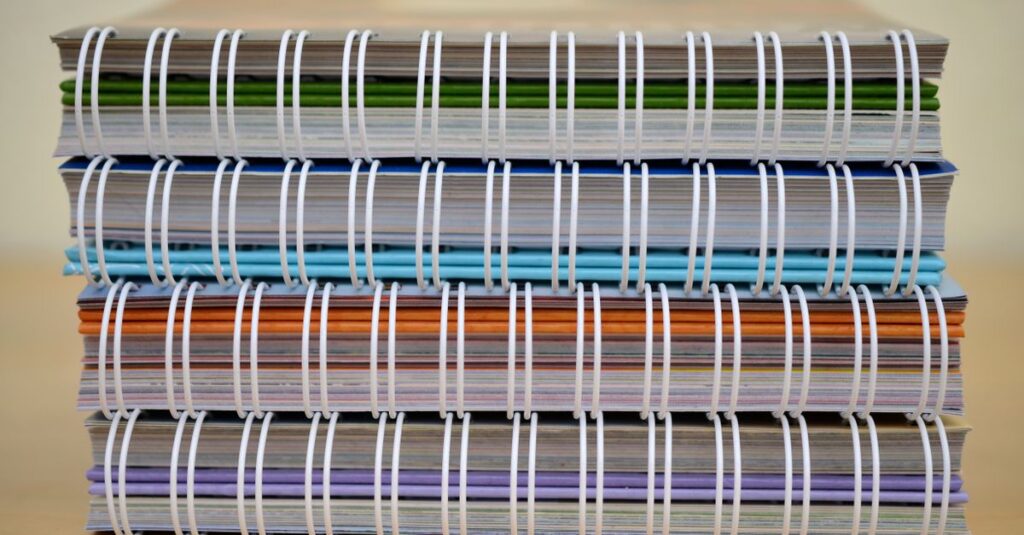
Finally, visit. If they’re truly “near,” go see the factory. Not the office — the factory floor. Look at the stacks of paper. Smell the air (it should smell like paper and ink, not mildew). Watch the machines. Is it organized chaos or just chaos? You’ll know in ten minutes.
I think — and I could be wrong — that nine times out of ten, the decision comes down to a feeling of trust after these steps, not the Excel spreadsheet. You’re not buying widgets. You’re buying the absence of future problems.
FAQ: Notebook Manufacturing Near Me
What should I look for in a local notebook manufacturer for my school?
Look for someone who understands academic timelines first. They should offer all the standard rulings (Single Ruled, Four Ruled for younger kids, Unruled for drawing) and common page counts (52, 92, 200 pages). Ask about their packing — can they deliver batches sorted by class and type? Most importantly, check the binding. School notebooks get thrown in bags daily; stapled binding won’t last. Opt for stitched or strong perfect binding.
Is it cheaper to import notebooks or source them locally?
For bulk, standard notebooks, local almost always wins when you factor in hidden costs. Importing involves shipping, customs delays, import duties, and massive lead times. If a local manufacturer has the scale (like a 40,000-notebooks-per-day capacity), their unit cost will be competitive, and you save on logistics headaches and risk. For custom, high-end items, importing might offer specific designs, but many Indian manufacturers now match that quality.
What’s the typical MOQ for custom printed notebooks?
It varies, but a realistic starting point for true custom work (your design, your specs) is usually 3,000 to 5,000 pieces. This covers the setup cost for printing plates, custom dies, and dedicating a production line. For simpler logo stamping on existing notebook styles, MOQs can be much lower — sometimes even 500 pieces. Always ask for both options.
How long does it take to get an order of bulk notebooks?
For standard, non-custom notebooks from stock designs, a reliable local manufacturer can often dispatch in 7-14 days. For fully custom notebooks, factor in 3-6 weeks: 1-2 weeks for sample approval and another 2-4 for production. Always build in a buffer for your deadline. The “near me” advantage really shines here for shorter lead times and faster problem-solving.
Can a manufacturer help with notebook design?
The good ones can and should. They know what’s technically possible (and cost-effective) in printing and binding. A manufacturer experienced in corporate stationery can advise on cover material, binding direction for left-handed writers, or which paper GSM is best for fountain pens versus ballpoints. Use their expertise—it’s free and prevents expensive mistakes.
A Few Final Thoughts
The search for “notebook manufacturing near me” is really a search for peace of mind. You want the order to arrive on time, look right, and hold together. That’s it.
The local advantage isn’t just about shorter trucks. It’s about the ability to have a direct conversation, to visit without a flight, to build a relationship where they feel accountable to you, face-to-face. In a world of faceless global supply chains, that still matters. Probably more than ever.
I don’t think there’s one perfect supplier for everyone. But there’s a right-fit supplier for your specific need — whether you’re a school, a corporation, or a distributor. The goal is to find the one where the distance between your problem and their solution feels shortest. And sometimes, that manufacturer might be a few hundred kilometers away, but they feel next door because they just get it. If you’ve read this far, you’re likely weighing a real decision, not just browsing. And maybe it’s time to have a conversation with someone who’s been solving these exact problems for over four decades.