Let’s talk about ordering notebooks. For real.
You need notebooks. A lot of them. Maybe you’re the person at a school who just got the budget approved for next year’s student supplies. Or you’re in a corporate office, and the boss wants branded diaries for the entire sales team by Q4. The task lands on your desk: “Order copies.” And suddenly, it’s not just about clicking ‘add to cart.’ It’s about paper quality, delivery timelines, minimum order quantities, and a dozen emails that start with “Just checking on…”
I’ve been talking to procurement managers and business owners about this for years. The frustration isn’t about the product itself. It’s about the process. The gap between what you need and what you actually get from a supplier who doesn’t ask the right questions. You’re not just ordering a product; you’re sourcing a piece of your company’s identity, or a tool for an entire school year. That’s a headache, honestly. If you’re in the middle of that search, this might be worth a look.
Anyway. Here’s what nobody tells you when you start looking to order copies in bulk.
The “Just Get It Done” Trap (And How to Avoid It)
The pressure is to just place the order and cross it off the list. I get it. But rushing this is how you end up with 5,000 notebooks that feel cheap, or covers that fade after two months, or a shipment that arrives two weeks into the new term. The real problem: most suppliers will happily take your money for the standard option. They won’t stop you.
Think about it this way. You’re not buying a pen. You’re buying a thousand small, physical representations of your brand, or a foundational tool for learning. The cost of getting it wrong isn’t just financial—it’s reputation. A flimsy notebook given to a client says something. A poorly bound book that falls apart for a student says something else.
Three things happen when you skip the questions: You assume the GSM is good enough. You hope the binding holds. You pray the delivery date is real. Hope is not a procurement strategy.
What You’re Actually Buying: The Specs That Matter
Right. Let’s get specific. When you say “order copies,” you’re ordering a combination of decisions you might not even know you’re making. Here’s the breakdown.
Paper (The Writing Experience): GSM isn’t just a number. It’s the difference between ink bleeding through and a clean page. Standard writing paper is around 54 GSM. It works. But for a corporate diary or a drawing book, you might need heavier paper. 70 GSM, 80 GSM. This is the part nobody says out loud: the paper weight directly affects how people feel about using the notebook. Cheap paper feels disrespectful of the user’s time.
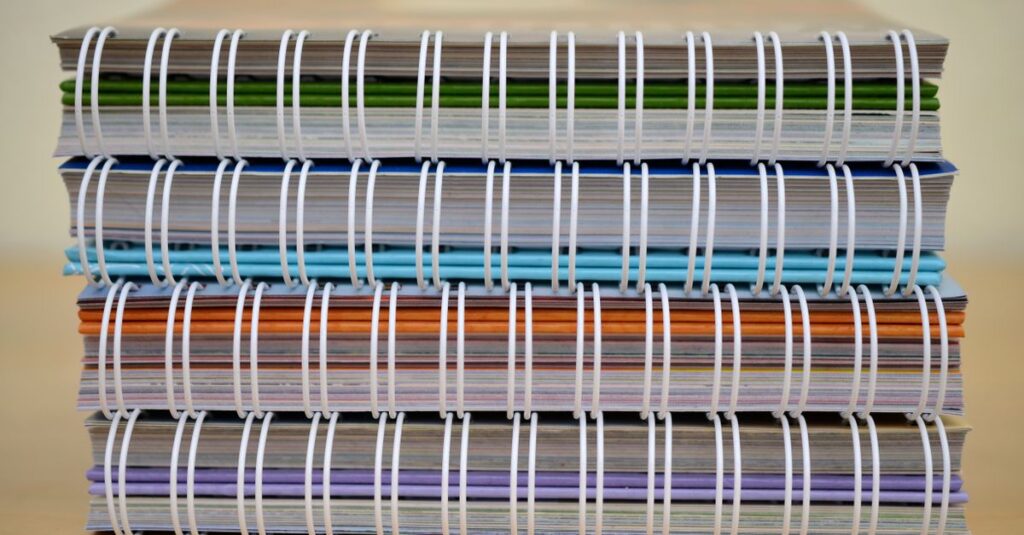
Binding (The Survival Rate): Stitched binding is classic, durable for most school notebooks. Spiral binding lets it lay flat—perfect for training manuals or sketchbooks. Perfect binding gives that clean, book-like edge for premium corporate gifts. The wrong choice means books cracking at the spine in a month.
Cover (The First Impression): 250 GSM art card? Laminated? Soft-touch coating? This is the handshake. A thin cover gets dog-eared in a backpack. A glossy laminate might look cheap if not done well. I was talking to a distributor from Hyderabad last month—over chai, actually—and he said his biggest returns came from clients unhappy with cover feel, not page count. They never thought to specify it.
Let me tell you about Rohan. He’s 38, a procurement manager for a mid-sized tech firm in Bangalore. Needed 800 custom notebooks for a developer conference. He went with the cheapest quote, a 92-page spiral-bound with a basic laminated cover. The books arrived. The spiral coils were weak, snagging on everything. The lamination had a weird purple tint under conference hall lights. He spent the entire event apologizing. The savings weren’t worth the embarrassment. Not even close.
You see the gap? Between the purchase order and the user’s hands.
Expert Insight
I was reading an old industry report a while back, and one line stuck with me. It said that in bulk stationery sourcing, the most common point of failure isn’t manufacturing error. It’s specification ambiguity. The buyer and the manufacturer are using the same words—”premium finish,” “durable binding”—but picturing completely different things. The researcher said something like—the more generic your request, the wider the gap between your expectation and the factory’s standard output. I don’t have a cleaner way to put it than that. Clarity is kindness, to yourself and your supplier.
Custom Notebooks vs. Standard Stock: A Real Comparison
This is where most people get stuck. Should you order copies of a standard, existing notebook? Or go custom? It’s not an obvious choice. Here’s a blunt comparison.
| Consideration | Standard Stock Notebooks | Custom Printed Notebooks |
|---|---|---|
| Lead Time | Short. Often ready to ship. | Longer. Needs design, plating, production run. |
| Cost Per Unit | Lower. Economy of scale is already baked in. | Higher. Covers setup, plates, and custom materials. |
| Minimum Order Quantity (MOQ) | Flexible. Can sometimes order a few hundred. | Higher. Usually starts at 500-1000 units to justify setup. |
| Brand Impact | Zero. It’s a generic product. | High. Your logo, colors, and message are front and center. |
| Uniqueness | None. Anyone can buy the same book. | Total. You control the entire spec and design. |
| Best For | Internal use, general distribution where brand isn’t key. | Corporate gifting, client giveaways, branded educational kits. |
The table makes it obvious, right? If brand matters, you pay and wait. If you just need functional paper quickly, stock is the answer. The mistake is trying to get custom-branding benefits at stock-notebook prices. Can’t be done.
Sometimes, seeing what a real custom setup looks like helps frame the decision.
How to Talk to a Manufacturer (Without Wasting Time)
Look, I’ll be direct. Your first email shouldn’t just say “Quote for 10,000 notebooks.” That’s like calling a car dealer and saying “Quote for a vehicle.” It gets you nowhere good. Here’s a better way to start.
Provide a spec sheet, even if it’s just in bullet points in the email body:
- Quantity: Your target number. (Be honest—is it 5,000 or 50,000?)
- Size: King Size (23.6×17.3 cm), Long (27.2×17.1 cm), etc.
- Page Count & Ruling: 200 pages? Single-ruled (SR) or unruled (UR)?
- Cover: Art card weight? Lamination? Need a design?
- Binding: Stitched, Spiral, or Perfect?
- Packaging: Bulk shrink-wrap? Individual poly-packing?
- Delivery Deadline: Real date, plus some buffer.
This does two things. It shows you know what you need, which makes the manufacturer take you seriously. And it forces you to make decisions you were probably putting off. Most people I’ve spoken to say this single step cuts the back-and-forth by 80%.
And honestly? If a supplier doesn’t ask you these questions after your initial inquiry, that’s a red flag. They should be digging into specs, not just sending a price list.
The Logistics Headache (And the One Question You Must Ask)
Production is one thing. Getting the books to your warehouse or school is another. This is where smooth projects go to die. Port delays. Truck breakdowns. Monsoon season. You need a supplier who owns this part, not one who drops pallets at a port and says “good luck.”
In my experience working with institutions, the single most important logistical question is: What’s your process for damage/claim handling? Not if they have one, but what it is. Do they have insurance? Who files the claim? How long does replacement take? A good manufacturer has a clear, written policy. A bad one gets vague. Fast.
For international buyers, it’s even trickier. You’re dealing with export documentation, Harmonized System (HS) codes, and clearance. A manufacturer who exports regularly will have this down to a system. One who doesn’t will turn your order into their learning experience. At your expense.
Which is… a lot to sit with.
Frequently Asked Questions
What does “order copies” usually mean in the notebook business?
It’s industry shorthand for placing a bulk purchase order for multiple units of a notebook or diary. It rarely means just one or two books. We’re talking hundreds or thousands, for schools, corporate promotions, or wholesale distribution. The phrase focuses on the quantity and the action of purchasing, not the customization specs (which you have to provide separately).
How many notebooks do I need to order to get a bulk discount?
It varies wildly by manufacturer. For standard stock notebooks, you might see price breaks at 500, 1,000, and 5,000 units. For custom orders, the Minimum Order Quantity (MOQ) is key—it’s often 1,000 pieces just to make the setup and plate costs worthwhile. Always ask for a tiered price list. If they won’t give one, they’re not really set up for bulk.
Can I order copies with my school logo or company brand on them?
Absolutely. That’s called private label or custom notebook manufacturing. You provide the logo and design, the manufacturer handles the printing on the cover and sometimes inside pages. Lead times are longer and costs are higher than standard stock, but the brand impact is the whole point. This is our specialty at Sri Rama Notebooks.
What’s the typical lead time to order copies of custom notebooks?
Don’t expect anything under 4-6 weeks for a custom job. Here’s why: design approval (1 week), plate/setup creation (1 week), paper procurement and printing/binding (2-3 weeks), shipping (1 week). And that’s if everything goes perfectly. Always build in buffer. For large standard stock orders, it can be 2-3 weeks if the items are in inventory.
Do you ship internationally when we order copies?
Yes, many established Indian manufacturers like us do. We regularly ship to the Gulf, Africa, the USA, and Europe. The key is working with a supplier experienced in export paperwork—commercial invoices, packing lists, certificates of origin. They handle the freight forwarding and customs clearance basics, so you don’t have to.
Wrapping this up
Ordering copies in bulk isn’t complicated. But it is detailed. It’s about moving from a vague need—”we need notebooks”—to a concrete spec sheet that a factory can execute without guessing. It’s about choosing between the speed of stock and the impact of custom. And it’s about partnering with a supplier who sees the order as the start of their responsibility, not the end of it.
The main takeaways? Know your specs. Ask the hard logistics questions. And match your expectations to your budget—premium branding costs more than basic utility. I don’t think there’s one perfect way to do this. Probably there isn’t. But if you’ve read this far, you already know what you’re looking for in a supplier—you’re just figuring out if they exist. We’ve been answering that question since 1985, if you want to talk specifics.