Look, You’re Probably Thinking About a Screen
Here’s what happens. Someone gives you the term “E notebook.” Your mind instantly goes to a tablet. A sleek, glowing screen. Maybe a fancy digital notepad. And I get it — that’s what everyone thinks first.
But then you start looking for a manufacturer. You see factories like mine talking about paper, GSM, and binding. And it clicks. Wait. They’re not talking about electronics.
You’ve just hit the quiet little gap in the stationery world. Right there. The problem isn’t the product — it’s the name. For over 40 years in this business, I’ve seen this confusion trip up procurement managers, school administrators, and even seasoned distributors. They come looking for one thing and find something entirely different, yet strangely exactly what they might have needed all along.
So, let’s clear this up. If you’re sourcing in bulk for a school, a corporate giveaway, or a wholesale order, this is the part you need to get right before you even talk numbers.
So What Actually Is an E Notebook?
In the manufacturing and printing trade — my trade — an “E” notebook isn’t digital. It’s a physical, paper notebook defined by its size. Specifically, it’s a European-standard size. The “E” likely stands for “Exercise” or references the European paper size series that includes A4, A5, and so on.
Think of it this way: while places like India have King Size, Long, and Short notebooks, the “E” size is a globally recognized dimension common in international markets, especially across Europe, the UK, Australia, and parts of Africa. It’s the notebook a student in London, an architect in Berlin, or a businessperson in Dubai might reach for. It’s less about technology and more about a universal, familiar footprint.
The silence has weight when you realize you’ve been searching in two different worlds.
The Real-World Specs: Breaking It Down
Forget the jargon. Here’s what you’re actually buying when you order E notebooks:
- The Size: An E notebook typically measures around 240mm x 165mm (that’s roughly 9.4 inches by 6.5 inches). It sits comfortably between an A5 and an A4 sheet. Not too big, not too small. The kind of size you can toss in a bag without it being a brick, but still gives you decent writing space.
- The Paper: This is where quality shouts. We’re talking about a smooth 70-80 GSM paper as a standard for this category. Thinner than that, and ink bleeds; it feels cheap. Heavier, and it becomes a premium product. The ruling? Everything from single ruled (SR) for general notes to cross-ruled (CR) for accounts or graph paper for technical work.
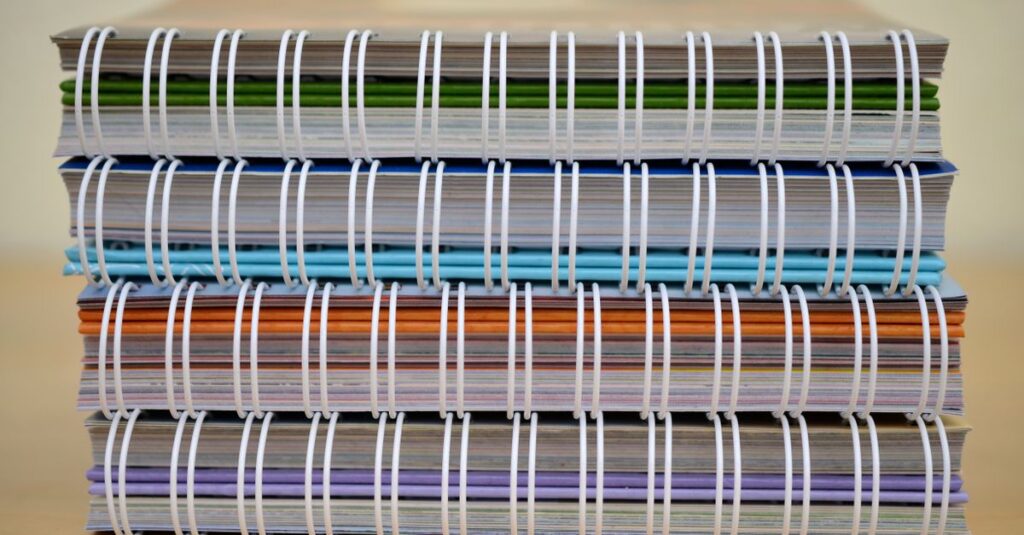
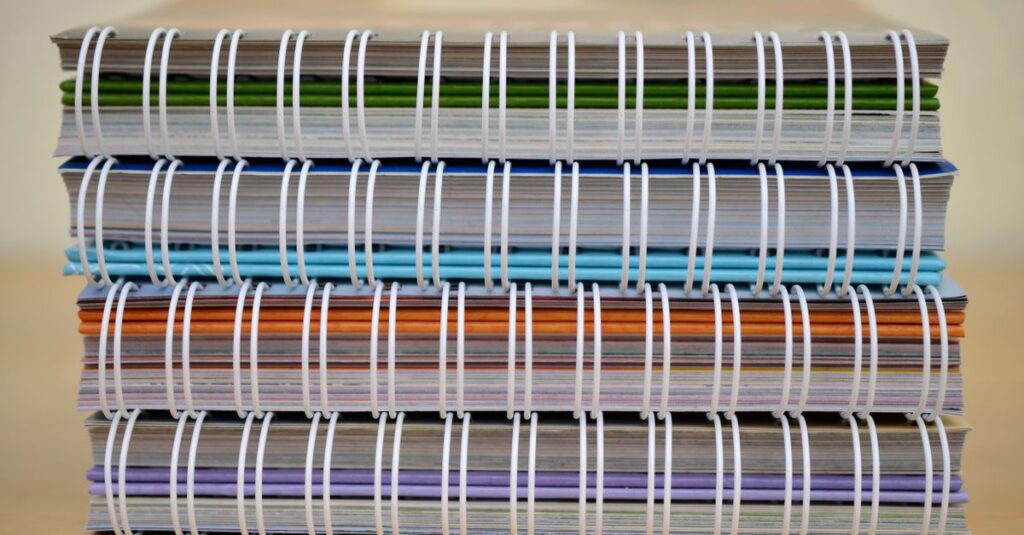
- The Binding: Usually perfect binding — that clean, glued spine you see on paperback books. It lays flat-ish, looks professional, and is durable for everyday use. Sometimes you’ll find it spiral bound for complete lay-flat ability, common in sketchbooks or project notebooks.
And honestly? That last point about binding is where most bulk buyers mess up. They see a price, but they don’t ask how it’s held together. A poorly bound notebook disintegrates in a semester. A well-bound one lasts years.
Who Uses These Things, Anyway? (The Answer Might Surprise You)
I was talking to a procurement manager from a Gulf country last month — over a crackly Zoom call, actually — and he laid it out perfectly. He said, “We don’t order ‘notebooks.’ We order ‘E notebooks’ because that’s the specification in our national education tender documents.” It’s not a preference; it’s a requirement.
So, who’s buying?
Let me tell you about Anya. She’s 42, a procurement officer for a mid-sized university in Kenya. Her desk is a controlled chaos of tender papers and samples. Last quarter, she needed 15,000 notebooks for incoming freshmen. The spec sheet from the academic department literally said “E-size, 192 pages, single-ruled, poly-wrapped.” She wasn’t shopping for a brand. She was matching a blueprint. Her whole process lives or dies on finding a manufacturer who understands that blueprint isn’t just a suggestion.
Beyond Anya’s world, the users are everywhere:
- International Schools & Universities: This is the big one. Curriculums, especially IB or other international boards, often standardize on E-size materials. It’s about uniformity.
- Corporate Training Departments: For workshops, seminars, leadership programs. A branded E notebook feels substantial, professional. It’s not a flimsy giveaway.
- Export-Driven Wholesalers: Guys who supply to supermarkets and stationery chains in Europe or Australia. Their customers walk in looking for that specific size.
- Professional Services: Architects, consultants, engineers. The E size is a sweet spot for field notes combined with structured diagrams.
The question isn’t whether it’s a niche. It’s whether your supplier knows it’s a global one.
E Notebook vs. The Usual Suspects: A Side-by-Side
Look, specs on a website are one thing. Seeing them next to what you already know is another. Here’s how the E notebook stacks up against other common types we manufacture daily.
| Feature | E Notebook (European) | Long Notebook (Indian) | A4 Notebook |
|---|---|---|---|
| Typical Size | 240 x 165 mm | 272 x 171 mm | 297 x 210 mm |
| Primary Market | International Export, EU, UK, AU, GCC | Domestic Indian, Subcontinent | Global, Universal for documents |
| Common Page Count | 192, 240 pages | 92, 200 pages | 120, 200 pages |
| Binding Preference | Perfect Binding, Spiral | Centre Stapled, Side Stitched | Perfect Binding, Spiral |
| Key Use Case | Standardized education, professional notes | Schoolwork, daily subject notes | Reports, official notes, meeting minutes |
| Paper Feel | Higher GSM (70-80), smoother finish | Standard GSM (54-60), functional | Varied, often higher quality |
See the difference? It’s not better or worse. It’s specific. Ordering a Long notebook when your tender asks for an E size is an expensive mistake. They won’t fit the shelves, the covers, or the expectations.
The Customization Game: Your Brand, That Size
This is where it gets interesting for corporate buyers. The E notebook is a fantastic canvas for custom printing. Because of its standardized, professional size, slapping your logo on it doesn’t look like an afterthought. It looks intentional.
We’ve done runs for banks that use them as premium client gifts. For tech companies who want a branded notebook for developer conferences. The process is always the same, and nine times out of ten, people overcomplicate the cover design. Keep it clean. A logo, maybe a subtle pattern. The quality of the binding and paper does the real talking.
I think the real advantage here is perception. Hand someone a flimsy, oddly-sized notebook with your logo, and they’ll stash it in a drawer. Hand them a well-made E notebook, and it goes on their desk. It gets used. Your brand is in their line of sight, not buried.
Expert Insight
I was reading through some old trade documents from the early 2000s, and one line stuck with me. A buyer for a major UK retailer wrote, “The ‘E’ size is the silent workhorse of the stationery aisle. It’s not the cheapest, nor the most glamorous, but its consistency is what keeps it from ever being discontinued.” I don’t have a cleaner way to put it than that. In a world chasing the next flashy thing, there’s a stubborn, quiet demand for the thing that just works, year after year. Manufacturing for that demand isn’t about innovation. It’s about reliability. And that’s a different kind of pressure entirely.
How to Actually Order E Notebooks in Bulk (Without the Headache)
Let’s say you’re convinced. You need 5,000 pieces for an international school program. Here’s the checklist I wish every buyer would run through before they ever hit ‘send’ on an inquiry email. It saves everyone a week of back-and-forth.
- Nail Down the Exact Specs: Don’t just say “E notebook.” Say “E notebook, 240x165mm, 192 pages, 70 GSM white paper, single-ruled, perfect bound, matte laminated cover.” Specificity is kindness.
- Ask for Dummy Samples: Any decent manufacturer will make a blank dummy sample with the exact paper, binding, and cover finish. Postage is cheaper than a wrong container-load.
- Clarify Packaging: Are they shrink-wrapped in 10s? Packed in cartons of 100? This affects your handling costs more than you think.
- Lead Time is Everything: A standard run might take 4-6 weeks. Custom printed covers? Add more. Don’t assume it’s off-the-shelf.
- Get a Breakup: Ask for the cost breakdown — paper, printing, binding, packing. It tells you where your money’s going and if a cheaper option (like a lower GSM paper) is worth it.
Most people skip straight to price. That’s the first mistake. Price is the last thing to talk about, because it depends entirely on the answers to everything above.
Right.
Frequently Asked Questions
Is an E notebook the same as an A5 notebook?
No, they’re close but different. An A5 notebook is 210 x 148 mm. An E notebook is typically 240 x 165 mm, making it slightly taller and wider. It’s a distinct, traditional stationery size. If your requirement specifies one, you can’t substitute the other.
Can I get E notebooks with custom logo printing?
Absolutely. This is one of the most common requests we get. You can customize the cover with your logo, brand colors, and even specific text. The process is straightforward, but you need to account for extra time for plate creation and proof approval. It’s one of our core services for businesses.
What’s the typical minimum order quantity (MOQ) for custom E notebooks?
It varies by manufacturer, but for a custom print run, you’re usually looking at an MOQ of 1,000 to 2,000 pieces. For standard, non-customized E notebooks, some suppliers might offer lower MOQs, but the unit price will be higher. Always ask.
Why choose an E notebook over a cheaper, local size?
If your end-users or market are outside South Asia, the E size is often the expected, standard size. It’s about compatibility with existing systems, shelves, and user habits. Using a local size can make your product look “off” or non-standard in an international context.
Do you export E notebooks internationally?
Yes, a significant part of our production is for export to markets in the Gulf, Africa, Europe, and beyond. We handle the export packaging, documentation, and can work with your shipping agent or arrange freight. It’s a routine part of the job.
Wrapping This Up
So, an E notebook. It’s not a gadget. It’s a specific, physical, globally-traded piece of stationery with a very clear job to do. The confusion around the name is real, but once you get past it, everything else is just solid, practical manufacturing details.
If you’re buying for an institution, a corporate program, or an international supply chain, knowing this difference is probably the most important first step. It filters out the wrong suppliers instantly and puts you straight into a conversation about paper grain, glue types, and carton counts — which is exactly where you need to be.
I don’t think there’s one perfect notebook for everyone. Probably there isn’t. But if you’ve read this far, you’re not looking for just any notebook. You’re looking for the right tool for a specific job. And sometimes, that tool has a very simple, old-fashioned, one-letter name. If that’s the case, and you want to talk specs and samples with someone who’s been making them for decades, that conversation is a phone call or an email away.