You’re Buying Paper. Actually, No. You’re Buying a Feeling.
Let’s be honest for a second. When you’re ordering notebooks for your school, your office, your whole damn organization, you’re not thinking about paper. You’re thinking about price per unit. You’re thinking about delivery timelines. You’re ticking a box on a procurement list. I get it.
But then the notebooks arrive. Someone opens the first one. They press a pen to a page and the ink bleeds through to the next five sheets. The paper feels like tissue. It tears if you look at it wrong. And that feeling — that cheap, flimsy, this-was-a-waste feeling — settles in. That’s what you’re really buying.
The paper is everything. It’s the silent, unseen workhorse. A good notebook paper doesn’t ask for attention; it just does its job, day after day, page after clean page. A bad one screams its failure every single time someone tries to use it. If you’re in charge of ordering, this is where the real decision happens.
Paper Weight Isn’t About the Scale
People throw around “GSM” like it’s a magic number. It stands for grams per square meter. Basically, how much does a single, giant square meter of this paper weigh? More grams usually means thicker, more substantial paper.
But here’s the thing — it’s not the whole story. You can have a thick, fluffy 70 GSM paper that feels like cardboard and still sucks for writing. And you can have a dense, smooth 54 GSM paper that feels premium. The finish, the fiber quality, the coating… they all matter. The GSM is your starting point, not your finish line.
Think about it this way. For a standard school or office notebook that’s going to get daily use, you’re usually looking at 54 to 70 GSM. Below 50? That’s flimsy poster territory — it’ll show everything you write on the other side. Above 80? Now you’re getting into sketchbook or high-end journal land. Thick. Pricy. Overkill for taking meeting notes.
Most people don’t realize the sweet spot exists. They either buy the absolute cheapest (thin, see-through) or they overspend on art-grade paper they don’t need. The goal is to find that paper that has just enough heft to feel trustworthy, but is still economical enough to order by the pallet.
What Happens on the Assembly Line
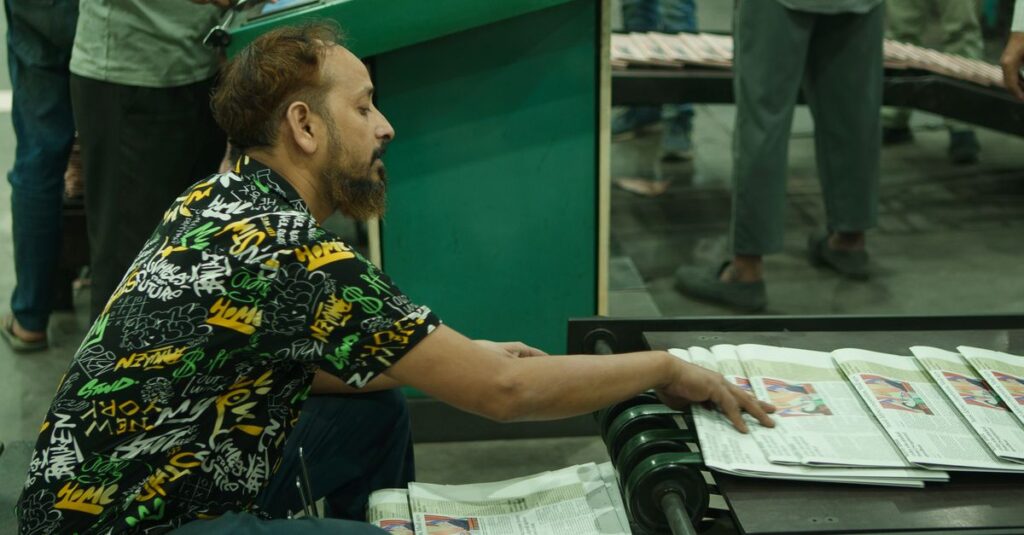
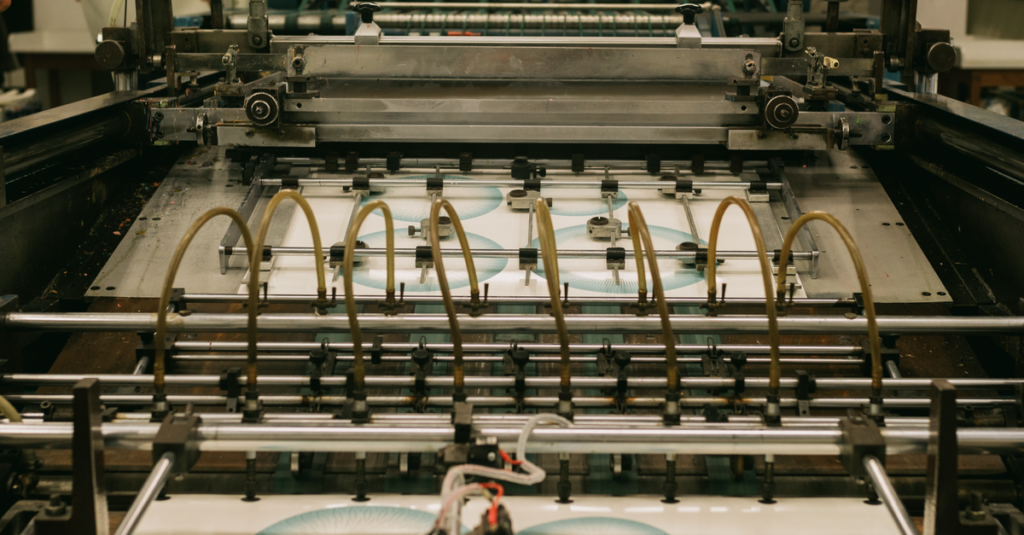
I was on the factory floor last week, watching a new roll of paper get fed into the cutter. The sound is a low hum, like a giant, contented bee. The operator — his name is Ravi, he’s been doing this for twenty years — he runs his thumb along the edge of a freshly cut stack. Just feels it. Doesn’t need a gauge. “This batch is good,” he says. “Smooth. No dust.”
That’s the part you never see. The paper arrives in massive rolls, each one a small fortune. Before a single notebook is stitched, that paper is tested for smoothness, for opacity, for how it takes ink. A dusty paper will jam the machines. A paper that’s too stiff won’t fold cleanly. It’s a balancing act between what feels good to write on and what actually works in a machine that’s binding 40,000 books a day.
The insight here is simple, but it gets lost: manufacturing isn’t just assembly. It’s curation. You’re not just putting parts together. You’re choosing the right parts to begin with. And nine times out of ten, the paper is the part that makes or breaks the whole product.
The Ruling of the Land (And Why It’s a Headache)
Single ruled. Double ruled. Four ruled. Unruled. Broad, narrow, center-broad, cross-ruled… it sounds like a medieval battle cry. For the person placing the bulk order, this is where you can get it catastrophically wrong.
Order single-ruled notebooks for a primary school that teaches four-ruled writing? The teachers will revolt. Send unruled notebooks to an accounts team that needs neat columns? You’ve just created a week of freehand drawing frustration. This isn’t a minor preference. It’s a functional requirement.
Look, I’ll just say it. This is the most common mistake I see from new procurement managers. They see a notebook as a notebook. But for the person using it, the ruling is the scaffold for their work. It dictates how they think on the page.
Here’s a quick cheat sheet:
- Single Ruled (SR): The all-rounder. For general notes, meetings, most student work.
- Double Ruled (DR): Leaves space between lines for corrections, editing. Popular with college students, researchers.
- Four Ruled (FR): Non-negotiable for early primary school. Teaches letter proportions.
- Unruled (UR): For designers, sketchers, mind-mappers. Freedom on a page.
- Cross Ruled / Graph (CR): For engineers, architects, anyone working with data, charts, or precise diagrams.
Get this right, and you’re a hero. Get it wrong, and you’re the reason someone’s day got harder. Which one do you want to be?
The Bulk Buy Dilemma: Custom vs. Stock
You need 10,000 notebooks. Do you take the standard, off-the-shelf option from a catalog, or do you go custom? This is the million-rupee question for corporate and institutional buyers.
Let’s break it down with a table. It’s not as clear-cut as you might think.
| Factor | Stock / Standard Notebooks | Custom Printed Notebooks |
|---|---|---|
| Cost Per Unit | Lower. Economy of scale, produced continuously. | Higher. Setup costs for plates,专属 designs, specific paper. |
| Lead Time | Short. Often ready to ship from inventory. | Longer. Design approval, proofing, dedicated production run. |
| Branding | None or generic. It’s a commodity. | Your brand front and center. Logo, colors, messaging on cover. |
| Internal Perception | “We got notebooks.” Functional. | “They invested in us.” Feels premium, intentional. |
| Flexibility | Minimal. Fixed sizes, rulings, page counts. | Total. You specify size, paper, ruling, page count, cover material. |
| Best For… | Large-scale school supply, internal admin use, general distribution where cost is king. | Corporate gifting, client gifts, branded conference kits, premium employee onboarding, schools with specific mascots/colors. |
The real question isn’t “Which is better?” It’s “What’s the job of this notebook?” Is it to be a disposable tool, or is it to be a brand ambassador, a keepsake, a signal of quality? Your answer tells you which path to take. Sometimes, the brand signal is worth the extra paisa.
When the Notebooks Land: A Real Story
Anita, a procurement manager for a chain of private schools in Hyderabad, ordered 50,000 “standard” long notebooks last year from a new supplier. Price was fantastic. The paper, according to the spec sheet, was “54 GSM writing paper.”
When they arrived, the covers were fine. The binding was okay. But the paper… it was porous. Like a sponge. Fountain pen ink feathered out in weird, hairy lines. Even ballpoint pens indentated the next three pages. The teachers complained. The students’ work looked messy. She had to answer for it.
She told me this over the phone, her voice still tight with that stress. “I saved two rupees per book,” she said. “And I spent ten times that in credibility.” She’s not just buying paper now. She’s buying trust. She asks for samples. She does the ‘pen test’ on every single one. She’s become, reluctantly, a paper expert.
That’s the transformation that happens. You start out ordering a product. You end up managing a relationship between the user and the page. It’s a bigger responsibility than it seems.
The Export Game: Why Paper Quality is a Passport
You think humidity in Andhra is bad? Try shipping a container of notebooks to Dubai in August. Or to a rainy season in West Africa. If the paper isn’t right, you’re not just shipping notebooks. You’re shipping potential mold, warped pages, and glue failure.
International buyers — the good ones — they know this. They’re not just looking at price. They’re asking about fiber source, acid content (acid-free paper lasts decades without yellowing), and moisture resistance. The paper needs to be a traveler. It needs to survive shifts in climate, long sea voyages, storage in less-than-ideal warehouses.
This is where the deep cuts of manufacturing knowledge matter. The kind of glue used in the binding has to work with that specific paper in varying temps. The packaging has to breathe just enough but not too much. It’s a symphony of small, correct decisions. Get one wrong, and the entire shipment can be a write-off.
And honestly? Most local manufacturers don’t think about this. They make for the local climate. Making for the world is a different mindset. You have to assume the worst journey and build for it.
Frequently Asked Questions
What GSM is best for standard office or school notebooks?
For everyday writing with ballpoint or gel pens, 54 GSM to 70 GSM is the sweet spot. It’s opaque enough to prevent serious show-through, has a good heft, and remains cost-effective for bulk orders. Lighter than 50 GSM feels cheap and transparent; heavier than 80 starts to be overkill and drives the price up unnecessarily.
How can I test notebook paper quality before a bulk order?
Always, always ask for physical samples. Do the ‘pen test’: write firmly with the pens you expect your users to use (ballpoint, fountain, marker) and check the back for bleed-through. Tear a page — does it tear cleanly or does it shred? Hold it up to a light to check opacity. The sample tells you more than any spec sheet.
What’s the difference between ‘writing paper’ and ‘printing paper’ in notebooks?
This is a big one. Writing paper is usually smoother, sometimes with a slight coating to help ink dry quickly and prevent feathering. Printing paper (like copier paper) is often more porous and abrasive – it’s designed to grab toner, not glide with a pen. Using printing paper in a notebook makes for a scratchy, unpleasant writing experience.
Is thicker paper always better?
Not always. Thicker paper (higher GSM) means fewer pages per book for the same thickness, or a bulkier, heavier notebook. It’s also more expensive. For a journal or sketchbook, thicker is great. For a student carrying five subjects’ worth of books or an employee needing a lightweight notepad, it can be a drawback. Match the paper weight to the actual use.
Why do some notebook papers have a creamy tint instead of being bright white?
The bright white paper often uses optical brightening agents (OBAs). Cream or ivory paper usually has fewer or no OBAs, and is often easier on the eyes for long writing sessions, reducing glare. It’s also often a sign of higher-quality, acid-free pulp that will age better. It’s a preference, but a yellowish tint can also indicate lower-grade, unbleached pulp.
The Takeaway? It’s a Relationship.
So what’s the point of all this? It’s that you’re not sourcing a product. You’re facilitating thousands of tiny interactions between a person, an idea, and a page. The paper is the medium for that interaction. Good paper disappears, letting the thought flow. Bad paper becomes the obstacle.
The three things to remember: One, GSM is a guide, not a gospel—test it. Two, the ruling is functional, not decorative—know your user. Three, custom branding isn’t a vanity project; it’s a tangible signal of value.
I don’t think there’s one perfect paper for every job. Probably there isn’t. But if you’ve read this far, you already know the cheap option isn’t really an option. You’re just figuring out how to justify the good stuff to the spreadsheet. And maybe that’s the real battle.
It starts with seeing the notebook not as a line item, but as a tool people will touch every day. Getting that right is quieter than you think.