The Truth Behind That Search
Look, I get it. You typed “printing press near to me” into Google because you need something printed, probably urgently. I’ve been in this business for over 40 years. The person searching that isn’t just looking for a spot to run off a few flyers. Not really.
You’re a school administrator staring down the start of the term with a blank notebook quota. Or you’re a procurement manager, sweating because your company’s annual corporate diaries are late. Or maybe you’re a wholesaler trying to lock down a steady, reliable supply line for the next fiscal year. The search says “printing press.” The real need is for a manufacturer. A partner. Someone who can handle the whole damn thing — the paper, the cover design, the binding, the delivery — not just put ink to paper. If this sounds familiar, what you need to know about printing and manufacturing services might be more relevant than you think.
The Printer vs. The Manufacturer: Why It Matters
Here’s where I see the mistake happen, time and again. Someone finds a local print shop. Great for business cards, sure. They ask about 5,000 custom notebooks. The printer quotes a price that seems okay. But then the questions start.
- Paper Quality: “What GSM is your writing paper?” Blank stare.
- Binding: “Do you do perfect binding for 700-page account books?” “Uh, we have a stapler.”
- Ruling: “We need Four Ruled (FR) for primary school kids.” They think you’re speaking another language.
And then, a month later, you get notebooks. The pages fall out. The ink smudges. The paper feels like tissue. You’re stuck with them, your budget is blown, and your students or employees have to use them anyway. It’s a horrible feeling.
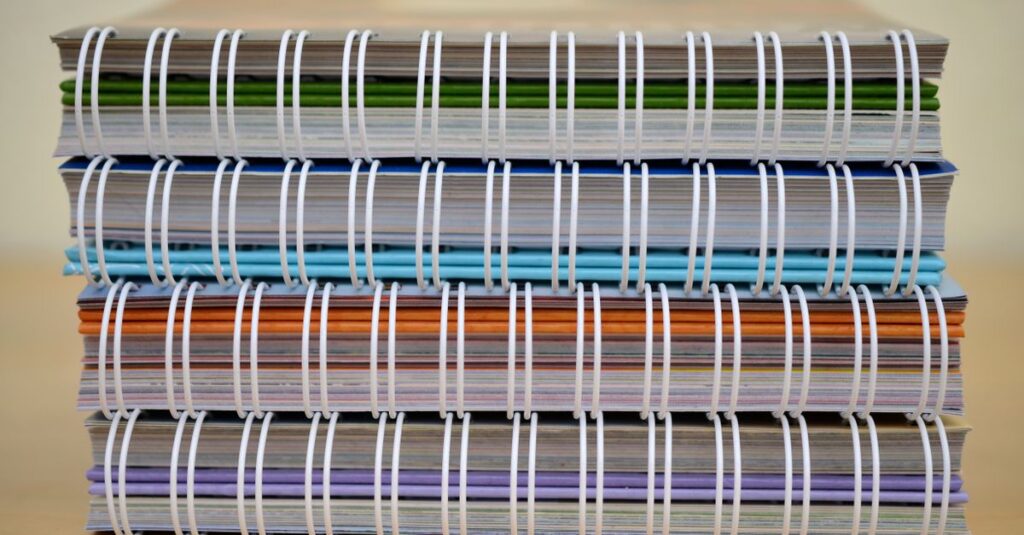
Right? That’s the difference. A printer applies ink. A manufacturer engineers a product. A manufacturer knows that 54 GSM paper is the sweet spot between opacity and affordability for school notebooks. They know that stitched binding is standard, but spiral binding is what you need for workbooks that lay flat. They think in terms of ruling types, page counts, and production runs of 30,000 units a day, not 300 sheets of A4. Which, when you think about it, is probably closer to what you actually need.
Expert Insight
I was on a call with a college procurement officer from Kerala last month — he’d been burned by a “printer.” He said something that stuck with me: “I don’t just need someone to make notebooks. I need someone to solve the problem of getting a thousand identical, durable learning tools into my students’ hands on August 1st, every single year, without me having to worry.” That’s it. That’s the whole job. It’s not about printing; it’s about dependable, scalable, intelligent production.
When “Near Me” Isn’t Actually The Point
This is the part nobody says out loud: proximity is often the least important factor.
Think about it. You’re ordering in bulk. A pallet of 10,000 notebooks. Does it matter if the factory is 50km away or 500km away if the logistics are handled professionally? Usually, the cost and headache saved by choosing an expert manufacturer far outweigh the “benefit” of being able to drive over and yell at someone. A reliable supplier with a solid export chain has shipping and freight down to a science. They can get your notebooks to a port, a distributor hub, or right to your school’s loading dock more efficiently than a local guy with a van.
I know a guy in Hyderabad — runs a stationery distribution business. He used to source from three different “local” presses to get all his sizes and types. Constant coordination headaches, inconsistent quality. He switched to working with a single, dedicated manufacturer (not us, a competitor, but the point stands). His inventory management became smoother. The quality was uniform. His customers stopped complaining. “Near me” became “right for me.” The freight cost was a line item, not a crisis. Which is how it should be. You want to check out a company’s background and capabilities more than you want to check their distance from your office.
What You Should Be Evaluating Instead
So, if “distance” goes out the window, what do you ask? Here’s what matters. Seriously, copy these down.
- Paper Specification: Don’t just ask for “good paper.” Ask for the GSM. For standard writing, 52-60 GSM is typical. For drawing books, 70+ GSM. If they can’t tell you immediately, hang up.
- Binding Capability: What do they offer? Stitched (standard), spiral (for workbooks), perfect binding (for thick diaries)? Your use case dictates this.
- Customization Depth: Can they print your logo? Your full-colour cover design? Custom page layouts? Or are they just swapping out the text on a template?
- Production Capacity: “Can you handle 50,000 units on a 30-day timeline?” Their answer tells you if they’re a shop or a factory.
- Sizing Knowledge: If you say “Long Notebook” or “Crown Size,” they should know the exact dimensions (27.2 cm × 17.1 cm, 23.6 cm × 17.3 cm). If they ask you to send a sample so they can measure it… run.
The goal here is to find a partner who speaks your language — the language of bulk orders, institutional supply, and branded merchandise. Not the guy who asks how many “copies” you need.
Comparison Table: Local Printer vs. Professional Notebook Manufacturer
| Factor | Local Print Shop | Notebook Manufacturer (like us) |
|---|---|---|
| Core Service | Printing documents, flyers, business cards. | Design, paper sourcing, printing, binding, finishing, and bulk logistics. |
| Paper Knowledge | Knows glossy vs. matte. May not understand GSM for writing. | Specifies exact GSM (e.g., 54 GSM writing paper), knows paper grain, sourcing. |
| Binding Options | Stapling, maybe simple spiral coils. | Stitched, spiral, perfect binding. Understands durability needs by product type. |
| Customization | Can print your logo on a template. | Full custom cover design, interior layout, private label/OEM manufacturing. |
| Order Scale | Hundreds to low thousands. May struggle or price poorly on bulk. | Built for bulk: 30k-40k notebooks/day. Competitive pricing scales with volume. |
| Supply Chain | Local pickup/delivery. Limited distribution. | Integrated logistics for pan-India and international export (Gulf, Africa, US, EU). |
| Ideal For | One-off promotional items, small office stationery. | Schools, corporations, wholesalers, government tenders, international buyers. |
See the difference? It’s not better or worse. It’s completely different jobs.
The Real-Life Process (What Actually Happens)
Let me walk you through what it looks like on this side of the fence. Say you’re a corporate manager ordering 2,000 branded diaries for the new year.
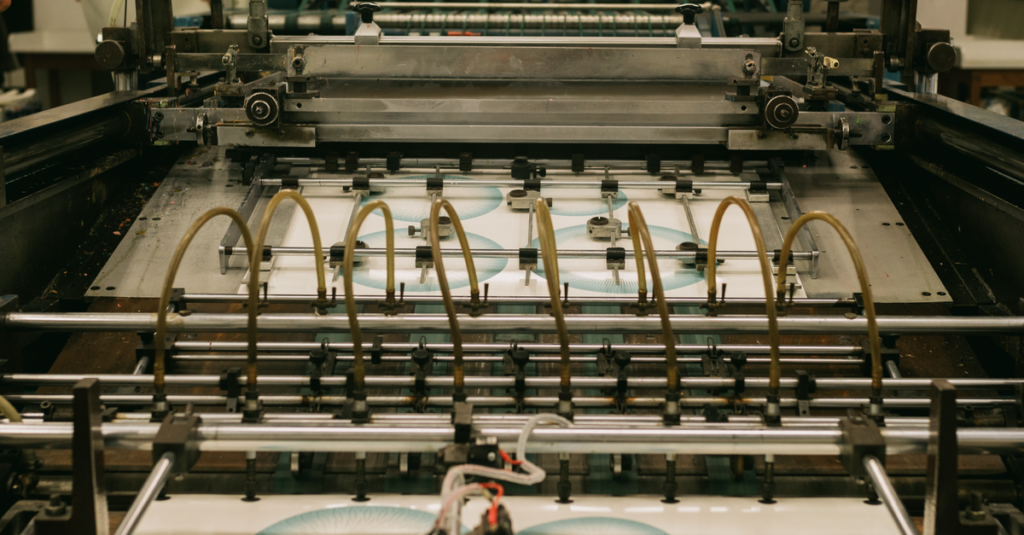
You send us your logo and maybe a design idea. We don’t just slap it on a cover. We talk about paper quality for the inside pages — maybe a thicker, cream-coloured paper for a premium feel. We decide on perfect binding because it lays flat and looks professional. We work on the interior layout: calendar pages, contact sections, maybe your company values printed on a divider page. We produce a sample. You approve it. Then, the machinery hums to life. The paper rolls are loaded. Printing, cutting, folding, gluing, stacking, boxing. It’s a symphony of industrial coordination. And then they’re packed, palletized, and shipped directly to your regional offices or a central warehouse.
You get one invoice. You deal with one point of contact. The problem is solved, start to finish. That’s manufacturing. That’s what you’re looking for when you type “printing press near to me” and feel frustrated. Because you sense, deep down, that your need is bigger than just printing.
Conclusion
I don’t think there’s one perfect supplier for everyone. Probably there isn’t. But if you’ve read this far, you already know your need is for production, not just printing. You’re figuring out if it’s okay to look beyond the “near me” search for someone who can actually handle the scale and specificity of what you do.
The short version? Stop searching for a printer. Start evaluating manufacturers. Ask the hard questions about paper, binding, and capacity. The right partner isn’t defined by their distance from you, but by their distance from understanding your problem. If you’re ready to have that kind of conversation about what can actually be manufactured, you’re already in a different league.
Frequently Asked Questions
What should I ask a printing press when ordering bulk notebooks?
Don’t just ask for a quote. Ask: “What GSM is your standard writing paper?” “What binding methods do you offer for 200+ page books?” “Can you do custom cover designs and interior layouts?” “What’s your daily production capacity?” Their answers separate a real manufacturer from a simple printer.
Is it better to find a printing press near me or use a distant manufacturer?
For bulk orders, distance is often irrelevant. A professional manufacturer has established shipping logistics. The savings in unit cost, quality, and reliability from a specialist usually far outweigh any minor local convenience. Focus on capability, not proximity.
What’s the difference between notebook printing and notebook manufacturing?
Printing is just one step. Manufacturing encompasses the entire process: sourcing the right paper, designing the cover and interior, printing, cutting, binding (stitched, spiral, perfect), and final packaging. A manufacturer builds the product; a printer only decorates part of it.
Can a local press handle a school’s order for 10,000 notebooks?
They might try, but they often lack the specialized binding equipment, bulk paper sourcing, and production line efficiency. This leads to higher costs per unit, longer delays, and potential quality issues. Dedicated notebook factories are built for this exact scale.
What does ‘private label notebook manufacturing’ mean?
It means the manufacturer produces the notebooks entirely for you, and you sell them under your own brand name. They handle everything — design (to your specs), production, quality control. You provide the branding, they provide the product. It’s a common need for distributors, wholesalers, and large institutions.