So, What The Hell Is A4 Paper Size?
Right. You’re probably staring at a procurement spreadsheet or a bulk order form for corporate diaries or school notebooks. And someone — maybe a designer, maybe a new school principal — has put “A4 size” in the spec column. And now you’re wondering: Is that the big one? The small one? What does it even mean for binding and paper costs?
Here’s the thing — A4 isn’t just a random number. It’s part of a whole system, a standard that makes everything from your office printer to the notebooks you order fit together. But in the notebook manufacturing world, it’s also a specific beast. The dimensions, the binding tolerance, the way it feels in a student’s backpack versus a manager’s briefcase. It all matters.
I’ve been making notebooks for over four decades at Sri Rama Notebooks. I’ve seen this question come from corporate buyers, school administrators, and international distributors. The confusion is real. And honestly? It’s costing people money and headaches on bulk orders when the size isn’t quite right. If you’re figuring out what A4 actually is and whether it’s what you need, this is probably worth a look.
It’s Not Just Numbers On A Page
Okay, let’s get the boring bit out of the way first. The official A4 paper size is 210 millimeters by 297 millimeters. In inches, that’s about 8.27″ by 11.69″. It’s the most common paper size in the world, outside of North America. You’ll find it in printers, copiers, and yes, notebooks.
But the real magic — and this is what most procurement sheets miss — is the A-series system. It’s based on a simple, kind of beautiful, mathematical ratio. The area of an A0 sheet is exactly one square meter. Fold it in half, you get A1. Fold that in half, A2. Keep going. A4 is that A0 sheet folded in half four times. This means every size in the series has the exact same proportions. Scale an A4 page up to A3, and nothing gets cropped or distorted. It just gets bigger. Perfectly.
This isn’t just trivia. It’s the reason A4 notebooks from different manufacturers should, in theory, stack neatly together. It’s why a page torn from an A4 pad can fit perfectly in an A4 binder. The system is designed for compatibility. The problem? In the real world of bulk manufacturing, “should” and “does” are two very different things.
Where You Actually See A4
Think about the last office you were in. The printer tray was almost certainly loaded with A4. Official documents, reports, letters — A4. But in notebooks, it gets more specific. A4 is the go-to for professionals who need space. Think lawyers with case notes, architects with sketches, university students with detailed lecture diagrams. It’s the workhorse size. Not as portable as an A5, but with enough real estate to actually get work done without feeling cramped.
I was talking to a procurement manager from a Hyderabad-based tech firm last month — over a very bad cup of office coffee, actually — and she said something that stuck with me. She said they switched to custom A4 notebooks for their developers because the smaller ones just led to scribbles in the margins and torn-out pages taped together. “It was a mess,” she said. “The A4 pad gave them the canvas. The mess became diagrams.”
That’s the shift. A4 isn’t chosen because it’s the default. It’s chosen because the work demands room to breathe.
A4 vs. The Rest Of The Notebook World
This is where it gets practical for anyone placing an order. You see “A4” on one list and “Long Book” or “Account Book” on another from a manufacturer. They’re not the same. Not even close. And confusing them is the fastest way to get 5,000 notebooks that don’t fit your branded slipcases.
Look, I’ll be direct. The Indian notebook market, where we operate, has its own traditional sizing alongside the ISO A-series. A “Long Notebook” for us is typically 27.2 cm x 17.1 cm. That’s taller and narrower than A4. An “Account Notebook” is often 33.9 cm x 21 cm — that’s bigger than A4. These sizes evolved for specific uses in schools and ledgers long before international standards came in.
So when you’re sourcing, you need to be precise. Are you asking for the international standard A4, or are you asking for a size that’s locally called something else but happens to be close? The difference of a few millimeters might seem trivial until you’re trying to bind 200 pages and the cover cutter is set for the wrong dimension. The whole batch is off.
| Specification | A4 Notebook (ISO Standard) | Common Indian “Long” Notebook |
|---|---|---|
| Dimensions | 210 mm x 297 mm (8.27″ x 11.69″) | 272 mm x 171 mm (10.7″ x 6.7″) |
| Primary Use | Official docs, professional notes, reports, university work | School essays, general note-taking, homework |
| Proportions | √2:1 ratio (standardized, scales perfectly) | Taller & narrower format (traditional) |
| Binding Consideration | Perfect for spiral, perfect, or stitched binding on side or top. | Often side-stitched; top-binding less common. |
| International Recognition | Global standard. Expected by corporate/international buyers. | Primarily regional. May confuse export clients. |
| Paper Optimization | Cuts from standard paper reams with minimal waste in ISO system. | May require custom paper sheet sizes, affecting cost. |
The table makes it obvious. Ordering “A4” when you need the local long book size means you get the wrong product. It’s a headache, honestly, and one I see far too often with new clients.
What Happens When You Order A4 Notebooks In Bulk
Let’s pull back the curtain on the factory floor for a second. You send a PO for 10,000 custom A4 notebooks with a client logo. What does that actually mean for us?
First, the paper. We’re not grabbing pre-cut A4 sheets off a shelf. We’re ordering large parent reels or sheets of paper — often much bigger — and cutting them down to that exact 210×297 mm spec. The cutter has to be calibrated to a razor’s edge. A half-millimeter drift across 10,000 sheets is a mountain of misaligned paper. The GSM (grams per square meter) matters too. Standard writing paper is around 54-70 GSM for A4 notebooks. Thicker for premium diaries, thinner for cheap pads. That weight affects everything from shipping costs to how the pen feels on the page.
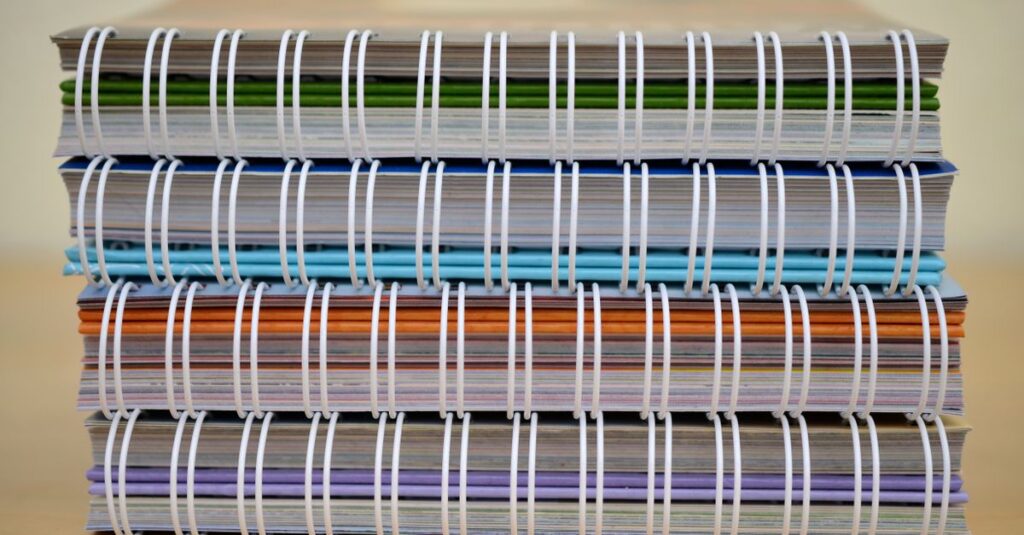
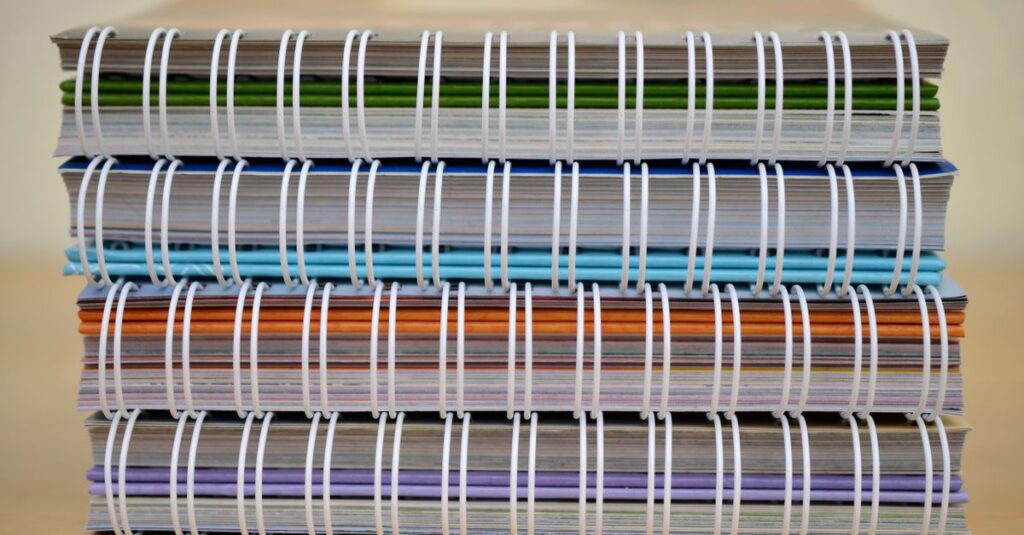
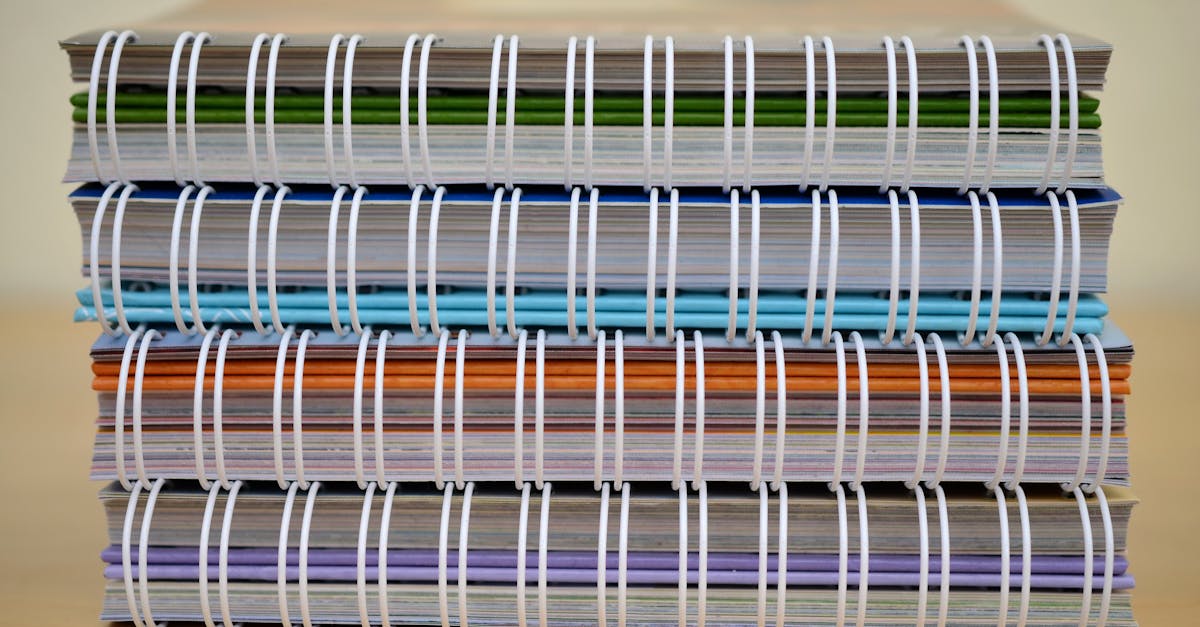
Then, binding. A4 is versatile. You can spiral bind it on the left for lay-flat convenience. You can perfect bind it (that glued spine you see on paperback books) for a sleek, corporate look. Or you can stitch it for durability. But each choice has a cost and a feel. Spiral binding adds to the width. Perfect binding needs a strong, flexible glue. Stitching needs margin space so the holes don’t eat into the text.
And the cover. An A4 cover isn’t just a bigger piece of card. It has to be scored and folded precisely to wrap that specific block of pages. Get the spine width wrong by even 2mm because the paper is thicker than spec’d, and the cover either strains or gapes. I’ve seen it. It looks sloppy. It feels cheap.
This is the part nobody says out loud: a good bulk A4 notebook order is a negotiation between your ideal spec and manufacturing reality. The perfect 100 GSM paper might not be available in time. The chosen binding might not work with your crazy 320-page count. A good manufacturer doesn’t just say yes. They tell you the trade-offs. That’s where experience in printing services actually matters more than a cheap price quote.
Expert Insight
I was reading an old industry journal last month, something about global paper standards, and one line stuck with me. It said something like, “The A4 format succeeded not because it was perfect, but because it was perfectly predictable.” I think about that a lot on the production line. In a world of custom requests and unique branding, that predictable 210×297 mm rectangle is an anchor. It means our cutters, binders, and wrappers can be set with a known constant. It lets us focus on making the notebook *better* — better paper feel, sharper print, tighter binding — instead of wrestling with an unpredictable size. The constraint, weirdly, is what allows for quality. I don’t have a cleaner way to put it than that.
The Real Cost of Getting It Wrong
Imagine this. You’re a stationery distributor in Dubai. You order 5,000 “A4” notebooks from a new supplier for a corporate client. The notebooks arrive. They look fine. But when the client tries to put them in the branded A4 leather folios they already bought? Too tight. Or the holes don’t line up with their standard A4 ring binders. Suddenly, you’re not delivering a product. You’re delivering a problem. A logistical, annoying, relationship-straining problem.
The cost isn’t just in returns or refunds. It’s in trust. Schools ordering in bulk for a new academic year run on tight timelines. If the notebooks don’t fit the desk shelves they have, or are too big for the younger kids’ bags, it’s chaos. Corporate clients giving branded notebooks as gifts want them to feel premium and precise. A size that’s “almost” A4 feels careless.
In my experience working with government institutions and large corporates, this is the single biggest point of failure with new suppliers. They assume “A4” is a loose guideline. It’s not. It’s a hard specification. Tolerances exist, of course — a millimeter here or there for cutting and swelling. But beyond that, it’s wrong. And in bulk, wrong multiplies.
Which is why the cheapest quote is often the most expensive choice. The supplier cutting corners is probably also being sloppy with the one thing that should be non-negotiable: the actual dimensions. You get what you pay for. Usually less.
So, Is A4 What You Actually Need?
Three questions to ask before you put “A4” on your next purchase order:
- Is it for portability or permanence? A4 is for the desk, the meeting room table, the study. It’s not a pocket notebook. If people need to carry it all day, every day, A5 might be the real answer.
- What’s going inside it? Are we talking bullet points and meeting notes? Or technical drawings, financial charts, and code architecture? The content dictates the canvas. Sketches and diagrams scream for A4. Quick memos don’t.
- Does it need to “fit” into an existing system? This is the big one. Are you replacing an old notebook that was actually a different size? Are these going into A4 binders, folios, or shelves? This isn’t just about the notebook. It’s about the ecosystem it lives in.
Answer those, and the size often picks itself. The goal isn’t to just buy A4 notebooks. The goal is to buy the right tool for the job. Sometimes that’s A4. Sometimes it’s something else entirely. And figuring that out before you order 20,000 units is the only smart move. Seeing the full range of products can help clarify what “right” actually looks like for your specific case.
Frequently Asked Questions
Is A4 the same as Letter size?
No, it’s not. This is a huge point of confusion, especially with US buyers. North American Letter size is 8.5″ x 11″. A4 is 8.27″ x 11.69″. A4 is slightly narrower and taller. They are not interchangeable in binders or folders. If you’re exporting notebooks, you must confirm which standard your client uses.
What is the most common page count for an A4 notebook?
It depends on the use. For standard corporate notepads, 96 or 120 pages is common. For student or project notebooks, you’ll see 200 or 240 pages. We manufacture A4 notebooks from 52 pages all the way up to 700 pages for heavy-duty record-keeping. The binding type has to support the page count — a thin glue won’t hold 700 pages.
Can A4 notebooks be spiral bound?
Absolutely. Spiral binding (or wire-o binding) is very popular for A4 because it allows the book to lay completely flat, which is great for sketching or writing across the gutter. The key is using a sturdy spiral coil and punching the holes accurately so the pages turn smoothly without tearing.
What paper GSM is best for A4 notebooks?
For general writing, 70-80 GSM paper gives a good, opaque feel without being too heavy. For budget school notebooks, 54-60 GSM is common. For premium corporate diaries, 90-100 GSM adds that substantial, quality feel. Thinner paper risks ink bleed-through; thicker paper makes the book bulky and expensive.
Do you manufacture custom A4 notebooks with logos?
Yes, that’s a core part of our business. We do full private label and custom notebook manufacturing. You can choose the A4 dimensions, cover design (with your logo), paper quality, ruling type (single ruled, unruled, grid, etc.), binding, and page count. We handle everything from design to production for bulk orders.
Look, It Comes Down To This
A4 paper size isn’t a mystery. It’s a specific, measurable, international standard. 210 by 297. But knowing the numbers is the easy part. The hard part is understanding what that size means for binding, for paper, for use, and for cost when you’re ordering in the thousands.
Earlier I said the system was designed for compatibility. That’s true. But the real world of bulk manufacturing adds layers — tolerance, material behavior, binding physics. A good supplier navigates those layers for you. A bad one just cuts paper and hopes for the best.
I don’t think there’s one perfect notebook for everyone. Probably there isn’t. But if you’ve read this far, you’re not just looking for dimensions. You’re looking for a reliable product that fits a real need, on schedule, and at a scale that makes sense. That’s the actual job. And getting the size right is the non-negotiable first step. If you’re at that step, it might be time for a direct conversation.