Let’s just get this out of the way. You’ve probably ordered them by the pallet. Or spent hours staring at a supplier’s catalogue, trying to figure out the difference between a ‘long book’ and an ‘account book’. You know what an exercise book is — at least, you think you do. It’s a notebook. For school. Right?
But then you get a quote from a manufacturer and the specs talk about GSM, ruling types, and stitch binding, and suddenly it doesn’t seem so simple. Is it just a stationery item, or is it a specific product with its own rules? The confusion is real, especially when you’re the one responsible for buying 5,000 of them for the upcoming school year or 500 branded ones for your corporate training program. The term gets thrown around loosely, and that’s where mistakes happen. Mistakes that cost money, time, and frankly, a lot of headaches.
I’ve been in this business for over four decades at Sri Rama Notebooks, and I’ve seen this exact confusion play out a thousand times. So let’s cut through the noise. This isn’t about fancy marketing. It’s about knowing exactly what you’re buying so you don’t get a shipment of the wrong thing. If you’ve ever wondered what the fuss is about, this might save you a lot of trouble.
What an Exercise Book Actually Is (And Isn’t)
Okay, definition time. An exercise book is a bound notebook, almost always stitched or stapled, with ruled pages, designed specifically for writing, practice, and work. It’s not a fancy journal. It’s not a sketchpad. It’s a workhorse.
Think about its DNA: it’s utilitarian. The paper is a specific weight — usually around 54 to 60 GSM — thick enough to handle a ballpoint pen without bleeding through, but not so expensive that it becomes a luxury item. The ruling is there for a reason: to guide handwriting. Single ruled for essays, four-ruled for early learners, squared for math. The cover is often a simple, durable card. It’s built to be used up, filled, and replaced.
And this is the part most people miss: the term ‘exercise book’ implies a standard. It’s why a school can issue a supply list saying “5 Single Ruled Exercise Books” and parents know roughly what to buy. It’s a category, not just a random notebook.
I was talking to a procurement manager for a chain of private schools last month — over a very rushed phone call, if I’m being honest — and she said something that stuck. “We don’t order ‘notebooks’. We order ‘exercise books’. The first term gets us fancy options with embossed covers. The second gets us the 92-page workbooks we actually need.” She wasn’t buying a product; she was buying a function.
The Unspoken Anatomy of a Proper Exercise Book
Let’s break it down like you’re looking at a spec sheet, because you probably are. What are you really paying for?
- The Paper: This is the soul of the thing. That 54 GSM writing paper isn’t chosen at random. It’s the sweet spot. Thinner, and the ink ghosts through. Thicker, and you’re paying for premium paper you don’t need for daily practice. It needs to have a certain tooth — a slight texture — so a pencil or pen grips it. Smooth, coated paper? That’s for annual reports, not for a student solving algebra problems.
- The Ruling: This is where intent gets printed onto the page. Single Ruled (SR) for general notes. Double Ruled (DR) or Four Ruled (FR) to teach letter proportions. Cross Ruled (CR) or graph for diagrams and calculations. The color of the ruling matters too – a light blue or grey that guides the eye without competing with the user’s writing.
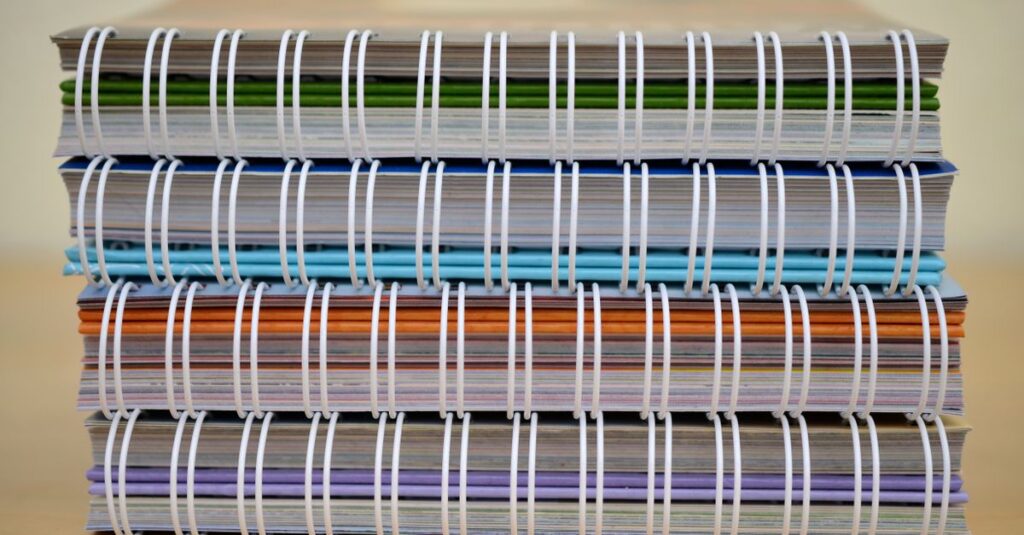
- The Binding: Stitched binding is the gold standard. It means the folded sections (signatures) of pages are sewn together through the spine, then glued. A spiral binding is a different beast — it’s an exercise book, technically, but it falls into a different category for bulk buyers because of how it’s used (and how it jams in a school bag). Stitched binding lies flat, lasts longer, and feels… substantial.
- The Cover: It’s a protector. A 250 GSM card cover, often with a light laminate. It’s not about being pretty; it’s about surviving a semester in a backpack. The front might have a printed margin for a student’s name, class, and subject. Function, function, function.
When these four elements come together correctly, you don’t notice the book. You just use it. And that’s the goal.
Expert Insight
I remember reading an old industry journal piece years ago. The writer, a factory foreman from way back, said something I’ve never forgotten. He called the exercise book “the most democratized tool for thought ever mass-produced.” It wasn’t hyperbole. He meant that its entire design philosophy is about removing barriers — cost, complexity, fragility — so the focus can be on the work happening inside it. A luxury notebook can feel intimidating. An exercise book invites you to fill it. That’s a tiny bit of genius in something we take for granted.
The Real Cost of Getting It Wrong (It’s Not Just Money)
So what happens when a batch isn’t up to spec? When the paper is too thin and you can see page 3 from page 1? Or when the stitching comes loose after a week?
The financial loss is obvious. You’re stuck with pallets of useless stock. But the real cost is trust. If you’re a school administrator and you hand out substandard books, parents notice. Teachers complain. If you’re a corporate buyer and the branded notebooks you give to new hires fall apart, it sends a message about your company’s attention to detail. A cheap, flimsy exercise book screams “we didn’t care enough to get this right.”
Take this example. A distributor we work with once bought a large shipment from a cut-rate manufacturer. The price was fantastic. The books looked fine on the surface. But the paper was around 45 GSM — it felt like tissue. When the books hit the shelves at local stationers, the returns started immediately. Teachers were furious. The distributor’s reputation in that region took years to rebuild. They saved 10% on the unit cost and lost 30% in future business. A headache, honestly.
The question isn’t whether you can find a cheaper book. It’s whether you can afford what comes with it.
Custom Exercise Books: When Standard Isn’t Enough
This is where it gets interesting. The basic exercise book is a masterpiece of standardization. But what if you need to own it?
Private label exercise books are a huge part of what we do. A coaching institute wants its logo and contact details on the cover. A corporation wants a specific shade of blue and its values printed on the inside front cover for an employee onboarding kit. A university wants a special graph ruling for its engineering students.
This isn’t just slapping a logo on a stock item. It’s tailoring the standard to fit a specific need. The anatomy we talked about stays the same — the quality paper, the durable binding — but the identity changes. It becomes a branded tool. A touchpoint.
The process, at least for us, starts with a conversation. What’s the primary use? Who’s using it? What do you want them to feel when they open it? That last part sounds fluffy, but it’s not. A well-made, custom exercise book feels considered. It says, “The work you do here matters.” For a business, that’s a subtle but powerful bit of communication. If you’re curious about how that process looks, our approach is pretty straightforward.
| Feature | Standard Stock Exercise Book | Custom/Branded Exercise Book |
|---|---|---|
| Primary Purpose | General use, cost-effective bulk supply | Brand reinforcement, tailored functionality |
| Cover Design | Pre-printed generic design (margins, patterns) | Fully customized with logo, colors, and messaging |
| Lead Time | Immediate or very short (from existing inventory) | Longer (for design approval, plate making, production run) |
| Minimum Order Quantity (MOQ) | Lower, often a single carton (e.g., 100 books) | Higher, due to setup costs (typically 1000+ units) |
| Cost Per Unit | Lower (economies of standardized scale) | Higher (includes design, setup, and exclusive materials) |
| Flexibility | Fixed specs (size, ruling, page count) | High (can mix page rulings, add custom sections, special paper) |
| Best For | Schools, general retail, anonymous bulk distribution | Corporate gifting, institutional branding, specialized training |
Buying in Bulk: The Pitfalls Only Pros Know
If you’re reading this, you’re probably not buying one exercise book. You’re buying a thousand. Or ten thousand. The dynamics change completely.
First pitfall: focusing only on unit price. It’s the easiest trap to fall into. But a cheaper book might have fewer pages, or use weaker binding, or have inconsistent ruling alignment. You need to calculate cost per usable page per student per term. A slightly more expensive, robust 92-page book that lasts is almost always cheaper than two flimsy 52-page books that need replacing.
Second: logistics. Where is the factory? A great price from a manufacturer on the other side of the country can be wiped out by freight costs. Consistency of supply is another thing. Can they handle a 50,000-book order and deliver it in four consistent batches over the academic year? Or will the color of the card stock change with batch two?
Third — and this is the big one — quality assurance on a massive scale. You can’t check every book in a shipment of 20,000. You need to trust the manufacturer’s process. Do they have checkpoints? How do they handle a defective signature before it gets bound? I think the most important question you can ask a potential supplier isn’t about price. It’s “Walk me through how you catch a mistake.” Their answer tells you everything.
Look, I’ll be direct. The market is flooded with options. The difference between a good bulk buy and a terrible one isn’t always visible in a sample. It’s in the thousandth book on the pallet, which is just as good as the first.
So, What Should You Do Next?
I don’t have a magic checklist that guarantees perfection. The exercise book is a simple thing made incredibly complex by scale and expectation.
But start here. Know what you’re really asking for. Be specific: “Single Ruled, 92-page, Stitched Binding, 54 GSM white paper, 250 GSM laminated cover.” That’s not being difficult; it’s being professional. It aligns everyone.
Understand the trade-offs. Between price and durability. Between speed and customization. Between a distant supplier with a great website and a local manufacturer you can visit.
And maybe, just maybe, think about the exercise book not as a commodity, but as the primary tool for the work you’re enabling. Whether that’s educating a classroom, training a new team, or building a brand. It’s the silent partner in the process.
The right one disappears. The wrong one becomes the whole story. If you’re figuring out which one you’re about to order, sometimes it helps to talk to people who’ve made nothing else for 40 years.
Frequently Asked Questions
What’s the difference between an exercise book and a notebook?
An exercise book is a specific type of notebook. All exercise books are notebooks, but not all notebooks are exercise books. Think of it like squares and rectangles. An exercise book is defined by its purpose (writing practice, work), standard ruled pages, durable but simple binding (usually stitched), and a utilitarian cover. A ‘notebook’ is a broader category that includes fancy journals, sketchbooks, and bullet journals with dotted paper.
What GSM paper is best for school exercise books?
For most school writing purposes, 54 to 60 GSM paper is the industry standard and the sweet spot. It’s thick enough to prevent ink bleed-through from pens and provide a good writing feel, but economical enough for mass production and purchase. Lighter paper (below 50 GSM) feels flimsy and shows writing from the other side. Heavier paper is more expensive and often unnecessary for daily exercises.
What does ‘stitched binding’ mean for an exercise book?
It means the inner pages are folded into sections (called signatures), which are then sewn together with thread along the spine before the cover is glued on. This is different from simple stapling or ‘saddle stitching’. It’s far more durable, allows the book to lie perfectly flat, and is the mark of a quality exercise book meant for heavy, daily use. It’s what prevents pages from falling out.
Can I get exercise books with my company logo on them?
Absolutely. This is called private label or custom notebook manufacturing. You can customize the cover with your logo, colors, and text, and even specify internal page layouts. Minimum order quantities apply (often starting at 1000 units) because of the setup required for printing your unique design. It’s a great tool for corporate gifting, training programs, or brand building.
What’s the typical lead time for a bulk order of exercise books?
For standard, stock exercise books from a manufacturer’s existing catalogue, lead time can be as short as 7-14 days, depending on quantity and your location. For fully custom exercise books with your own design, expect 4-6 weeks. This includes time for design approval, plate making, production, and quality checks. Always confirm this before placing an order, especially for time-sensitive projects like school year starts.