You Probably Use Them Every Day, But Let’s Be Honest, You Have Questions
Look, I’ve been in this business for a while now. And you know the one thing I keep hearing from procurement managers and school principals? They’re ordering thousands of notebooks every year, but when I ask about the specifics, they hesitate.
“A4? Sure, that’s the standard one,” they say. But then they pause. “Wait, is that the long one? Or the one we get for the account books?”
This isn’t a small detail. If you’re ordering in bulk for an entire school, a corporate training batch, or for government forms, getting the size wrong means wasted money, logistics headaches, and a whole lot of annoyed end-users. The difference of a few centimeters changes everything about a notebook’s purpose.
The real question isn’t just “what is an A4 notebook?” It’s this: Is it the right tool for your specific job, or are you just ordering it because everyone else does? If you’re looking at options, here’s a breakdown of what we actually manufacture.
So, What Actually Is A4 Paper Size? (The Simple Math)
Alright, let’s cut through the noise. A4 is an international standard paper size, part of the ISO 216 system. That’s the boring bit. Here’s what you actually need to know: it measures 210 mm by 297 mm. In the inches and centimeters you see on purchase orders, that’s roughly 8.27 inches by 11.7 inches.
Why this specific, slightly odd size? The entire A-series is genius in its geometry. Fold an A4 sheet in half widthwise, and you get an A5 sheet. Double an A4, you get A3. It’s a perfectly scalable system. That’s why it’s used everywhere from Europe to Asia—it just works for printing, copying, and filing.
Now, here’s the part that trips people up in India. We have our own traditional names: “Long Notebook,” “Short Notebook,” “King Size.” An A4 notebook is closest to what many Indian manufacturers call a “Long Notebook” (27.2 x 17.1 cm) but it’s not an exact match. The A4 is a bit narrower and a bit taller. It’s a global fit, not a local one.
That mismatch is why importers and exporters get specific. If you’re supplying notebooks to the Gulf, Europe, or Australia, they’ll ask for A4. Not “long book.” A4.
What Happens When You Get the Size Wrong? A Micro-Story.
Let me tell you about Priya. She’s a procurement manager for a chain of private schools in Hyderabad, been doing it for eight years. Last quarter, she ordered 5,000 “standard notebooks” for senior classes from a new supplier. The sample looked fine.
The shipment arrived. The books were slightly, infuriatingly smaller than the existing stock. Not a lot. Maybe a centimeter. But it meant the older textbook covers the school had bought in bulk didn’t fit. The pockets in the student desks were too tight. The teachers complained the ruling was off. It was a cascade of tiny, expensive annoyances.
Priya’s story isn’t unique. It’s a Tuesday problem. The real cost wasn’t just the notebooks; it was the time, the hassle, the reputation hit. All over a few millimeters no one thought to specify.
Expert Insight
I was talking to a designer for an international education publisher last year. We were having coffee, and he said something that stuck. “We design every workbook and textbook page for A4. It’s the canvas. If a school uses a different size notebook, the student can’t paste the activity sheet properly, the margins are wrong for notes… the entire learning material ecosystem breaks.” He wasn’t being dramatic. The more standardized education gets, the more the physical page size matters. It’s infrastructure.
The A4 Notebook vs. The Indian “Long Notebook” – A Side-by-Side
Don’t just take my word for it. Here’s where the rubber meets the road. If you’re deciding between ordering A4 for international compliance or the traditional Long Notebook for the local market, this table shows you exactly what you’re working with.
| Feature | A4 Notebook (ISO Standard) | Traditional Indian Long Notebook |
|---|---|---|
| Standard Dimensions | 210 mm x 297 mm (8.27″ x 11.7″) | ~272 mm x 171 mm (10.7″ x 6.7″) |
| Primary Use Case | International projects, corporate reports, official documentation, standardized educational materials. | Everyday school notes, local market wholesale, general-purpose writing. |
| Paper & Ruling | Often 70-80 GSM for quality, suited for pen & pencil. Ruling (SR, DR) aligns with international styles. | Typically 54-60 GSM for cost-efficiency. Ruling follows local CBSE or state board patterns. |
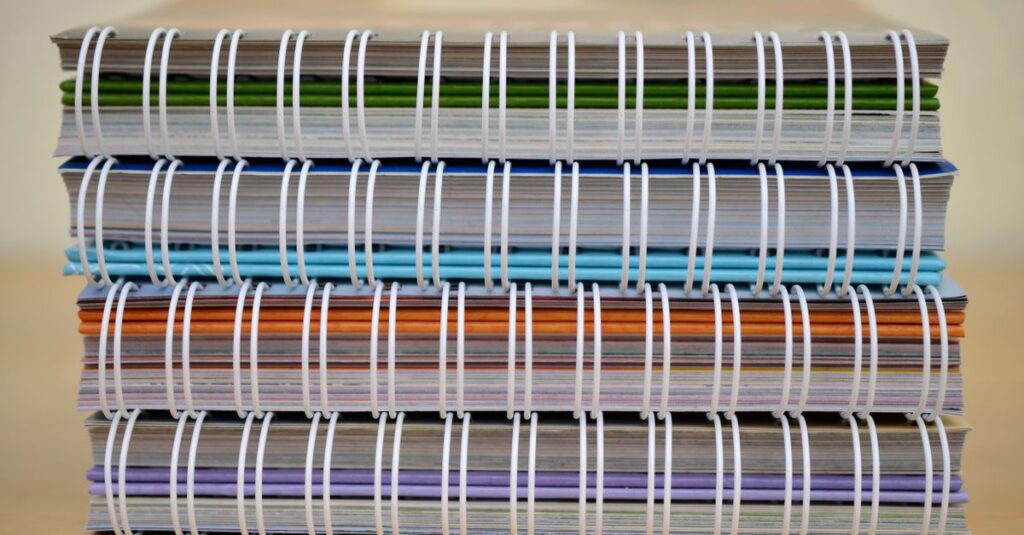
| Binding Style | Spiral binding is very common for lay-flat use. Also perfect binding for a sleek look. | Stitched side-binding is the classic, durable norm. Spiral is an upgrade. |
| Key Buyer | Exporters, MNCs, universities with international curriculums, government tenders with ISO specs. | Local schools, colleges, distributors, retail stationery shops across India. |
| My Recommendation | If your end-user expects a global standard, or you’re printing materials designed for A4, don’t compromise. This is the one. | For cost-sensitive, high-volume supply to the domestic Indian market, this is the workhorse. It’s what the system is built on. |
See? It’s not that one is better. It’s that they’re tools for different jobs. Ordering the wrong one is like using a screwdriver to hammer a nail.
When Should You Absolutely Choose an A4 Notebook?
Let’s get practical. Based on the thousands of bulk orders we’ve handled at Sri Rama, here are the situations where A4 isn’t just an option, it’s the only option.
First: Corporate Branding and Reports. This is probably the biggest one. An A4 notebook with a company logo embossed on the cover? It looks professional. It feels substantial. It fits perfectly in standard conference folders and executive briefcases. When a manager is presenting to international clients, an A4 notepad aligns with the A4 printouts and proposals. It signals a certain level of detail. For corporate diaries and custom printed notebooks, A4 is the default for a reason.
Second: Schools Following International Curriculums (IGCSE, IB, etc.). Their textbooks, workbooks, and exam papers are all set to A4. Asking a student to use a different size notebook creates a ridiculous, daily friction. The pages don’t align, handouts don’t fit for pasting, it’s a mess. For these institutions, bulk ordering A4 notebooks is a non-negotiable part of their supply list.
Third: Government and Institutional Documentation. A lot of official forms, tender documents, and standardized report sheets are designed for A4. Using an A4 notebook as a companion log or record book means everything can be filed together neatly. No folding, no awkward trimming. It’s about creating a seamless paper trail, which matters more than you’d think in administrative work. We see this a lot with our custom printing for institutions.
And fourth, the one people forget: Artists, Designers, and Architects. That extra height on the A4 (compared to a wider Long book) is perfect for sketching concepts, vertical diagrams, and preliminary drafts. It’s a more versatile canvas for visual work.
How to Order A4 Notebooks in Bulk Without the Headache
Right. So you’ve decided you need A4 notebooks. Great. Now comes the real test: getting exactly what you asked for, on time, and at a price that makes sense for your budget. This is where most bulk deals go sideways.
Here’s what I tell every procurement manager or business owner who calls us:
- Specify, Specify, Specify. Don’t just say “A4.” In your quote request, list it all: Dimensions (210×297 mm). Paper GSM (Do you want standard 54 GSM for writing, or thicker 70+ GSM for markers?). Binding (Spiral for lay-flat, or stitched for durability?). Cover type (Hardbound, soft laminated?). Page count (92 pages? 200?). Ruling (Single Ruled, Unruled, Cross?). This isn’t being picky; it’s being a professional buyer.
- Ask for a Dummy. Any reputable manufacturer will make a physical sample—a “dummy”—before running your full order. Insist on it. Hold it. Write in it. Try to tear a page. This is your only chance to catch a mistake before it costs you thousands.
- Understand the Lead Time. Custom printing and binding takes time. A simple A4 notebook might have a 15-day production window. A complex custom-printed cover with specific branding? That could be 30 days. Factor this into your planning, especially for academic or corporate calendar year starts.
And honestly? The cheapest quote is almost always the most expensive choice. I’ve seen it a hundred times. A lower GSM paper means bleed-through and a flimsy feel. Weak binding leads to pages falling out in a month. It reflects poorly on you, the buyer.
The goal isn’t to buy the cheapest notebook. It’s to buy the notebook that disappears—the one that does its job so well that no one ever complains about it. That’s where the real value is.
Frequently Asked Questions
Is A4 the same as a Legal Size pad?
No, they’re different. Legal size is longer (8.5″ x 14″). A4 is shorter and wider (8.27″ x 11.7″). They won’t fit in the same folders. This mix-up is common with US-based companies ordering for Indian offices.
What is the best paper quality (GSM) for an A4 notebook?
It depends on use. For everyday writing with pens, 70-80 GSM is excellent—no ghosting. For bulk school orders where cost matters, 54-60 GSM is standard and works fine for pencils and ball pens. For artists or premium corporate gifts, go 90 GSM or higher.
Can I get custom logos printed on A4 notebooks?
Absolutely. This is one of the most common requests. We do hot foil stamping, embossing, or digital printing of logos on the cover. You can even customize the header on each page. It’s a great branding tool for businesses.
What’s the minimum order quantity for custom A4 notebooks?
It varies by manufacturer. For us, for a standard custom print run, we usually start at 500 pieces. For fully bespoke designs with unique paper, it might be higher. It’s always best to just ask with your specs.
Which is more durable: spiral or stitched binding for A4?
For laying completely flat, spiral wins. For sheer durability against pages tearing out, a well-stitched side binding is incredibly tough. If the notebook will be thrown in bags and battered, I’d lean towards stitched. For desk use, spiral is more user-friendly.
Wrapping This Up
Look, at the end of the day, an A4 notebook is just a tool. But like any tool, its value comes from being exactly right for the task. It’s the global standard for a reason—it creates consistency in a world of chaotic paper sizes.
If you’re supplying an international market, or if your internal processes demand that consistency, then the A4 notebook isn’t a choice, it’s a requirement. The details—the GSM, the binding, the ruling—those are your choices. Get those right, and you solve a problem no one will ever notice, which is the mark of a good procurement job.
And if you’re still figuring out whether it’s the right fit for your organization, that’s okay. The question isn’t really about paper size. It’s about what your people actually need to do their work without friction. Start there. If you want to talk specifics, we’re always here.