Introduction
Here’s a weird thing about buying notebooks in bulk. You’ll hear “A4 size” a lot. And the person saying it is probably thinking about paper. But an A4 size notebook isn’t just a notebook made with A4 paper. It’s a specific, standardized thing. If you’re ordering thousands of units for a school or a corporate project, you need to know what that means. Because ‘A4’ sounds international, but the actual notebook you get depends on the manufacturer’s process, the binding, and frankly, their interpretation of the size. I’ve seen buyers get confused when the shipment arrives and the notebooks feel a little off. That’s usually because they ordered “A4 notebooks” without asking about the actual dimensions. Anyway. Let’s break this down. If you’re sourcing notebooks in bulk, this might be worth a look.
What Exactly Is an A4 Size Notebook?
It’s straightforward, but it’s also not. The A4 paper size is a global standard: 210 mm by 297 mm. That’s 8.27 inches by 11.69 inches. So an A4 notebook should, logically, use pages cut to that size. But here’s where it gets messy. In notebook manufacturing, the finished product—the bound book—is often slightly smaller than the raw page size. The binding process trims edges. The cover adds bulk. So when you’re talking to a manufacturer, you need to clarify: are you talking about the page size or the finished book size? Most of the time, in the industry, “A4 notebook” means the pages are A4, and the final bound notebook is close to that. But “close” can vary by a few millimeters. Which, when you’re stacking hundreds of them in a warehouse, matters.
The A4 Standard: More Than Just Paper
The A series paper sizes (A0, A1, A2, A3, A4, A5) are part of the ISO 216 standard. They’re used everywhere—Europe, Asia, most of the world except North America. The beauty of the system is its ratio. Each size halves the previous one’s area. So A4 is half of A3. That makes it predictable for scaling designs, printing, and binding. For a notebook, this consistency is gold. It means your custom logo or pre-printed content scales perfectly from, say, an A4 corporate diary to an A5 pocket diary. But most procurement managers don’t think about that ratio. They just want the notebook to fit their briefs and folders. Which it does. An A4 notebook fits standard A4 folders and filing systems. That’s probably the biggest reason businesses love it.
Real-Life Micro-Story
I spoke to a procurement manager from a university in Hyderabad last month. Priya, 38. She was ordering 5,000 custom notebooks for a new academic program. She specified “A4 size” in her tender. Three manufacturers bid. One quoted for a notebook with a finished size of 208x295mm. Another quoted for 210x297mm pages but a bound size of 205x292mm. The third just said “A4” and didn’t clarify. Priya went with the second supplier because they explained the trim loss. The notebooks arrived perfect. The others? One batch didn’t fit the university’s standard file covers. The third batch was all wrong—they’d used a local “royal size” paper and called it A4. She had to return them. It was a Tuesday, I think. Maybe Wednesday. She was on her third coffee of the day, no food since lunch, dealing with the logistics mess.
How A4 Notebooks Are Made (And Why Binding Matters)
The process starts with the paper. Large sheets are printed, then cut down to A4 dimensions. This is where the GSM (grams per square meter) of the paper comes in. For a standard writing notebook, you’d use around 54-60 GSM paper. It’s smooth, takes ink well, doesn’t feel flimsy. Then the pages are collated—52 pages, 92, 200, whatever you need. The ruling gets printed: single ruled, double ruled, unruled. Then binding. And the binding type changes the final product more than you might think.
- Stitched Binding: Classic, durable. Pages are stitched together through the spine, then glued into a cover. This method allows for a very square, clean edge. The trim loss is minimal. The finished notebook is very close to the A4 page size.
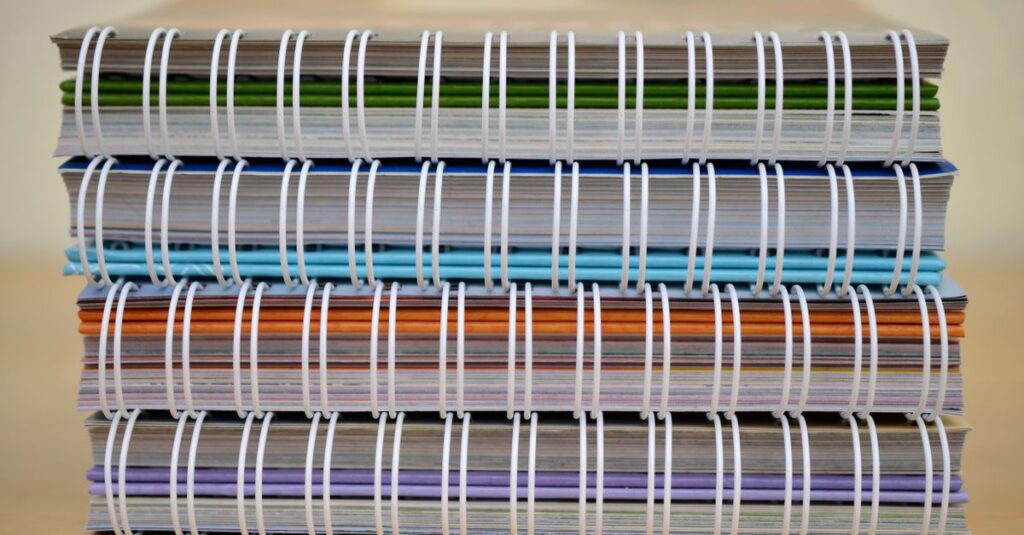
- Spiral Binding: A metal or plastic coil runs through holes punched along the edge. This requires a margin for the holes, so the usable page area is slightly less than the full A4 sheet. The overall dimensions of the book can be a bit larger because of the coil protruding.
- Perfect Binding: Like a paperback book. Pages are glued at the spine. It looks sleek, but the glue adds thickness at the spine, and the edges are trimmed aggressively. The final book can be a few millimeters smaller on all sides.
So when you’re ordering, you’re not just ordering an A4 notebook. You’re ordering an A4 notebook with a specific binding that determines its final fit and feel. Most good manufacturers will walk you through this choice.
Expert Insight
I was reading something last month from a paper engineer, and one line stuck with me. He said something like—the tolerance for “A4” in commercial production is +/- 2mm. That’s the standard allowance. But in notebook binding, especially with stitched or perfect binding, you can lose another 1-3mm on each side from trimming and glue. So your “A4” notebook might actually be 207x294mm. And that’s still considered A4. I don’t have a cleaner way to put it than that. It’s not cheating. It’s just how manufacturing works. If you need exact 210x297mm, you have to specify “untrimmed pages” or a special binding—which is rare and more expensive. Most people don’t need that precision. They just need it to fit in an A4 folder. Which it will.
A4 Notebooks vs. Other Common Sizes
This is where a comparison table helps. Let’s look at A4 against other popular notebook sizes we manufacture, like Long Notebook and Short Notebook.
| Feature | A4 Size Notebook | Long Notebook (Common in India) | Short Notebook (Common in India) |
|---|---|---|---|
| Standard Dimensions | 210 x 297 mm (8.27 x 11.69 in) | 272 x 171 mm | 195 x 155 mm |
| Primary Use | Official documents, corporate work, university projects, international correspondence | School notebooks, general writing, Indian academic standard | School notebooks (younger students), pocket notes, quick calculations |
| Binding Compatibility | Excellent for all types: stitched, spiral, perfect | Best for stitched binding | Works well with stitched and spiral |
| Paper Size Origin | ISO 216 International Standard | Regional Indian standard | Regional Indian standard |
| Fit with Folders | Fits international A4 folders and briefs | Fits Indian long book folders | Fits small folders and bags |
| Bulk Order Consideration | Preferred by multinationals, universities, export buyers | Preferred by Indian schools, local institutions | Preferred for primary schools, retail packs |
The thing about A4 is its universality. If you’re supplying notebooks to an international client, or a corporate office that uses standard filing, A4 is the only size that makes sense. The Long and Short notebooks are perfectly good—we make millions of them—but they’re regional. They don’t fit the global paper ecosystem. A4 does.
Who Uses A4 Notebooks and Why?
Three main groups. And they all have different reasons.
- Corporate Offices & Procurement Managers: For meeting notes, project logs, official documentation. A4 notebooks look professional, fit into the company’s A4 binder system, and can be custom-branded easily. The size signals a certain formality.
- Universities & Higher Education Institutions: For research notes, student submissions, lab books. Many international journals and submission formats require A4. So students and faculty get used to working on that size. Bulk orders for student kits often specify A4.
- Export Buyers & International Distributors: This is probably the biggest market for A4 notebooks from Indian manufacturers. The Gulf, Africa, Europe—they all use the ISO paper sizes. When an overseas wholesaler orders from India, they’re not asking for “Long Notebooks.” They’re asking for A4. Because that’s what sells in their market.
And then there’s a fourth, less obvious group: Designers and Architects. They use A4 notebooks for sketching and notes because the A4 page is a good middle ground—big enough for details, but not too bulky to carry. They often prefer unruled or grid pages. But that’s a smaller, niche order.
Look, I’ll be direct. If you’re a bulk buyer in India supplying to local schools, you might not need A4. But if your client has any international connection, or wants a “premium” feel, A4 is the way to go. It’s a global product.
Common Mistakes When Ordering A4 Notebooks in Bulk
I’ve seen this happen. A lot.
- Not Specifying the Finish Size: You must ask: “What will the final bound dimensions be?” Get that number in mm.
- Assuming All Paper is the Same: A4 is a size, not a paper quality. You also need to specify GSM, ruling, and maybe even brightness. A 70 GSM paper feels premium. A 54 GSM is standard school quality.
- Ignoring Binding Impact on Page Count: A 200-page spiral-bound A4 notebook is thick, heavy. A 200-page stitched-bound one is slimmer. The page count affects the thickness, which affects packaging and shipping cost.
- Forgetting about Cover Stock: The cover material adds weight and thickness. A thick laminated cover makes the notebook feel more durable but adds to the final bulk. A4 notebooks with thin covers can feel flimsy.
- Not Asking for Samples: Always. Get a physical sample before confirming a bulk order. Feel it. Measure it. Write on it. Check if it fits your folder. This is the single most important step most people skip because they’re rushing the tender process.
And honestly? The manufacturers who are worth working with will encourage you to get a sample. They’ll send it without hesitation. The ones who hesitate—you should hesitate too.
How to Choose the Right A4 Notebook Manufacturer
It’s not just about price per unit. It’s about clarity, consistency, and the ability to handle your specific needs. Here’s what I tell people who ask.
- Ask About Their A4 Paper Source: Do they cut from larger sheets themselves, or buy pre-cut A4 paper? Cutting themselves gives more control over quality and trim.
- Look at Their Binding Options: Can they do stitched, spiral, and perfect binding? If they only do one, you’re limited.
- Check Customization Capability: Can they print your logo on the cover? Can they do custom rulings or pre-printed headers on each page? A4 is often used for branded corporate products.
- Understand Their Export Experience: If you’re an international buyer, ask if they regularly export A4 notebooks. They’ll know about packaging for shipping, compliance, and documentation.
- Visit the Factory or Get a Virtual Tour: See the process. A good manufacturer will show you their cutting, binding, and printing lines. It builds trust.
In my experience working with corporate procurement teams, the ones who take these steps end up with a supplier they stick with for years. The ones who just go for the lowest quote end up dealing with quality issues every single order cycle.
Frequently Asked Questions
Is A4 the same as Long Notebook size?
No. They’re different standards. A4 is an international ISO size (210x297mm). Long Notebook is an Indian regional size (272x171mm). They have different shapes and uses. An A4 notebook is wider and shorter compared to a Long Notebook, which is taller and narrower.
Can I get custom-branded A4 notebooks?
Yes, absolutely. Most manufacturers, like us at Sri Rama Notebooks, offer full customization for A4 notebooks. You can put your logo on the cover, choose the paper quality, ruling, page count, and binding type. It’s a common request for corporate gifts and branded stationery.
What is the typical page count for an A4 notebook?
It varies based on use. For standard office use, 92 or 200 pages is common. For students or heavy note-taking, 240 or 320 pages. For premium executive diaries, sometimes 700 pages. You can choose based on how thick and substantial you want the notebook to feel.
Which binding is best for A4 notebooks?
Depends on the use. Stitched binding is most durable and gives a clean, professional look—great for corporate diaries. Spiral binding lets the notebook open flat and is good for sketching or frequent reference. Perfect binding is sleek and modern, often used for premium branded products. There’s no single “best”—it’s about the user’s need.
How much do bulk A4 notebooks cost?
The cost per unit depends on paper GSM, page count, cover quality, binding type, and customization. For a standard 92-page, stitched-bound A4 notebook with 54 GSM paper, you might look at a range of INR 8-12 per notebook for large bulk orders (10,000+ units). Custom printing and higher GSM paper increase the price. Always get a detailed quote based on your exact specifications.
Conclusion
So an A4 size notebook is more than a measurement. It’s a product built around a global standard. It fits into systems. It communicates a certain level of formality. For bulk buyers, the key is to move past just the word “A4” and dig into the details: final dimensions, paper feel, binding, and customization. Because that’s where the real product happens. I don’t think there’s one perfect A4 notebook for everyone. Probably there isn’t. But if you’ve read this far, you already know what you need—you’re just figuring out how to specify it so you get exactly that. We’ve been making these for over 40 years, and we know the questions you should ask.