It’s Not Just a Logo on a Notebook
You get the email. Or the call. Your boss wants 500 notebooks for the new hires. Or the school you supply needs their crest on every cover this term. It sounds simple — just slap a logo on it, right? But then the questions start. What kind of paper? Which binding? How long does it take? And the big one: how much will this actually cost? Suddenly, “custom printing” feels less like a solution and more like a headache you didn’t see coming.
I’ve had this conversation, in one form or another, probably a thousand times. The procurement manager from a big corporation in Bangalore. The stationery wholesaler in Delhi trying to get a competitive edge. The school administrator in Rajahmundry who just wants something durable for the kids. They all start in the same place: they need something specific, but they don’t speak the language of the factory floor. And honestly? That makes complete sense. Why would you?
This is where most people get lost. They think custom printing is just about the design. It’s not. It’s about translating a need — “we need branded notebooks for our conference” — into a physical object that doesn’t fall apart, looks professional, and gets there on time. The gap between those two things is where everything happens. Or doesn’t. If you’re staring at that gap right now, this is probably what you need to see.
The Custom Printing Process: No Magic, Just Steps
Let’s break it down without the jargon. Think of it like building a house, but for paper. You need a plan, the right materials, and someone who knows how to put it all together so it stands up.
Step 1: The Brief (Where Most Mistakes Are Made)
This isn’t a formal document. It’s a conversation. A good manufacturer will ask you things you haven’t thought about. How will these be used? Carried in a bag every day? Left on a desk? Given as a corporate gift? That changes everything — the paper weight, the cover material, the binding.
I was talking to a client last week — a tech startup in Hyderabad — and they wanted sleek, minimalist notebooks for their developers. They sent over a beautiful digital design. But the paper they’d picked was too thin for the pens their team uses. The ink would bleed through. A tiny detail. A massive problem if we’d missed it. The question isn’t what you want it to look like. It’s what you need it to survive.
Step 2: The Nuts and Bolts You Actually Get to Choose
This is the menu. You don’t need everything, but you should know what’s on it.
- The Cover: Art paper, laminated, leatherette, hardboard. It’s the first thing people see and feel. A flimsy cover says “cheap” before anyone opens it.
- The Paper Inside: GSM is just fancy talk for thickness. Standard notebook paper is around 54-70 GSM. Go thinner, and writing shows through. Go thicker, and the notebook gets bulky and expensive. You need the right balance for writing, not just looking.
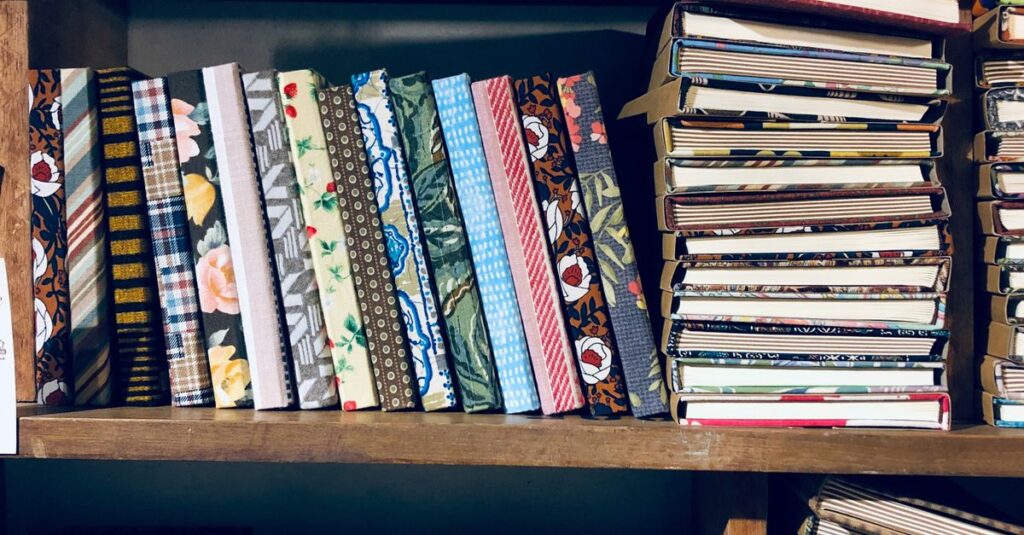
- The Binding: This is the spine of the operation. Literally.
- Stitched Binding: Classic, lies flat, durable. For notebooks that get heavy use.
- Spiral Binding (Wire-O): Lies completely flat, pages turn 360 degrees. Great for manuals, sketchbooks.
- Perfect Binding: That glued, square spine you see on paperback books. Looks clean and professional for corporate diaries.
- The Print Itself: Offset printing for large, consistent runs. Digital for smaller batches or last-minute changes. The method affects the colour vibrancy and, crucially, the cost.
Look, I’ll be direct. Most people fixate on the cover design and ignore the binding. And then they get complaints that pages are falling out after a month. The binding is what holds your brand together. Literally.
Custom vs. Stock Notebooks: What You’re Really Paying For
This is the conversation I have almost every day. A wholesaler will call, wanting a custom line but worried about the minimum order quantity (MOQ). They ask, “Why can’t I just get your stock notebooks cheaper?”
You can. And you should, if branding isn’t the goal. But if it is, you’re not just paying for ink. You’re paying for the factory to stop its regular production line. You’re paying for the machine setup, the colour calibration, the quality checks on your specific run. It’s the difference between buying a suit off the rack and getting one tailored. One fits okay. The other fits you.
| Factor | Stock Notebooks | Custom Printed Notebooks |
|---|---|---|
| Cost Per Unit | Lower | Higher (setup costs included) |
| Lead Time | Short (often ready stock) | Longer (production time needed) |
| Branding | None or generic | Your logo, colours, messaging |
| Flexibility | Fixed specs (size, paper, ruling) | Tailored to your exact needs |
| Minimum Order | Low (even single cartons) | Higher (MOQ applies) |
| Best For | Resale, general supply, internal use where brand isn’t key | Brand building, corporate gifting, premium product lines, institutional identity |
The real cost isn’t in the table, though. It’s in the missed opportunity. A generic notebook is a commodity. A custom notebook is a brand ambassador that sits on someone’s desk for months.
A Real Story: What This Actually Looks Like
Let me give you a picture that’s not from a brochure.
Rohit, 42, runs a mid-sized stationery distributorship in Chennai. He’d been selling our stock school notebooks for years. Good business, but competitive. Margins kept getting thinner. Last year, he decided to launch his own private label line for local colleges. He was nervous about the upfront cost — the custom printing, the new packaging.
We worked through it. He chose a durable stitched binding for the engineering students, a thicker 70gsm paper that could handle fountain pens and pencil sketches. The cover had the college crest and a simple, modern design. Not flashy. Solid.
He placed his first order. It wasn’t huge. A few thousand units. The notebooks arrived. He told me later the moment he opened the carton mattered. They felt substantial. They looked like they belonged to the college. He wasn’t just selling notebooks anymore; he was selling a part of the campus identity. His margin improved. But more than that, the colleges kept coming back. They’d found “their” supplier.
That shift? From vendor to partner? That’s what you’re buying. You’re buying the thing that makes people come back.
Expert Insight: The One Thing Nobody Talks About
I was reading an industry report a while back — one of those dry PDFs that puts you to sleep — and one line stuck with me. It wasn’t about tech or trends. It said the most common point of failure in custom stationery orders isn’t quality. It’s communication.
A vague brief. An assumption that “they know what I mean.” A rushed approval on a proof because the deadline is looming. The paper feels wrong. The colour is off. The logo is pixelated.
The expert insight, if I can call it that, is this: treat your manufacturer like a partner in the problem, not just a button-pusher. Share the why behind the order. “We need these for an investor meet, they need to feel premium.” “These are for schoolchildren, they need to withstand rough bags.” That context changes the recommendations we make. Every single time. I don’t have a cleaner way to put it than that. Good custom printing is a conversation, not a transaction.
Frequently Asked Questions
What is the minimum order quantity (MOQ) for custom printing?
It varies wildly. For something simple like a logo stamp on a stock notebook, it could be a few hundred. For a fully custom job with unique paper, size, and binding, you’re usually looking at a few thousand units minimum. The reason? The machine setup costs are fixed, whether we make 10 notebooks or 10,000. Spreading that cost over too few units makes each one prohibitively expensive. Always ask for a quote based on your quantity — it’s the only way to know.
How long does custom notebook printing take?
Don’t expect overnight. A typical timeline from final approved design to delivery is 4-6 weeks for a standard order. This includes production time, drying time for inks, binding, and quality checks. Rushing it is possible, but it often costs more and risks mistakes. The best plan? Start the conversation at least 2-3 months before you absolutely need the notebooks. It takes the pressure off everyone.
Can you match my brand colours exactly?
We can get very, very close using Pantone colour matching. This is a standardised colour system used in printing. If you provide your brand’s Pantone codes, we can match them precisely. If you only have a digital file (like a PNG or JPG), we’ll match it as closely as possible, but remember — colours on a screen (RGB) always look different to colours printed on paper (CMYK). Always ask for a physical proof before the full run starts.
What file format do you need for my logo/design?
Vector files are best. Think .AI, .EPS, or .PDF. These are infinitely scalable, so your logo stays crisp whether it’s tiny on a page corner or huge on a cover. We can work with high-resolution .PNG or .JPG files, but if they’re low-res, the print will be blurry. A good rule: if you zoom in on your file and the edges get pixelated, it’s not high-res enough.
Do you handle packaging and shipping for bulk orders?
Yes, absolutely. For bulk custom printing orders, we can pack them in master cartons, palletise them, and arrange shipping across India or for export. This is part of the quote. We see it through from the blank paper to the delivery truck. For international buyers, we handle all the export documentation — that’s part of our standard service.
So, Is It Worth It?
Here’s my take, after seeing orders come and go for years. Custom printing isn’t an expense. It’s an investment in how people see you. A generic notebook is forgotten. A well-made, branded one sits there. On the desk. In the meeting. In the student’s bag. It’s a reminder.
But — and this is the part I always stress — it only works if it’s done right. The wrong paper, a weak binding, a smudged print… that investment turns into a bill for something that damages your reputation. The goal isn’t just to get something printed. It’s to get something printed that you’re proud to put your name on.
I don’t think there’s one universal answer for every business. Probably there isn’t. But if you’ve read this far, you’re not just looking for a supplier. You’re looking for a solution that lasts. And that’s the whole point. If you want to talk through what that actually means for your next order, that’s what we’re here for.