

Let’s Just Get Straight to The Point
Here’s a question that’s far more common than you’d think: “What’s the size for an A4 sheet?” It sounds simple. It’s not. Because the moment you ask that question, you’re not just looking for numbers. You’re usually standing in an office, staring at a catalogue, trying to decide between ten different notebook “A4” options for a bulk order. You need to know the exact dimensions, sure. But you also need to know what those numbers actually mean for binding, for printing, for shipping, and for the people who’ll be using the damn things. Right? This is where the confusion starts. And I’ve seen it happen for over 40 years. If you’re ordering notebooks in bulk – for a school, a corporation, a government office – understanding A4 size is the first step to not making a costly mistake.
The Exact Numbers (And Why They Matter)
Alright. The size for an A4 sheet, in millimeters, is 210 mm by 297 mm. In inches, that’s roughly 8.27 inches by 11.69 inches. That’s the ISO standard. Globally. But here’s the thing – those numbers are for the paper before it gets turned into a product. The moment you decide to bind that paper into a notebook, you lose a little margin. You need space for the binding, for the hole punches if it’s spiral, for the gutter. So the actual usable writing area inside an “A4 notebook” is slightly smaller. Think about it this way: if you’re ordering corporate diaries with a company logo printed on every page, you need to know where the print area is. If you’re a school buying A4 graph books for math classes, you need to know if the squares will fit properly. The numbers are a starting point. The real headache is applying them.
Most people don’t realize this until the shipment arrives and someone says, “Wait, the margins are too small.” I’ve heard this enough times now that I start every conversation with this exact point. The size for the A4 sheet is fixed. The size for the A4 notebook product is negotiable. It depends on your binding, your ruling, your finish. Which is… a lot to sit with.
A4 vs. Everything Else: The Notebook Arena
You’re probably comparing A4 to other sizes. King Size, Long Notebook, Account Book size. Let’s just lay them out side-by-side. Because this isn’t about preference; it’s about function.
| Notebook Type | Dimensions (cm) | Common Use Cases | Our Manufacturing Notes |
|---|---|---|---|
| A4 Notebook | 21.0 x 29.7 cm | Official reports, corporate diaries, university project work, legal pads. | Standard international size. Perfect binding works best. Needs heavier paper (70+ GSM) to feel substantial. |
| Account Notebook | 33.9 x 21.0 cm | Ledger books, financial records, large-scale drawing sheets. | Much larger. Often uses 200+ pages. Stitched binding is mandatory for durability. |
| Long Notebook | 27.2 x 17.1 cm | School notebooks (high school), general writing, note-taking. | The most common size we produce for Indian schools. Spiral binding is popular here. |
| King Size Notebook | 23.6 x 17.3 cm | Primary school notebooks, everyday journaling, rough work. | Compact but spacious. Easy for kids to handle. We run this in 52-92 page counts daily. |
| A5 Notebook (Half of A4) | 14.8 x 21.0 cm | Personal diaries, pocket notebooks, meeting notes. | A4 sheet cut in half. Efficient for paper usage. Great for custom, branded giveaways. |
The table makes it obvious, I think. A4 is the formal one. The one you use when the document might need to be filed, scanned, or presented. It’s the corporate choice. The other sizes are more… task-specific. And honestly? Most procurement managers already know this intuitively. They just need the numbers confirmed.
When A4 Is The Right Call (And When It’s Not)
Expert Insight
I was talking to a procurement manager from a Bangalore tech company last month – over a call, actually – and she said something I keep thinking about. They’d ordered A4 branded notebooks for all employees. Beautiful cover, premium paper. Six months later, she found stacks of them unused in cabinets. People were using smaller, cheaper notepads from the supply room instead. The reason? The A4 diaries were “too formal.” Too bulky to carry to quick meetings. Too nice to scribble rough ideas in. They felt like a document, not a tool. The more capable a notebook is, the harder it becomes to just… use it. I don’t have a cleaner way to put it than that.
So, use A4 when:
- You’re producing official corporate diaries that represent the company.
- The content needs to be archived or scanned (A4 is the scanning standard).
- You’re making project reports or legal pads where space for detailed notes is critical.
- You’re exporting to international markets (Gulf, Europe, USA) where A4 is the expected norm.
Avoid A4 when:
- You need portable, everyday notebooks for quick notes and meetings.
- Your budget is tighter (A4 paper costs more, binding is more complex).
- Your users are students or field staff who need lightweight, carry-around books.
- You’re ordering in massive bulk for general distribution and cost-per-unit is the biggest driver.
The Manufacturing Reality: From A4 Sheet to A4 Notebook
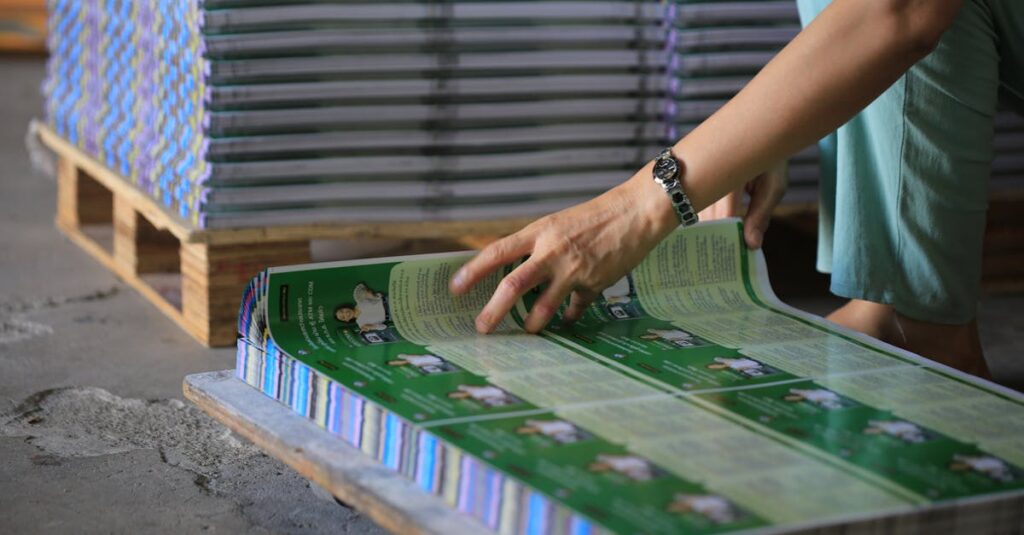
This is the part nobody usually asks about, but it’s probably the most important. When you say “I want A4 notebooks,” what happens in the factory? The paper comes in large parent sheets – usually A0 or A1 size. Those are cut down, precisely, to the A4 dimension. That’s a precision job. If the cut is off by even a millimeter, the binding machine later will jam, or the pages will be uneven. Then, based on your order – 52 pages, 200 pages, 700 pages – those sheets are collated. The ruling happens. Single Ruled, Double Ruled, Cross Ruled. The printing happens if it’s custom. Then binding. Stitched binding for durability, spiral for flexibility, perfect binding for that clean, book-like look.
Real-life micro-story: Priya, 28, procurement officer for a chain of private schools in Hyderabad. She ordered 20,000 A4 drawing books for art classes. She specified “A4 size, spiral bound.” What she didn’t specify was the paper weight. We used our standard 54 GSM paper. The books arrived. The teachers complained: the paper was too thin, the spirals snagged when students flipped pages aggressively. The drawings bled through. We re-made the order with 70 GSM paper and a heavier spiral coil. Cost went up by 15%. She approved it, but the initial hassle – the back-and-forth, the delay – was a headache for everyone. The size was correct. The product wasn’t.
That’s the gap. Knowing the size for an A4 sheet is step one. Knowing how that sheet becomes a usable, durable, fit-for-purpose notebook is step ten. And most manufacturers, honestly, will only tell you about step one.
Answers to The Questions You’re Actually Asking
Frequently Asked Questions
Is A4 the same as Legal Size paper?
No. They’re different. Legal Size (used mostly in the US) is 8.5 x 14 inches. A4 is 8.27 x 11.69 inches. A4 is shorter and a bit narrower. If you’re supplying notebooks to international markets, this distinction is crucial – you can’t substitute one for the other.
Can I get A4 notebooks with different page counts?
Absolutely. The size of the sheet stays the same, but the thickness changes. We commonly produce A4 notebooks in 52, 92, 200, 240, 320, and even 700 pages. The binding method changes with the page count – a 700-page A4 book needs stitched binding, not spiral.
What’s the best binding for an A4 corporate diary?
For a formal, corporate look: Perfect Binding. It gives a clean, book-like spine. For a functional, flip-anywhere diary: Spiral Binding. For a heavy-duty, archive-quality diary: Stitched Binding. The “best” depends on whether you want it to look prestigious or be purely practical.
Why do some A4 notebooks feel flimsy?
Paper weight (GSM). Standard writing paper is around 54 GSM. For an A4 notebook to feel substantial, especially with many pages, you need 70 GSM or higher. It’s a cost trade-off. Thinner paper = lower cost, but a flimsier feel. We always advise clients on this based on the notebook’s use.
Is A4 the most cost-effective size for bulk school notebooks?
Usually, no. For bulk school orders, Long Notebook (27.2×17.1 cm) or King Size (23.6×17.3 cm) are more common and cost-effective. They use less paper per unit, are easier for kids to handle, and the manufacturing process is streamlined. A4 is used for specific, higher-end school items like project books or art books.
Look, It’s Not Just About The Numbers
I think the biggest takeaway here isn’t the millimeter dimensions. It’s understanding that “A4” is a standard that triggers a whole chain of decisions – paper weight, binding type, ruling, cover stock, even packaging. When you’re ordering 5,000 units for a corporate event or 50,000 for a school district, each of those decisions adds up. To cost. To usability. To satisfaction. Knowing the size for an A4 sheet is the entry ticket. Knowing what to do with that sheet is the real game.
And if you’re at that stage – staring at a spec sheet, trying to match a paper size to a real-world need – it might help to talk to someone who’s been making these decisions for four decades. Not for a sales pitch. Just to get the specs right, from the start.