Look, you buy a bunch of diaries for your team or your students, or you order them as corporate gifts, and within a month they’re falling apart. Pages are snagging on a mangled wire on the side. That cheap metal coil is unwinding itself. The whole book feels flimsy, and by March, half your employees are using sticky notes because their diaries are a mess.
You don’t care about the “manufacturing nuances.” You just want notebooks that last the damn year.
That’s the diary spiral problem. It’s not a fancy term. It’s that moment of quiet irritation when a piece of functional stationery fails at its one job. And the worst part? It’s almost always avoidable. If you’re a procurement manager ordering in bulk, or a principal sourcing next year’s notebooks, this headache is costing you more than money — it’s costing trust. Your team thinks the company cheaped out. Your students think the school doesn’t care. It’s a small thing that creates a real, bad impression.
Right. Let’s break it down. How notebooks are put together is half the battle.
What ‘Diary Spiral’ Actually Means (Hint: It’s Not Just the Coil)
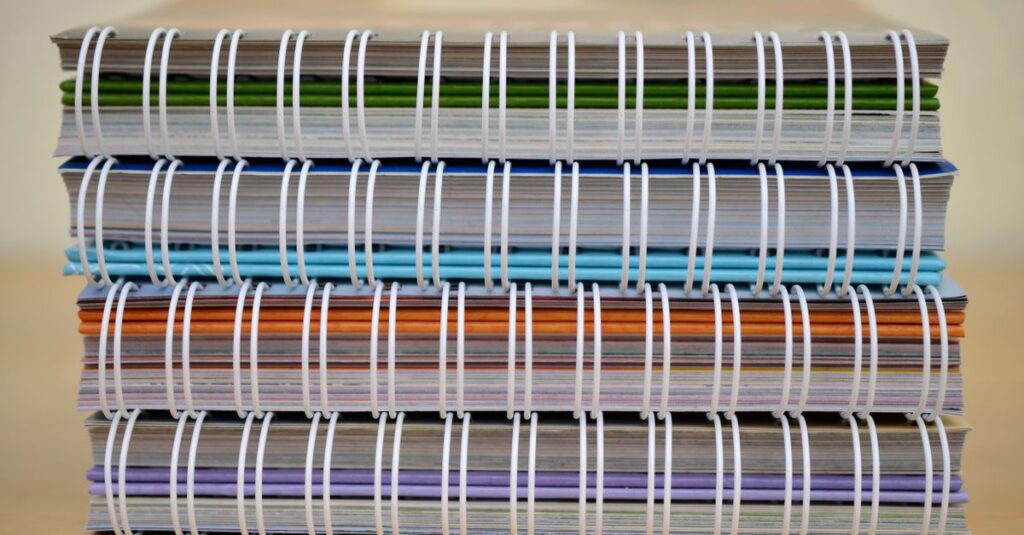
Most people see the word “spiral” and think only of the metal or plastic coil. And yeah, that’s part of it. But in the notebook industry, “diary spiral” refers to the whole binding system — the holes, the coil, the crimping. It’s a process, not just a part. When someone complains about a spiral issue, they could be talking about one of three breakdowns.
First, the coil itself is garbage. You get thin, coated wire that kinks if you look at it wrong, or cheap plastic that cracks in a cold office. Second, the hole-punching is sloppy. The holes aren’t clean, there’s paper dust left behind, and the edges fray and catch on the coil every time you turn a page. And third — this is the silent killer — the crimping at the ends is weak. Those little metal end caps? If they’re not crimped tightly, the whole coil starts to unwind. Slowly. Like a slow-motion notebook apocalypse.
I was talking to a school supplier in Hyderabad last month. He showed me a diary from a batch he had to return. The pages hadn’t fallen out yet, but you could spin the end cap with your finger. “They shipped these,” he said, shaking his head. “They looked at this and thought it was okay.” That’s the spiral problem. It’s a quality control failure that gets shipped out the door.
The Real Cost of a Cheap Spiral (It’s Not What You Think)
So the coil breaks. Big deal, it’s a few dollars, right? Wrong. Here’s the thing — the financial cost of replacing a faulty diary is the smallest part. The real cost is operational and emotional.
Think about a corporate office. An employee’s diary is their brain’s external hard drive. Meetings, deadlines, notes. When it fails, stuff gets lost. It breaks their workflow. They grumble. They make do with loose sheets, and suddenly your clean, branded corporate gift is a pile of disorganized paper on their desk. It makes your company look sloppy.
For schools, it’s a daily annoyance. A kid’s notebook snags and tears. They’re embarrassed. They stop using it neatly. Teachers waste time dealing with “torn pages” instead of teaching. The perceived value of the entire academic material drops. You ordered in bulk to save money, but you lost something much bigger: functionality and respect.
The silence in a classroom when a notebook fails is different. It’s a specific kind of distraction. You can see it.
A Micro-Story: Priya’s Procurement Headache
Priya, 38, is a procurement manager for a mid-sized tech firm in Bangalore. Last November, she ordered 500 branded diaries for the new year from a new supplier, lured by a 15% cheaper quote. By February, she had a stack of 30 returned diaries on her spare chair. The spiral coils had sprung loose, scratching desks and catching on sweater sleeves. Her internal chat was peppered with “Hey Priya, my diary is… broken?” messages. She spent hours apologizing, arranging replacements from a local store at retail price (wiping out the “savings”), and drafting a firm email to the supplier. The worst part? She looked incompetent. Over a spiral binding.
She hasn’t made that mistake again.
Spiral vs. Stitched Binding: Choosing the Right Spine
Not every book needs a spiral. Sometimes the problem is choosing it in the first place. Here’s a quick, honest look at how it stacks up against stitched binding — the other common workhorse.
| Feature | Spiral / Coil Binding | Stitched (Saddle-Stitched) Binding |
|---|---|---|
| Lay-Flat Ability | Perfect. Lies completely flat, 360-degree rotation. | Good. Lies flat, but has a crease in the middle. |
| Durability (Heavy Use) | Can be weak if coil/ends are low quality. Prone to bending/unwinding. | Very durable. Thread and staples hold firm under stress. |
| Page Count Suitability | Best for thick books (100+ pages). Handles bulk well. | Best for thinner books (up to ~128 pages). Bulky ones strain the spine. |
| Perceived “Premium” Feel | Varies. Good metal coil feels professional; plastic can feel cheap. | Classic, trustworthy feel. Often seen as more formal for corporate items. |
| Common Use Case | Art pads, project notebooks, training manuals, thick planners. | Standard school notebooks, corporate notepads, booklets, reports. |
| Risk of “Diary Spiral” Failure | Higher. Multiple points of failure (coil, holes, ends). | Lower. Simpler construction. If thread is good, it lasts. |
The choice isn’t just about “which is better.” It’s about what the notebook needs to survive. Giving a thick, 240-page training manual a stitched binding is asking for trouble. Giving a standard 92-page office diary a spiral is often an unnecessary cost and risk.
How to Spot a Spiral That Will Last (Before You Order 10,000)
You can’t visit every factory. But you can ask the right questions and check samples like a pro. Forget the glossy cover for a second. Pick up the sample and do this.
- Twist the Ends: Firmly try to rotate the metal end caps. They should not move. At all. If they spin, the crimping is weak. Reject it.
- The Pinch Test: Gently pinch the coil together along its length. A good, hardened coil will have very little give. A cheap one will compress easily and may not spring back fully.
- Check the Hole: Look at the punched holes on an inner page. Are they clean-cut, or are they rough with little paper tags? Run your finger around the inside. Rough edges will fray and tear.
- Open & Close: Rapidly flip through the entire book a few times. Listen. A good binding is quiet. A bad one will crackle and pop. Then, fold the cover all the way back. The coil should not gap away from the pages.
This takes two minutes. It tells you more than any product spec sheet. Ask the manufacturer what GSM paper they use for the cover (it should be thick, 250+ GSM for protection) and what wire gauge the coil is. A thicker gauge (like a lower number – think 25 vs 30) is stronger. If they can’t answer, that’s your answer.
Why This Still Happens in Bulk Manufacturing
It’s 2025. Why is this still an issue? You’d think it’d be solved. From inside a factory, it usually comes down to two things: speed and hidden cost-cutting.
Spiral binding machines have to be set up perfectly — the hole punch alignment, the coil feed tension, the crimping pressure. In a rush to hit a huge daily target (some plants push 50,000+ notebooks), those settings drift. An operator might not catch it for a few hundred books. And if quality checks are just a ‘spot check’ every few hours, a whole batch of weak-spiraled books gets boxed up.
The other reason is the raw material. Coil wire is bought by the tonne. A manufacturer can switch to a thinner, cheaper coil or a less durable plastic coating, and the buyer might never know from the sample — if the sample was even made from the same batch. The saving is marginal per book, but massive across an order of 100,000. They’re betting you won’t notice until it’s too late.
Expert Insight
I was reading an old trade magazine once, interviewing a factory floor manager. He said something that stuck with me. “The best binding is the one you never think about. It’s invisible. Your focus stays on what’s written on the page, not on the thing holding the pages.” That’s the goal. A diary spiral should disappear. When it announces itself, it’s already failed.
The more I thought about it, the more it made sense. It’s not about the notebook being ‘premium’. It’s about it being reliable. You shouldn’t have to think about it.
FAQs: Your Diary Spiral Questions, Answered
Can a damaged diary spiral be fixed?
Not really, not in a way that’s practical for an office or school. You can sometimes squeeze the coil back with pliers, but it’ll never be right and will likely fail again. For bulk buyers, replacement is the only real fix. This is why vetting your manufacturer upfront is everything.
Is plastic coil binding better than metal?
It depends. Plastic (PVC) coils are more flexible and come in colors, which is great for aesthetics. But they can crack in cold temperatures and are generally less durable under constant flexing than good-quality, hardened metal wire. For a corporate diary that gets daily, year-long use, metal is usually the safer bet.
What is the best binding for a heavy-use corporate diary?
For a standard thickness diary (up to 200 pages), a well-made stitched binding is often the most durable and professional choice. For thicker planners or manuals, a high-gauge metal spiral with proper end crimping is necessary. Always, always request and rigorously test a physical sample.
How can I ensure my custom logo diary doesn’t have spiral issues?
Specify it. In your purchase order or quote request, mention binding specs: “Metal coil binding, 25-gauge wire, with secure crimped end caps.” Request a pre-production sample from the actual production batch, not a generic showpiece. And work with a manufacturer known for quality control, not just the lowest price.
Are there alternatives to spiral binding for lay-flat notebooks?
Yes. Perfect binding (like a paperback book) with a flexible glue can allow books to lie fairly flat. There’s also “Tabloid” or “Wire-O” binding, which uses a double-loop wire that’s often more secure than a single spiral. It’s worth discussing the final use with your notebook supplier to explore all options.
The Bottom Line on Avoiding the Spiral of Disappointment
So here’s the takeaway. The diary spiral problem is a symptom, not the disease. The disease is choosing a supplier on price alone, not on proven durability. It’s not checking the sample like your business depends on it. Because in a way, it does. Your team’s efficiency, your brand’s image, your own time spent dealing with complaints — that’s all on the line with a piece of coiled wire.
Demand better. Ask the annoying questions. Test the sample until it almost breaks. Your diary shouldn’t be a source of daily friction. It should just work. The goal is to order it, forget about it, and have everyone use it until the pages are full. That’s it.
If you’re tired of guessing and want to talk to a manufacturer who gets why the small details are the only details that matter, we should talk.