Let’s talk about your logo disappearing from a notebook.
You order a thousand corporate notebooks. The branding looks good on the sample. Then, three months later, the guy from accounting holds one up and says, “What company is this for?” The logo’s rubbed off. The cover’s peeling. It looks cheap. And you just handed a thousand of them to your team and clients.
That’s the whole problem, right? You need branding that lasts. Something that doesn’t fade or peel the first time it goes into a laptop bag. Which is why you’re probably searching for this term — print in print.
It sounds like jargon. But it’s the only thing that solves that problem for good. If you’re buying bulk notebooks for your school, company, or as a distributor, you need to know this. We see this every single day.
What “Print in Print” Actually Means (It’s Not What You Think)
Most people guess it’s printing something twice. Or maybe a fancy layered effect. It’s not.
Think of it this way. You have a notebook cover. It’s usually one color of paper or board. “Print in print” means the branding — your logo, text, pattern — is printed as the cover is being made. The ink becomes part of the paper sheet itself before it’s even cut and bound. It’s not a layer on top. It’s baked into the material.
The opposite is a sticker. Or a laminate. Or a spot UV coating applied after. Those sit on the surface. They can peel, scratch, or wear off. Print in print can’t. It’s permanent. I was talking to a procurement manager for a chain of coaching institutes last week — over a very rushed phone call — and he said something obvious that stuck with me: “I don’t care how pretty the sample is. I need it to look the same for the next two academic years.”
That’s the only thing that matters here. Durability.
How It Works in a Real Factory
Okay, so here’s the process. This is what our floor looks like for a print-in-print order.
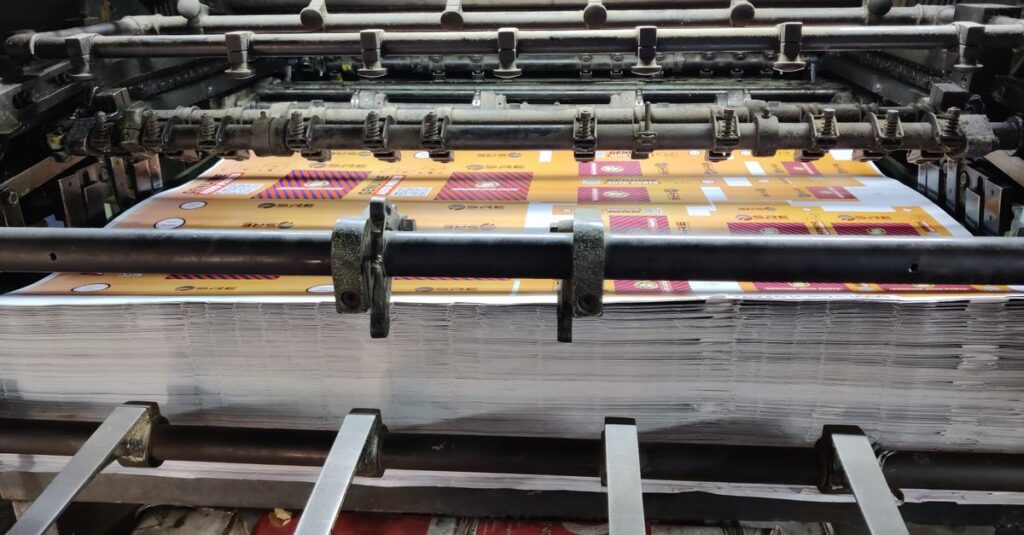
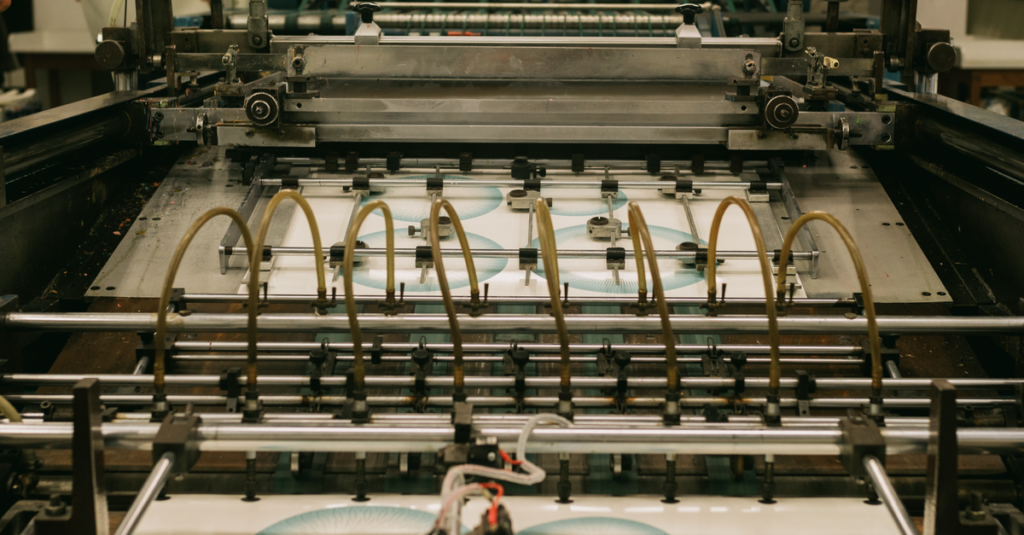
The paper reels come in. Your design is loaded onto the offset printing press. But instead of printing on already-made covers, the press prints directly onto the large, raw paper sheets that will become the covers. The ink is set with heat and pressure. It dries into the fibres. Then, those printed sheets are cut to the exact notebook size — King Size, Long, A4, whatever you need. Only then does binding happen.
The branding survives everything after that. The binding glue heat. The handling. The stacking. The shipping. The daily grind in a student’s backpack or a sales rep’s briefcase.
It’s not a magic trick. It’s just doing the work in the right order.
The Real Cost of Getting This Wrong
Let me tell you about Rohan. He’s 42, runs procurement for a mid-sized IT firm in Hyderabad. Ordered 500 executive diaries for the new year. Went with the cheaper option — a foil stamp on leatherette. Looked luxurious in the boardroom presentation. Six weeks later, half the logos were flaking. Clients were noticing. It became an internal joke. “The disappearing company.”
He didn’t lose just the diary budget. He lost face. And that’s a real cost nobody puts on the purchase order.
This is why institutions — schools, governments, big corporates — always ask for print in print. They’re not being fussy. They’ve been burned before. They need the brand to be as durable as the product. A notebook that lasts 200 pages needs a logo that lasts 200 pages of use.
And honestly? Most suppliers who offer cheap per-unit prices are skipping this step. They’re using faster, surface-level methods. It looks okay until it doesn’t.
Print in Print vs. Every Other Printing Method
Look, I’ll be direct. If you’re evaluating suppliers, you need this comparison on hand. It’s the difference between a marketing asset and a waste of money.
| Feature | Print in Print | Surface Printing (Foil/UV/Sticker) |
|---|---|---|
| Durability | Extremely high. Becomes part of the cover. | Low to medium. Prone to peeling, scratching. |
| Feel | Smooth, matte finish. No raised texture. | Can be textured (foil raised, sticky laminate). |
| Cost Overhead | Higher initial setup, lower per-unit in bulk. | Lower setup, but quality risk is high. |
| Best For | Bulk school notebooks, corporate diaries, long-term branding. | Short-run promos, event giveaways where longevity isn’t key. |
| Production Time | Longer, as it’s integrated into cover making. | Faster, as it’s a final-step add-on. |
| Brand Perception | Professional, established, quality-conscious. | Can look cheap if it degrades. |
The takeaway? For anything you’re ordering in the thousands, for anything that represents your brand for more than a season, you want the left column. Every time.
When Print in Print Isn’t the Answer (And That’s Okay)
I know I’ve been pushing this hard. But let’s be fair — it’s not for every single project.
If you need a metallic sheen or a glossy, reflective logo, print in print can’t do that. It’s ink-on-paper. It’s matte. If you want that gold foil shine for a luxury diary, you need hot foil stamping. Just know it might wear. That’s the trade-off.
Also, for tiny runs — say, 100 notebooks for a workshop — the setup cost for print in print might not make sense. The machine wash-up and plate-making time is the same whether you run 100 sheets or 10,000. So the per-notebook cost shoots up.
The rule of thumb we use: If you’re ordering over 500 pieces, and you need the brand to last as long as the notebook, it’s print in print. Under that, or for temporary stuff, other methods can work. You just have to know the risk.
Expert Insight
I was reading an old industry journal last month — one of those dense technical ones — and a line from a paper on substrate bonding stuck with me. The researcher said something like, “Permanence in print isn’t an additive feature; it’s a foundational property determined at the moment of impregnation.” Sounds fancy, but it just means: if the ink isn’t in the paper from the start, it’s just a visitor. And visitors leave.
I don’t have a cleaner way to put it than that. The best branding is part of the product, not an accessory to it.
What to Ask Your Notebook Supplier
Don’t just ask, “Do you do print in print?” They’ll all say yes. Dig deeper. Your checklist for the next supplier call:
- “Is the branding printed on the cover sheet BEFORE or AFTER it’s cut to size?” (It must be before.)
- “What’s the rub test result?” (They should have a standard test. Ask for the number.)
- “Can I see a sample you produced six months ago?” (See how it’s held up. Not a fresh sample.)
- “What’s the minimum economical order quantity for this method?” (This tells you if they’re serious about bulk.)
This separates the real manufacturers from the resellers. A reseller won’t know the rub test. A manufacturer lives by it.
We get these questions all the time, and it’s a good sign. It means you’re thinking about the right things.
Frequently Asked Questions
What does “print in print” mean in notebook manufacturing?
It’s a printing method where your logo or design is printed directly onto the raw paper sheets that become the notebook cover, before cutting and binding. The ink bonds with the paper fibres, making it extremely durable and resistant to peeling or rubbing off. It’s the standard for bulk, long-life notebooks.
Is print in print more expensive than other printing?
Initially, yes. The setup (plate-making, machine wash-up) costs more. But for bulk orders — typically over 500 units — the per-unit cost becomes very competitive. You’re paying for permanence. Surface methods look cheaper on the quote but can fail, making the real cost much higher.
Can you do multi-color logos with print in print?
Absolutely. Modern offset presses used for print in print handle multi-color process (CMYK) printing seamlessly. Your full-color logo gets reproduced accurately and permanently. It’s not limited to one or two colors.
What notebook types is print in print best for?
It’s ideal for any notebook meant for heavy, long-term use. Think school notebooks (which take daily abuse), corporate diaries used year-round, account books for office record-keeping, and any branded notebook you want to keep your logo visible for its entire lifespan.
How do I know if my supplier is using real print in print?
Ask for a production video or visit the facility. Real print in print happens on large offset presses at the very beginning of the cover-making line. If they’re applying branding at the end, on already-bound notebooks, it’s a surface method. Also, a true print-in-print sample will have zero raised texture; the print is flush with the paper.
Look — It’s About Trust
At the end of all this, buying bulk notebooks isn’t just a procurement task. It’s a branding decision. Every notebook you give out is a tiny, physical piece of your brand walking around in the world. You want it to represent you well, for as long as it exists.
Print in print is the method that respects that. It accepts that notebooks get used — shoved in bags, written on, left in sun, handled daily. And it ensures your mark stays.
I don’t think there’s one perfect solution for every single order. But if you’ve read this far, you’re not just looking for the cheapest option. You’re looking for the right one. And you probably already know which one that is.
If you want to see what a 40-year-old notebook factory means when it talks about permanent branding, the details are here. We don’t do temporary.