Look, Let’s Get This Straight
You’re probably here because someone told you they need notebooks with “bill printing.” And now you’re looking at a quote or a specification sheet thinking, what does that even mean? Right? I’ve had this exact conversation with maybe two dozen procurement managers just this year. They get tasked with ordering custom notebooks for their school, their office, or their distributor network, and suddenly they’re drowning in terms like GSM, ruling types, and binding. And then “bill printing” shows up. It sounds like… printing a bill. Which it kind of is. But not the way you think.
Here’s the real problem: nobody in this industry explains it simply. They assume you know. Or they use jargon to sound more technical. So you either nod along and hope for the best, or you end up with 5,000 notebooks that don’t look anything like what you wanted.
Bill printing, in the simplest terms, is the process of printing the main, repeating ruled lines on the pages of a notebook — the “bills” of the notebook. It’s the foundational print run that defines whether it’s a single-ruled book, a double-ruled ledger, or a four-ruled account book. Everything else — the cover, the logo, the headers — is secondary. That’s the part that matters. If you’re ordering notebooks in bulk for a corporate gift, a school supply, or a private label, you can’t mess this up. The entire usability of the book depends on it. If this sounds like the headache you’re trying to solve, seeing how a real manufacturer handles it might clear things up.
What Bill Printing Actually Is (And What It Isn’t)
Okay, let’s break it down. I think the confusion starts because “bill” is an old printing term. In our factory — and I’ve been walking these floors for decades — “bill printing” refers specifically to printing the page rulings. Those lines you write on. The skeleton of the notebook.
It’s NOT:
– Printing the cover.
– Printing your company logo on the cover.
– Adding custom headers or footers to each page (that’s a separate, more expensive process).
– The binding or the stitching.
Think about a standard school notebook. The blue or red lines that go across every page? That’s the bill print. For an account book, the complex grid of lines? Also bill printing. It’s the first, most critical print run on the blank paper before it gets cut, folded, and bound. The precision here is everything. If the lines are crooked, spaced wrong, or the ink bleeds, the entire batch is scrap. I’ve seen it happen. A millimeter off on the printing cylinder, and you’ve got 10,000 useless books.
Why does this matter to you? Because when you’re comparing quotes from different notebook manufacturers, the “bill printing” cost is a core part of the manufacturing price. A simple single rule (SR) is cheaper and faster than a detailed cross rule (CR) for graph paper. Knowing what you’re asking for is the only way to know if you’re being quoted fairly.
The Different “Bills” You Can Order (And Who Needs Which)
This is where it gets practical. You don’t just order “bill printing.” You order a type of ruling. And the type you choose dictates who the notebook is for and how it will be used. Most manufacturers have a code for each. We do.
- SR (Single Ruled): One horizontal line. The classic. For general writing, school notes, meeting minutes. It’s the default for a reason — it works for almost everything.
- DR (Double Ruled): Two close horizontal lines. Often used for subject-specific notebooks in schools or for specific clerical work. Gives a neater writing channel.
- FR (Four Ruled): Four lines — two solid outer lines, two dotted inner lines. This is for early learners. It’s how kids are taught to write alphabets in India. If you’re supplying notebooks to a primary school, this is non-negotiable.
- CR (Cross Ruled / Graph): A grid of squares. For math, engineering, charts, sketching. Scientists, accountants, students — they all need this.
- UR (Unruled): No lines. Blank pages. For drawing, sketching, brainstorming. Still goes through the “bill printing” stage — it just means we’re running blank paper through the press to maybe apply a watermark or just condition it. Unruled doesn’t mean zero process.
I was talking to a procurement head from a tech company in Bangalore last month. They wanted custom notebooks for their developers. They insisted on unruled, thinking it was the simplest, cheapest option. But then they wanted a faint, non-photo-blue grid on every page for wireframing. That’s not unruled. That’s a specific, light-tone cross rule. It changed the quote by 15%. He was frustrated until we walked him through it. The question isn’t what you think you need. It’s what the people actually using the notebook will do with it.
Expert Insight
I was reading an old industry journal a while back — the kind printed on paper that yellows at the edges. There was a quote from a master printer that stuck with me. He said, “The bill print is the notebook’s voice. Everything else is just the accent.” At first, I thought that was overly poetic for a bunch of lines. But he was right. A perfectly bound notebook with a gorgeous embossed cover is useless if the ruling is wrong for the task. The user fights the page. Their handwriting goes messy. Their diagrams don’t align. The frustration is quiet, daily, and real. It’s the difference between a tool that helps and a prop that just sits on a desk. I don’t have a cleaner way to put it than that.
A Real-Life Example: Priya’s School Order
Let me tell you about Priya. She’s 42, manages procurement for a chain of private schools in Chennai. Her job is to get the best quality supplies within a tight budget. Last summer, she needed 50,000 notebooks for the new academic year. The previous supplier had delivered books where the four-ruled lines were too faint — teachers complained the kids couldn’t see them properly.
This time, she was nervous. She spent a week just understanding specs. She learned that the opacity of the ink and the pressure of the printing cylinder during the bill printing stage were the culprits. She started asking manufacturers, “What’s your standard ink density for FR ruling?” Most couldn’t answer. One finally said, “We just run it like usual.” She hung up. She found us because we could explain it: we use a specific, darker blue formulation for four-ruling on 54 GSM paper to ensure it’s clear but doesn’t bleed. She placed the order. The books were delivered in July. She told me later the principal sent a thank-you note. No one thanks the procurement manager. But that time, they did. She just got the bill printing right.
Bill Printing vs. Other Custom Printing: A Cost & Use Comparison
This is the part where people get shocked by pricing. “Why is adding my logo so expensive? The lines are already there!” Right? Let’s lay it out. Imagine you’re ordering 1,000 custom A4 diaries for your corporate clients.
| Printing Stage | What It Is | Typical Cost Driver | Best For… |
|---|---|---|---|
| Bill Printing | Printing the ruled lines/grid on all pages. | Complexity of the ruling (FR/CR > SR), paper size. | Defining the core function of the notebook. |
| Cover Printing | Printing/embossing the front, back, and spine cover. | Number of colors, special finishes (foil, UV), material. | Branding, aesthetics, first impression. |
| Header/Footer Printing | Adding custom text (e.g., “Property of,” date fields) to each page. | Additional print run, plate setup cost, per-page complexity. | Specialized corporate diaries, lab notebooks, official logs. |
| Logo on Cover | A single-color or multi-color logo imprint. | Separate print setup, color matching. | Corporate gifts, branded merchandise, promotional items. |
| Full Custom Page Layout | Every page is uniquely designed (like a planner). | Very high. Involves design, multiple plates, precise alignment. | High-end executive diaries, specialized academic planners. |
See the jump? Bill printing is the baseline manufacturing cost. Every other layer is an add-on that needs new plates, new setups on the press, and more time. That’s why a simple single-ruled notebook with a plain cover is cheap, but a cross-ruled notebook with your full-color logo on a premium textured cover and a custom header on each page… isn’t. It’s not a scam. It’s just physics, machinery, and labor. If you want to understand the full journey of a custom order, our printing services page walks through each step without the fluff.
How to Talk to a Manufacturer About Bill Printing (Without Sounding Clueless)
You don’t need to be an expert. But asking three smart questions will make any serious manufacturer pay attention and give you a straight answer.
- Ask for physical samples of the ruling. Don’t just look at a PDF spec sheet. Say, “Can you send me a cut-sheet sample of your 54 GSM paper with the double ruling (DR) and the four ruling (FR)?” Hold it up to the light. Write on it with the pen your team uses. Check for show-through and smoothness.
- Ask about ink consistency. “Do you use the same ink density for all ruling types, or do you adjust it?” A good factory will adjust. Faint lines on graph paper are a nightmare. Bleeding ink on thin paper is worse.
- Clarify the “page count” in relation to the ruling. This is a classic mix-up. You order a “200-page notebook.” Is that 200 leaves (400 writing sides)? Or 200 writing sides (100 leaves)? And is the ruling on both sides? Usually, it’s both sides. But for something like One Side Ruled (OSR) drawing books, it’s not. Spell it out: “I need 200 leaves, 400 sides, all sides single-ruled.”
Anyway. The goal isn’t to sound technical. It’s to avoid the gut-sinking feeling when the shipment arrives and it’s all wrong. A manufacturer that patiently answers these questions is one that has a process. The one that gets annoyed is one you should run from.
So, What’s the Actual Process Inside the Factory?
Right. Let’s walk through it. I’ll describe a Tuesday morning run for 5,000 A4 single-ruled notebooks.
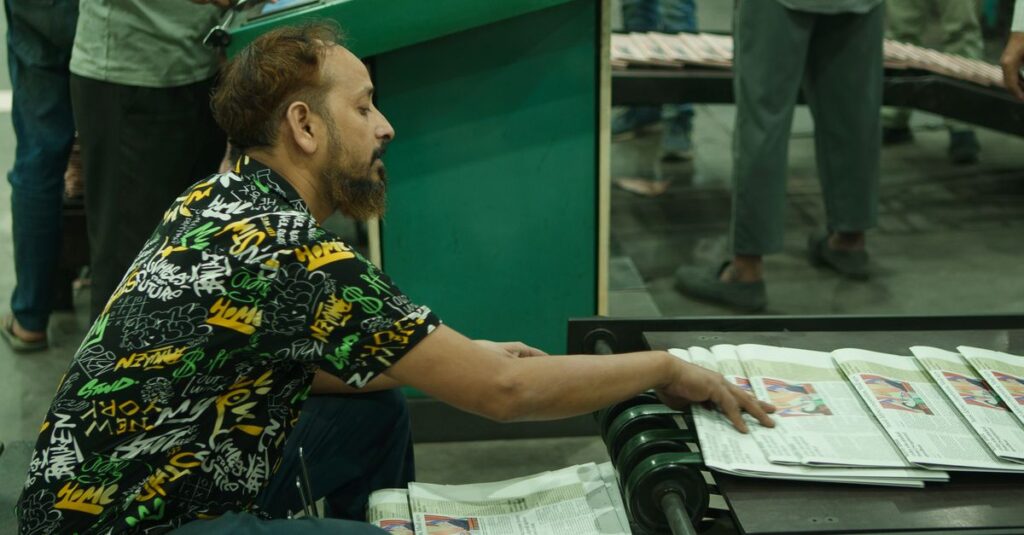
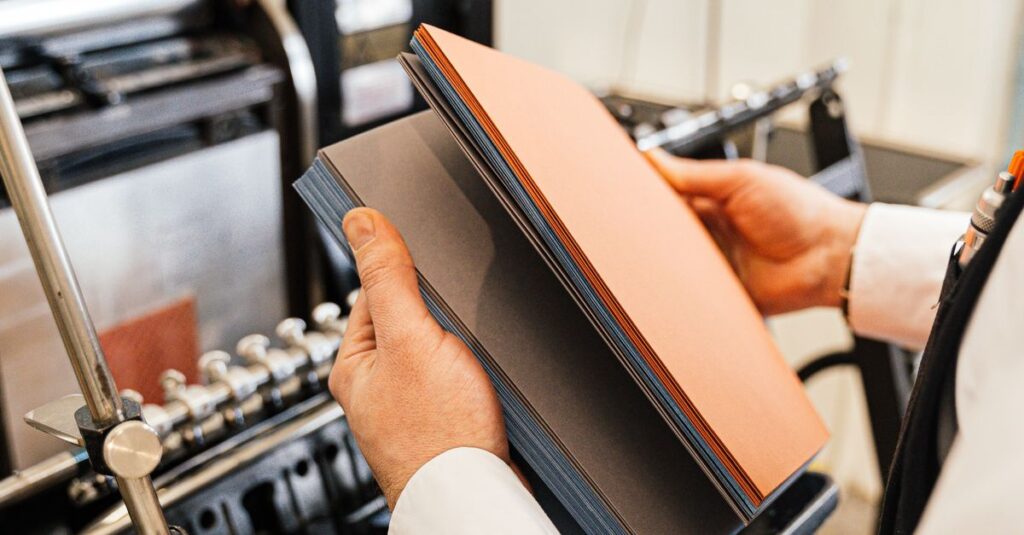
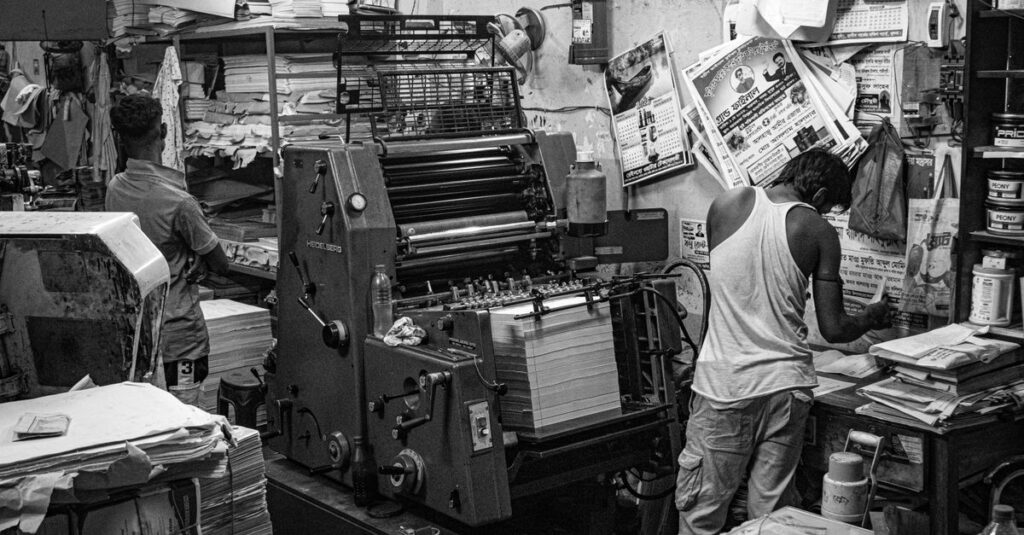
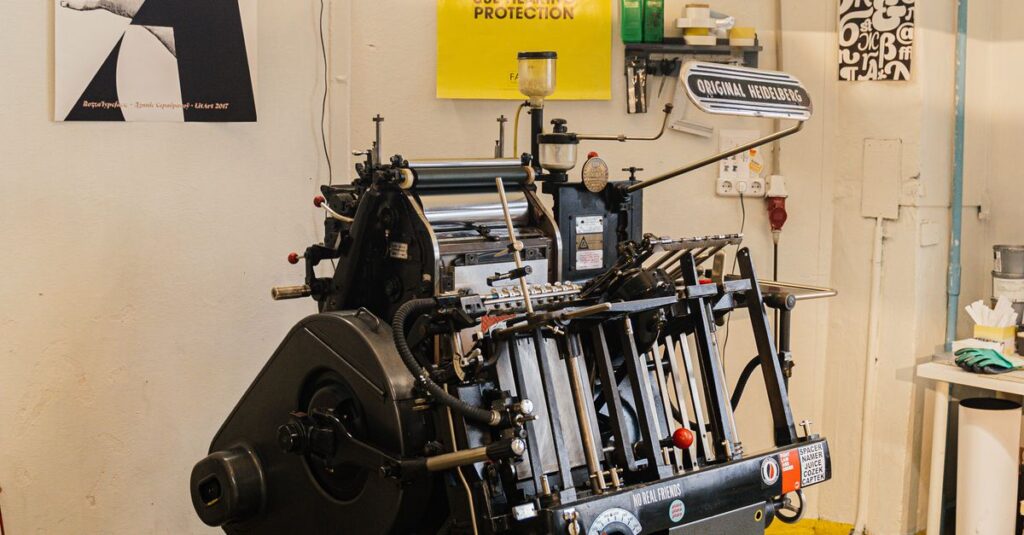
The giant rolls of 54 GSM paper — each one weighs more than my car — are loaded onto the offset press. The printing plates for the single-ruled lines are mounted. These are thin metal sheets with the line pattern etched onto them. This is the “bill.” The press starts. It’s incredibly loud, a rhythmic thumping. The paper flies through, getting kissed by the inked plates. The lines are printed in a fast, cyan-blue ink that dries almost instantly. We’re not printing one page at a time. We’re printing multiple pages side-by-side on a huge sheet, in a layout called a “signature.” This sheet, now covered in grids of blue lines, gets inspected under bright lights. A guy named Ravi has been doing this job for twenty years. He spots a slight streak or a misalignment I’d need a magnifying glass to see. That sheet gets pulled. The rest move on to be cut, folded into bundles, and then stitched. The bill printing stage is over in a few hours. But it sets the tone for everything that comes after. Mess it up here, and the next three days of work are wasted.
And honestly? Most people don’t need to know this. But you asked. Now you know why it matters. The precision isn’t for show. It’s to make sure the notebook in your hand just works, without you ever having to think about how the lines got there.
Frequently Asked Questions
Is bill printing the same for all notebook sizes?
No. The printing plates and press setup are specific to each paper size. Printing the lines for a Short Notebook (19.5 x 15.5 cm) uses a different plate layout than for a Long Notebook (27.2 x 17.1 cm). Changing sizes means stopping the press and changing plates, which adds time and cost. That’s why per-unit prices can vary with size, even for the same page count.
Can I get different colored lines, not just blue or red?
Technically, yes. But it’s a custom order. Standard bill printing uses fast-drying cyan (blue) or magenta (red) inks. Want grey lines for a sleek corporate look, or green for a brand color? That requires a special ink batch, cleaning the entire press system, and a new setup. It significantly increases the cost and minimum order quantity (MOQ). For most bulk orders, it’s not practical.
Does the paper quality affect the bill printing?
Absolutely. It’s the biggest factor. Low GSM paper (like 40-45) is thin. If the ink is too heavy or the press pressure is wrong, the lines will bleed through to the other side or even feather, making writing messy. Higher GSM paper (70+) can take a crisper, darker line. A good manufacturer will adjust their ink viscosity and press settings based on the paper you choose.
What’s the difference between ruled and printed headers?
This is a crucial distinction. The ruling (bill printing) is the repeating pattern of lines. A printed header is custom text or graphics (like “Meeting Notes” or a company name) that appears at the top of every page. Headers require a separate, additional print run after the bill printing. They add cost because you’re paying for two separate printing processes on the same sheet.
How do I check the quality of bill printing in a sample?
Do three things. First, hold a page up to a bright light. The lines should be consistent in opacity with no skips or blobs. Second, write on it with a pen you commonly use. The ink shouldn’t feather along the printed line. Third, look at the reverse side. There should be minimal show-through (a faint ghost image is normal), but the lines shouldn’t be visibly bleeding through.
The Simple Truth
Forget the jargon for a second. Bill printing is just about making sure the notebook does its job. It’s a functional, behind-the-scenes process that you only notice when it’s done badly. When it’s done right, the book feels intuitive. The lines guide the hand without getting in the way.
If you’re sourcing notebooks in bulk, your focus shouldn’t be on finding the absolute cheapest bill printing. It should be on finding a manufacturer who understands that this first step is the foundation. One who has the controls in place to keep it consistent across 5,000 units or 500,000. Because in the end, you’re not buying paper and ink. You’re buying a tool for students to learn, for employees to organize, for ideas to be captured.
I don’t think there’s one perfect way to do it. Every factory has its own rhythm. But if you’ve read this far, you already know what you’re looking for — you’re just figuring out who you can trust to get the lines straight. Literally. If you want to talk to a team that’s been getting those lines straight since 1985, it might be worth starting a conversation.