Right. So, What Actually IS an A4 Notebook?
Okay, let’s clear this up first. When you’re looking up ‘A4 pages’ — especially if you’re ordering for a school, a corporate office, or a university — you’re probably not just thinking about loose paper. You’re thinking about bound notebooks. The size you’re picturing in your head, the standard ‘big’ notebook sitting on an office desk or the main ledger in a accounts department? That’s the one. A4.
It’s 21.0 cm by 29.7 cm. 8.27 inches by 11.69 inches. In notebook manufacturing, it’s also called an ‘Executive’ or ‘Account Book’ size.
Here’s the thing — it’s not just about the measurements. It’s about the feel. An A4 notebook is substantial. It lays flat on a table. It says ‘this is serious work’. It holds minutes. It holds ledgers. It holds lesson plans and blueprints. You get the difference.
Look, I’ll be direct. If you’re a procurement manager or a business owner looking for bulk corporate diaries or institutional supplies, this is the size you’re most likely going to benchmark everything else against. And if you need that kind of scale and professionalism, understanding A4 is the first step. You can see what that size looks like in our product range to get a proper sense of it.
The Reality on the Ground: Where A4 Notebooks Actually Work
Let me give you a real-life picture. It’s 10 AM at a government office in Hyderabad. On the desk of the head clerk are three A4 notebooks — one for meeting minutes, one for inward-outward correspondence, one account ledger. Each is over 200 pages. Hardbound. Stitched binding. They get used, hard, every single day. They need to withstand that. That’s an A4 notebook’s real job.
It’s the same in a corporate setting. Think conference room. Think quarterly reviews. Think training manuals. These aren’t ideas you scribble in a pocket notepad. They are the official record. The A4 page count — whether it’s 200, 240, or a massive 700-page ledger — is what provides that space for formal, extended documentation.
And then there’s education. Not for the student’s daily classwork, no. But for the teacher’s master lesson plan book. For the lab record book in a college. For the principal’s administrative log. These are applications where the larger canvas matters. Where single-ruled or double-ruled lines on an A4 page provide the structure for organized, long-form content.
We’ve been making these for decades, and I can tell you — the demand for A4 hasn’t shrunk. It’s just become more specific. Institutions aren’t buying generic stationery anymore. They’re buying a tool. That’s what you should be looking for.
A4 vs. Everything Else: A No-BS Size Comparison
People ask all the time: “We need notebooks, but should it be A4 or A5 or something else?” It’s a valid headache for a buyer. Let’s break it down without the marketing fluff.
| Size | Dimensions (in cm) | Common Use Case | Who Orders It in Bulk? |
|---|---|---|---|
| A4 / Executive / Account | 21.0 x 29.7 | Official meetings, accounting ledgers, master logs, lesson plan books, official reports. | Government offices, corporate HQs, university administration, principals. |
| A5 / Half A4 / Long Size | 14.8 x 21.0 | Project notes, student notebooks, mid-level manager diaries, personal journals. | Schools (student notebooks), corporate L&D departments, distributors. |
| King Size | 17.3 x 23.6 | General notetaking, smaller account books, student rough work. | Small businesses, coaching centers, retail stationery shops. |
| Short Size | 15.5 x 19.5 | Pocket diaries, small scribble pads, quick memos. | Sales teams, event organizers, as complimentary corporate gifts. |
The takeaway? If the content needs to be formal, referenced, or presented, it likely needs the real estate of an A4 page. If it’s for daily, portable note-taking, you go smaller. It’s that simple. The confusion often happens when companies try to use one size for everything. Don’t do that.
Paper, Binding, and the Stuff That Actually Matters
So you’ve decided on A4. Great. Now the quality questions start — and they’re the important ones. Because an A4 notebook with poor paper or a binding that fails in three months is worse than useless. It’s a waste of budget and trust.
Paper Quality (GSM): For standard writing, we use 54-60 GSM paper. It’s the sweet spot. Thick enough that ink doesn’t bleed through to the other side (a major annoyance with cheaper paper), but not so thick that you’re paying a premium for no real benefit and the notebook becomes a brick. For drawing books or premium corporate diaries, you jump to 70-80 GSM. But for 90% of institutional A4 work — minutes, ledgers, plans — the mid-50s GSM is perfect. It feels good to write on.
Binding Types: This is where the physical durability comes in. You have three main types, and the choice depends entirely on how the book will be used.
• Stitched Binding: The classic. Threads sewn through the fold of the pages. This is for your workhorse notebooks — the ones that get opened and laid flat a thousand times. It lasts. Most of our bulk school and office notebooks use this.
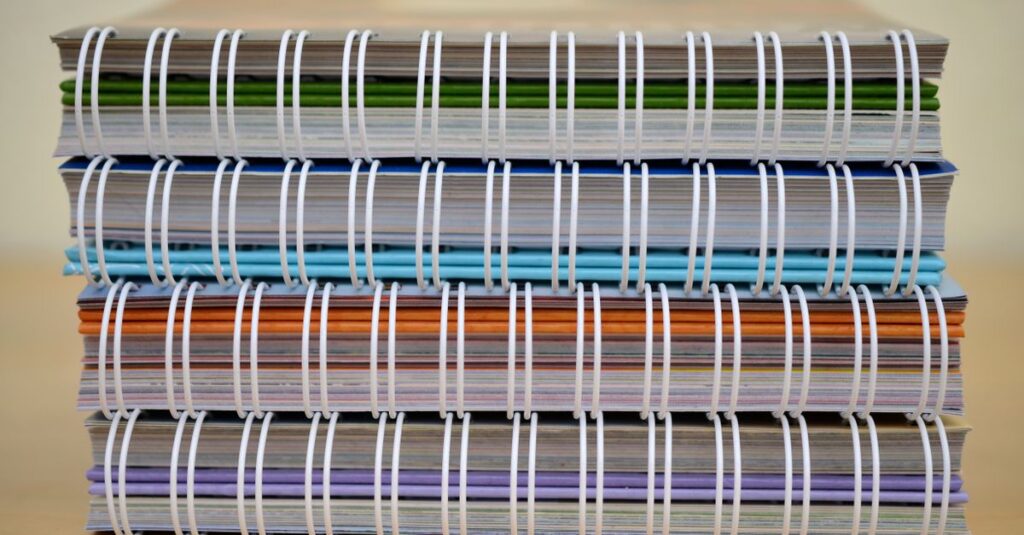
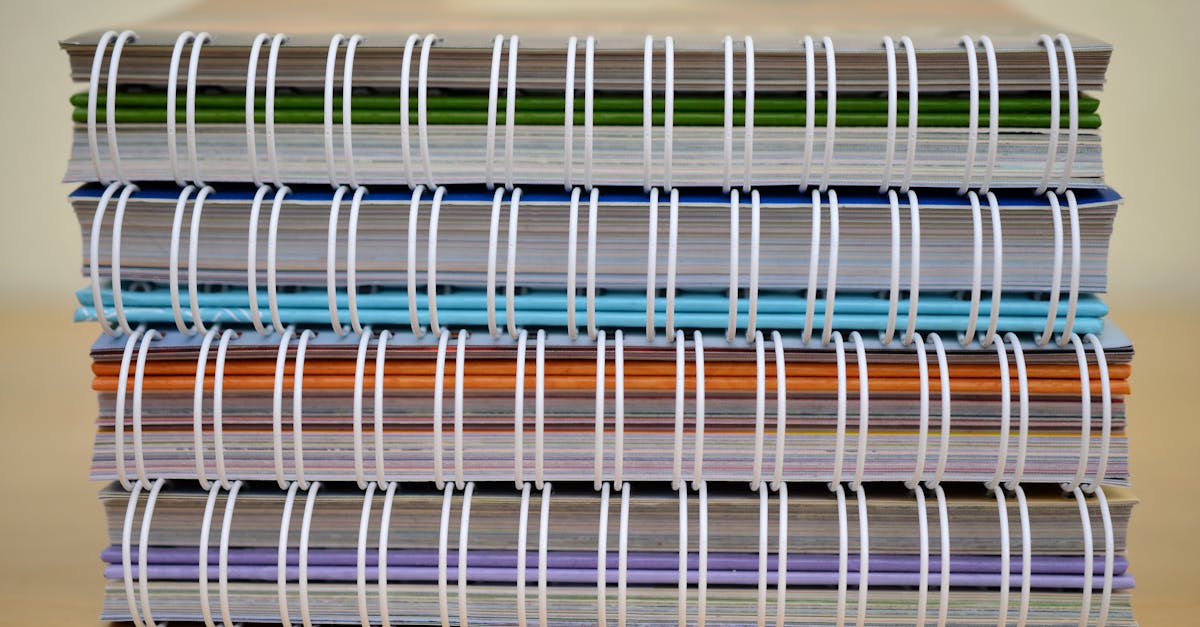
• Spiral Binding: The metal or plastic coil. It lets the notebook fold back on itself completely. Amazing for lab books, training manuals, or anything you need to reference while using both hands. It’s more expensive to produce, but for specific uses, it’s the only option.
• Perfect Binding: That glued edge you see on paperback novels and some corporate reports. It gives a very clean, professional look for something like a company annual report or a formal proposal. Not as durable for daily, aggressive flipping as stitching, but looks sharp.
You see the pattern? It’s not about which is “best.” It’s about which is best for the job. Get the job wrong, and the notebook fails.
Expert Insight
I was on a call last month with a procurement head for a chain of engineering colleges. He was frustrated. Their old supplier’s lab notebooks were falling apart — pages coming loose, covers detaching. The problem, when we dug into it, wasn’t the page count or even the paper. It was the binding glue. They were using a standard perfect binding for a book that students were manhandling on lab benches every day. The expert insight — the thing that gets missed — is this: The manufacturing spec sheet is one thing. The real-world use-case is another. You have to match the physical construction to the human behavior around the object. A lab book needs spiral or stitched binding. Full stop. No amount of good paper fixes a bad binding choice. I keep thinking about that. How often we design for the shelf, not for the hand.
Making It Yours: Custom A4 Notebooks for Brands & Institutions
This is where it gets interesting — and where most of our corporate and institutional clients come in. You don’t just want ‘an A4 notebook’. You want your A4 notebook. Private label. Custom printed. With your logo, your color scheme, your specific ruling on the pages. Maybe you’re a real estate company and you want a custom A4 diary for your agents with sections for client details and property specs. Maybe you’re a university and you need 10,000 lab books with the department crest on the cover and graph paper inside. That’s all doable.
The process, honestly, isn’t as complicated as people fear. It goes like this: You tell us the size (A4), the page count, the paper type, the ruling (single, double, quad, graph), the binding, and the cover design. We make samples. You approve. We mass produce. For large institutional orders, this is the only way to go — you get exactly the tool you need, and it builds your brand’s presence every time it’s opened.
I think — and I could be wrong — that a lot of businesses hesitate here because they think customization is only for luxury gifts. It’s not. It’s for efficiency. A well-designed, custom A4 notebook can actually improve how your team documents and organizes information. That’s not a stationery cost; that’s an operational investment. If you’re curious about what that journey looks like, our printing and customization service page walks you through it without any sales pressure.
The Big Question: Local Manufacturer or Bulk Importer?
If you’re ordering in volume — thousands of units — this becomes a critical business decision. Do you source from a local manufacturer like us in Rajahmundry, or do you import cheaper notebooks from a large-scale overseas factory?
Let me give you a direct answer from our 40 years in this: It depends entirely on your priority.
Imports can sometimes offer a lower upfront unit price on truly massive shipments (think millions). But.
You deal with long lead times (45-90 days shipping).
You deal with minimum order quantities that can lock up immense capital.
You have zero flexibility for last-minute changes or re-orders.
Quality control is a photo on a screen until the container arrives at your port.
Local manufacturing, like what we do, has different advantages.
Lead time is weeks, not months. We can often turn around a sizable order in 3-4 weeks.
Communication is direct. You can call us. Visit the factory. See the paper and binding yourself.
Customization is easier, faster, and more responsive.
You support local industry and reduce your logistical and environmental footprint.
For most schools, colleges, and Indian corporates, the agility and control of a local partner outweigh the marginal per-unit savings of an import. The headache isn’t worth it. Nine times out of ten.
Frequently Asked Questions
What are the standard page counts for A4 notebooks?
It varies, but common bulk manufacturing counts are 52 pages (for thin pads), 92, 200, 240, 320, and up to 700 pages for heavy-duty ledgers. The right count depends on use — 200-240 pages is the corporate sweet spot for meeting notebooks, while 320-700 is for account books.
Can I get custom rulings on A4 notebook pages?
Absolutely. Standard rulings are Single Ruled (SR) and Double Ruled (DR). But for specialized needs, we regularly produce quad-ruled (graph), broad-ruled, cross-ruled, and even one-side-ruled pages for specific accounting or creative formats. You tell us the layout.
What’s the difference between A4 paper and an A4 notebook?
A4 paper refers to loose sheets of that size. An A4 notebook is those sheets bound together with a cover, designed to be a permanent record. When you order in bulk for an institution, you’re almost always looking for the bound notebook for durability and organization.
How many A4 notebooks can a manufacturer produce in a day?
Capacity matters. Our facility, for example, produces 30,000 to 40,000 bound notebooks per day across all sizes. For a dedicated A4 line, that could mean 10,000-15,000 units depending on page count and binding complexity. Always ask about daily output when vetting a supplier for large orders.
What’s the minimum order quantity (MOQ) for custom A4 notebooks?
It varies by manufacturer. For standard customizations (logo print, cover color), our MOQ starts at 500 pieces. For fully bespoke designs involving new printing plates or special paper, it’s higher. It’s always best to discuss your specific project for an accurate MOQ.
Wrapping This Up
Look, at the end of all this, your decision on A4 pages boils down to purpose. Is it for formal, lasting documentation? Then the size, the binding, the paper quality — none of it is an afterthought. It’s the core specification.
You’re not just buying paper glued into a cover. You’re buying a system. A tool. The right A4 notebook can last an entire fiscal year, holding every critical number and decision. The wrong one falls apart by Diwali.
I don’t have a cleaner way to put it than that. The details we talked about — GSM, binding types, ruling — they’re not technical jargon. They’re the checklist for avoiding that second, failed outcome. If you’re sourcing for an institution, your job is to match the physical object to the human need. Everything else is just logistics.
And if you’ve read this far, you probably have a specific need in mind. Maybe it’s time to talk to a manufacturer who sees it the same way. You can reach out to us here to start that conversation — no fluff, just specs and solutions.