You're probably staring at a spreadsheet right now. A list of 5,000 notebooks you need for the new school term. Or maybe it's 2,000 branded diaries for your company's next fiscal year. The email chain is long, the budget is tight, and you typed “printing press near me” into your search bar because you just need someone close who can handle this. Fast.
I get it. Location matters. You want to be able to drive over, check on the print run, maybe shake the manager's hand. But here's the thing — proximity isn't the whole game. It's not even half of it. What you're actually looking for, deep down, isn't just a local shop. It's a reliable partner who doesn't make your procurement job harder. Because a bad supplier, even if they're five minutes away, can cause months of headaches. And honestly? Most people realize this after the first delayed delivery.
If this sounds familiar, understanding what a real printing partner does might be worth your time.
What “Near Me” Really Means For Bulk Orders
Let's break this down. When a school administrator or a corporate procurement manager searches for a printing press “near me,” the intent isn't just geographical. It's about control. It's about the ability to visit, to see the stacks of paper, to point at a color sample and say “that's not our Pantone blue.” It's logistical — shorter lead times, lower shipping costs, easier coordination. These are real, practical needs.
But the risk is focusing so hard on the map that you forget to check the machine. A local press might be great for quick flyers or wedding invitations. Can it handle 30,000 notebooks with uniform ruling, consistent binding, and a custom cover design that doesn't fade? That's a different question. The production capacity, the paper sourcing, the binding technology — these things don't magically appear because the factory is in your city. I've seen businesses lock in with a nearby press because it felt convenient, only to find out their “high-speed” binder can't do more than 5,000 books a week. The silence in that meeting room has weight.
Three things happen when you choose based only on location:
- You compromise on scale. They might not have the daily capacity for your bulk order.
- You assume quality. But their 54 GSM paper might feel like tissue, and your students' pencils will tear through it.
- You overpay for “convenience.” Local doesn't always mean cheaper, especially if they're outsourcing the actual printing.
The question isn't whether you need someone nearby. It's whether they can actually do the job.
Beyond The Map: The Capabilities That Actually Matter
Alright. Let's talk about what you should be looking for, even if the press is next door. This isn't a checklist — it's the stuff that decides whether your order lands perfectly or becomes a constant source of complaint emails.
Production Capacity & Daily Output
This is probably the biggest reason businesses get stuck. They see a nice website, a modern office, maybe even a sample book that looks good. But they never ask: “How many notebooks can you bind per day?” For institutional orders, you need a factory that can turn over volume. Like, real volume. A school might need 50,000 units before June. A corporation might want 10,000 diaries by December 1st. If the press near you can only produce 10,000 a day, your order will take five days. If they can do 40,000, it takes one. The difference isn't just time; it's consistency across the batch, reduced logistics chaos, and one single point of contact instead of a staggered nightmare.
I was talking to a procurement manager from a college in Visakhapatnam last week — over a painfully slow coffee, actually — and she said something I keep thinking about. She'd chosen a local press for their exam notebooks. The press promised 15-day delivery. On day 14, they called to say they'd only finished half. The college had to postpone distribution. The local factor didn't save her; it trapped her.
Paper & Binding — The Unseen Details
Look, I'll just say it. Most buyers focus on the cover design. The glossy finish, the logo placement, the color. That's important. But the paper inside and how it's held together are what users actually interact with for months. A 54 GSM writing paper should feel smooth, not rough. It should take ink without bleeding. The ruling — single, double, four-ruled for accounting — needs to be precise. Misaligned lines make a notebook feel cheap, no matter how fancy the cover is.
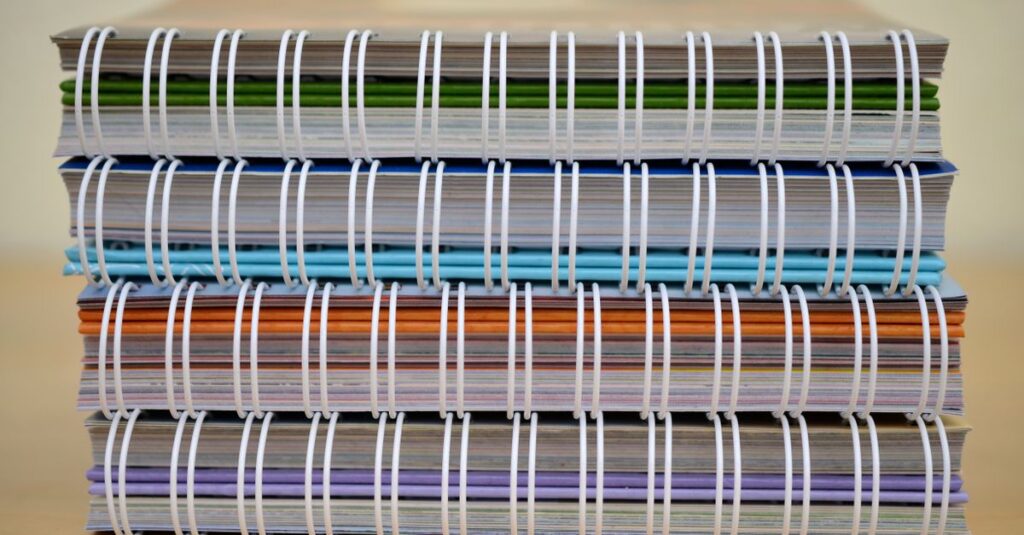
And binding? It's not just “stitched” or “spiral.” It's about whether the pages hold for 200 pages of constant use. A student's notebook gets thrown in a bag, dropped, opened 50 times a day. A corporate diary sits on a desk, opened and closed repeatedly. If the binding fails, the whole product fails. You need a press that understands this as a engineering problem, not just a finishing step.
Expert Insight
I was reading an industry report last month and one line stuck with me. It said that for bulk stationery, the most common point of failure isn't the printing — it's the post-production logistics. The packing, the palletizing, the loading. A press near you might print beautifully, but if their warehouse can't handle loading 5,000 boxes onto a truck without damage, you've got a problem. I don't have a cleaner way to put it than that: proximity helps only if the entire chain, from paper roll to delivered box, is under competent control.
The Hidden Cost of “Local" Customization
Custom notebooks and diaries are where intentions meet reality. You want your school's crest on the cover, your company's values printed on the inside flap, a specific page layout for your accounting team. A local press might say “yes, we can customize.” But can they?
Customization isn't just changing a color. It's about having design templates for different ruling types (SR, DR, FR, CR). It's about print technology that can handle fine logo details without smudging. It's about the ability to do small test runs before committing to 10,000 units. Many smaller local presses use digital printing for custom jobs, which is fine for small batches. For 5,000+ notebooks, you need offset printing capability for consistency and cost. If the press near you doesn't have an offset line, your per-unit cost on a large custom order will be surprisingly high.
And then there's the back-and-forth. Being close allows for quick sample reviews. But if their design team is just one person who also handles sales and accounts, your revision rounds will take weeks. Physical proximity doesn't speed up creative or technical processes if the team isn't scaled for it.
Anyway. Where was I.
A Different Kind of “Near" — Trust & Communication
This is the part nobody says out loud. When you're ordering in bulk, you're not just buying products. You're buying a relationship. You need someone you can call at 4 PM when a last-minute change comes from the principal. You need someone who understands that “account books” aren't just notebooks — they need specific rulings, thicker paper, sometimes numbered pages.
This kind of “closeness” isn't about GPS coordinates. It's about whether the supplier understands your sector. A press that mostly does wedding cards might not get why a school needs 92-page single-ruled books in five different colors for different grades. A press that focuses on corporate clients will instinctively know why a diary needs a ribbon marker, a back pocket, and maybe a monthly planner layout.
So maybe “near me" should also mean “near my industry.” Near my specific needs. That's the trust factor. It's why some buyers choose a supplier 300 kilometers away over the one in their suburb — because the distant one speaks their language, has worked with similar institutions, and doesn't need every detail explained from scratch.
Think about it this way: the real cost of a supplier isn't just the invoice amount. It's the time you spend managing them, explaining things, correcting mistakes. A press that's culturally “near" you saves that cost entirely.
Comparing Your Options: Local Press vs. Dedicated Manufacturer
Let's put this side-by-side. Not to say one is always better, but to show what you're actually evaluating when you search “printing press near me.”
| Factor | Local General Printing Press | Dedicated Notebook Manufacturer |
|---|---|---|
| Primary Focus | Broader print services (flyers, brochures, labels) | Specifically notebooks, diaries, stationery |
| Bulk Capacity | Often limited; may batch large orders over weeks | Built for volume (e.g., 30,000-40,000 units/day) |
| Paper Expertise | General paper knowledge; may not specialize in writing paper GSM | Deep knowledge of 54 GSM, 70 GSM, etc. for writing feel |
| Binding Tech | Often one method (e.g., only spiral) | Multiple methods (stitched, spiral, perfect) for different uses |
| Customization Scale | Good for small custom runs (digital print) | Can handle large custom orders (offset print) cost-effectively |
| Sector Knowledge | General commercial | Specific to education, corporate, institutional needs |
| Problem Solving | May need guidance on ruling types, page counts | Already knows SR, DR, FR rulings, standard page options (52, 92, 200) |
What most people don't realize is that a dedicated manufacturer often has more efficient logistics for bulk orders, even if they're farther away, because they do this every day. The local press might be learning on your order.
So, What Should You Do When You Need a Printing Press?
Right. Let's get practical. You've got the order. You need the books. Here's a way to think about it that doesn't just start with a map.
First, define the actual need. Not just “5,000 notebooks,” but: 5,000 A4-size, 92-page, single-ruled notebooks with a custom cover, delivered to five different school locations by May 15th. That level of detail.
Then, use that detail to ask questions, regardless of location:
- “What's your maximum output per day for this type of notebook?”
- “Can I see samples of your 54 GSM paper with pencil and pen writing?”
- “How do you handle multi-location delivery for bulk orders?”
- “What's your process for color matching our logo?”
If the local press answers these confidently, great. If they hesitate, or say “we'll figure it out,” that's a red flag. For high-volume, specific-use products, you need a supplier who has already figured it out. The convenience of proximity is real, but it's a bonus on top of capability, not a substitute for it.
And sometimes, the right partner isn't the closest one. They're the one whose entire business is built around making the thing you need, thousands of times a day, for decades. The distance then becomes a shipping calculation, not a risk factor. That's the kind of relationship that turns procurement from a headache into a solved problem.
Frequently Asked Questions
Is a local printing press always better for bulk notebook orders?
Not always. While local offers easier visits and potentially faster initial communication, the critical factors are daily production capacity, paper quality expertise, and binding technology. A local press that primarily does flyers might struggle with 20,000 notebook orders. You need to verify their scale-specific capabilities first.
What should I ask a “near me" printing press before placing a large order?
Ask about their maximum daily output for notebook binding. Request samples of the actual writing paper (like 54 GSM) to test. Ask how they handle custom cover color matching and what ruling templates they have. Finally, ask for a detailed timeline breakdown — not just final delivery date, but printing, binding, and packing stages.
Can a printing press near me handle custom diary manufacturing for my company?
It depends on their equipment. Custom diaries often need features like ribbon markers, pocket backs, specific page layouts. If the local press has digital printing only, large custom runs can be costly. For 1,000+ diaries, offset printing capability is better. Ask if they have experience with corporate diary specs before committing.
How important is paper GSM when choosing a printing press for school notebooks?
Very. GSM (grams per square meter) determines the thickness and feel of the paper. School notebooks typically use 54-70 GSM paper for smooth writing and durability. A press unfamiliar with stationery paper might use thinner paper that tears easily. Always request a paper sample and test it with a pen.
If the nearest printing press can't meet my volume, what are my options?
Look for dedicated notebook manufacturers, even if they are farther away. They are built for volume (often 30,000+ units/day) and have streamlined logistics for bulk shipping. The extra freight cost can be offset by lower unit prices and guaranteed on-time delivery. It turns a location search into a capability search.
Closing Thoughts
The search for a printing press “near me" is natural. You want control, visibility, maybe a sense of local reliability. But for bulk notebooks, corporate diaries, institutional stationery — the things that hundreds or thousands of people will use every day — the checklist has to be deeper.
Capacity. Paper knowledge. Binding strength. Sector experience. These aren't nice-to-haves; they're what decides whether your order is a success or a series of apology emails. Sometimes the right partner is across the city. Sometimes they're across the state. The map is a starting point, not the destination.
I don't think there's one perfect answer here. Probably there isn't. But if you've read this far, you already know what you need — you're just figuring out if it's okay to prioritize capability over convenience. It is. Your job is to get the right books delivered, not just the closest ones.