

Here’s the thing nobody tells you about A3 paper.
I get this question a few times a month. Usually from a procurement manager in Bangalore, or a school principal in Hyderabad who’s just seen an invoice with ‘A3 size notebooks’ on it and is now trying to figure out what the hell that means. Their voice has that specific kind of tired confusion — the one you get from comparing five different supplier quotes, all using different terms. They just want to order notebooks. Not decode an international paper standard.
So let’s decode it. A3 page size is 297mm by 420mm. That’s 11.7 inches by 16.5 inches. It’s exactly twice the size of an A4 sheet. You know, the one in your printer. That’s the only thing that matters here: it’s big. Impressively big. Annoyingly big, if you’re trying to bind it into something that fits on a desk.
And honestly? In over four decades of making notebooks, I can count on one hand the number of times we’ve been asked to mass-produce true A3 bound notebooks for a corporate or school order. It happens, but it’s the exception. It’s like ordering a custom-built race car when you need a fleet of sedans for the sales team. If you’re looking for a reliable supplier for everyday notebooks and diaries, this is where we come in.
What A3 size is actually good for (and it’s not your average notebook).
Let’s be practical. When would you genuinely need an A3 page? Think architecture studios. Engineering drawing offices. Artists’ sketchpads for large compositions. It’s a workspace, not a notepad. It’s the paper you spread out on a drafting table, not the one you tuck into a conference folder.
I remember a client — a civil engineering firm in Vizag — who ordered A3-sized graph books. They needed them for site sketches and schematics. The books were spiral bound, lay-flat, and lived on a shelf in the project room. Nobody carried them to meetings. They were tools, not accessories. That’s the key difference.
For 99% of business needs — meeting minutes, project notes, daily planners — an A3 page is overkill. It’s cumbersome. It doesn’t fit in standard briefcases or laptop bags. It shouts when you need it to whisper. The real question isn’t ‘What is A3 size?’ It’s ‘Does my team need to wrestle with a poster-sized page just to take notes?’
The Real-World Headache of Big Paper.
This is where theory meets the factory floor. And it gets messy. A3 paper means A3 covers, which need heavier, more rigid board. It means bigger machines for trimming and binding. It means custom-sized packaging boxes. Every step in the production line — from printing to stitching to packing — has to adjust. The cost doesn’t just go up a little. It jumps.
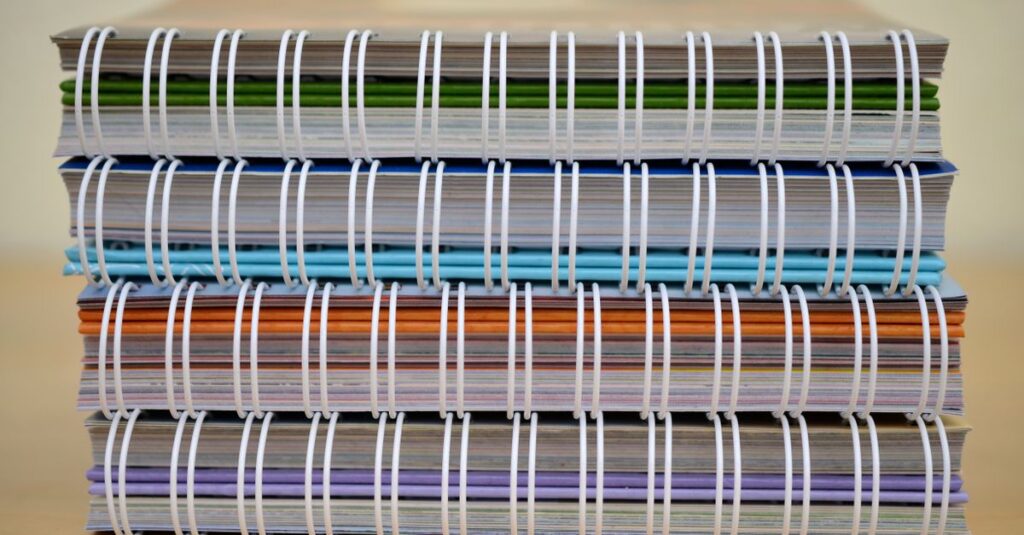
Then there’s the binding. Perfect binding (like a paperback book) on an A3 notebook? The spine glue has to work overtime to hold that much paper area. Spiral binding? You need thicker, more expensive wire coils. Stitched binding? Feasible, but it becomes a chunky, heavy block. The notebook itself becomes a logistical project.
And shipping. Good luck getting a pallet of A3 notebooks to fit cost-efficiently with standard A4 or Crown size stock. You’re paying for air. You’re paying for specialty. Most businesses ordering in bulk — schools, corporations, government offices — they need efficiency. They need standardization. A3 is the opposite of that.
Expert Insight
I was talking to a paper mill rep last year — over chai at our factory in Rajahmundry — and he said something obvious that stuck with me. The global paper supply chain is built around A4. The machines, the pallets, the warehouse racks, the retail shelves. Everything is optimized for that 210x297mm rectangle. Choosing A3 isn’t just choosing a bigger page. It’s choosing to fight the entire system. You can do it. But you need a damn good reason. ‘Because it looks impressive’ isn’t one.
A3 vs. A4: The Only Comparison You Need.
| Consideration | A3 Notebooks | A4 Notebooks (The Standard) |
|---|---|---|
| Typical Use Case | Architectural drawings, large sketches, detailed spreadsheets. | Meeting notes, project planning, daily journals, standard documentation. |
| Portability | Poor. Requires large bags or portfolios. | Excellent. Fits in laptop cases, backpacks, and desk drawers. |
| Production & Binding Cost | High. Needs specialized handling and materials. | Low. Streamlined, high-volume manufacturing. |
| Bulk Order Lead Time | Longer. Often requires custom production runs. | Short. Usually ready for dispatch from stock or quick turnaround. |
| Practicality for Daily Use | Low. Awkward to use on standard desks and in meetings. | High. Designed for everyday office and academic environments. |
Look at that table. For corporate diaries, school notebooks, account books — the stuff you order 500 or 5,000 of — A4 wins every time on practicality. It’s not even close.
So what are you actually looking for? (A confession).
Here’s my guess. When people search ‘A3 pages size,’ a lot of them aren’t looking for blueprint paper. They’ve heard ‘A3’ as a synonym for ‘big’ or ‘premium.’ Maybe they saw a fancy executive diary online and it said ‘A3 format.’ They think bigger page = more important notes.
But that’s not how it works. Importance comes from the content, not the real estate. I’ve seen CEOs who swear by small, leather-bound A5 notebooks because they can always have it with them. The notes get used. The giant, impressive A3 ledger? It sits on the shelf, pristine and intimidating, a monument to good intentions.
If you need more writing space than a standard Long Notebook (27×17 cm), the jump isn’t to A3. It’s to an Account Book size (34×21 cm). That’s our most popular large-format book for businesses. It’s spacious, but it’s still bound like a book, not a poster. It’s manageable. We make thousands of them every week.
The Micro-Story: Why Theory Fails on a Tuesday Morning.
Let me tell you about Priya. She’s 38, a procurement manager for a network of private schools in Chennai. Last year, a new principal insisted on A3 ‘observation diaries’ for his teachers. Priya ordered 200. They arrived — beautiful, thick, spiral-bound. A month later, she did a site visit. She found a stack of them, still in shrink wrap, in a storage cupboard. The teachers were using cheap, A4-sized notepads from the local market. Why? The A3 diaries didn’t fit on the small tables in the staff room. They were too heavy to carry between classrooms. The theory of ‘better note-taking’ crashed into the reality of a teacher’s day. Priya didn’t reorder. Now she asks us for durable A4 notebooks with reinforced covers. Simple.
That’s the gap. Between what looks good on a spec sheet and what actually gets used.
Your Practical Checklist Before You Order ‘Large Format.’
Right. If you’re still considering a larger-than-standard notebook, run through this list. Out loud.
- Desk Test: Will it fit on the actual desks your team uses? With a laptop and a coffee cup?
- Carry Test: How will people transport it? Is there a bag or case that fits it?
- Storage Test: Where will it live between uses? On a bookshelf? In a drawer?
- Cost Test: Is the price per unit at least 2-3x a standard notebook? Are you okay with that?
- Usage Test: Be brutally honest. Is this for daily jotting, or for quarterly presentations that need a big, impressive prop?
If you answer ‘no’ or ‘I don’t know’ to more than one, you’re probably solving for a problem that doesn’t exist. You’re buying a concept, not a tool.
Frequently Asked Questions
Is A3 the same as ledger size?
No, they’re close but not identical. A3 is 297x420mm (11.7×16.5 in). Ledger size (or Tabloid) in the US is 11×17 inches. They’re often used for similar things — large format printing, drawings — but if you’re sourcing materials or machines, the few millimeters difference can matter. For notebooks, most manufacturers will treat them as ‘large format’ and the binding process is similar.
Can you make custom A3 notebooks for a corporate gift?
Yes, absolutely. We can. We’ve done it for architects’ firms and design studios. But it’s a custom job. It needs special paper, special binding, and it costs more. The real question is intent. Is it a functional gift you expect people to use daily, or a prestige item? For the former, I’d steer you to a premium A4 or Account size diary. It’ll get more actual use. Our custom printing can make even a standard size feel luxurious.
What’s the biggest notebook size you make regularly?
Our standard largest size is the Account Book at 33.9 cm x 21 cm. It’s bigger than A4, smaller than A3, and it’s the sweet spot for ledger books, large registers, and detailed project notes. We run this size every day. It’s practical for bulk orders, ships easily, and users don’t need a drafting table to open it.
Why do A4 notebooks cost less than A3?
It’s all about the machinery and the material yield. Paper is made in large rolls and then cut down. The cutting patterns for A4 are hyper-optimized globally — there’s almost no waste. A3 cuts are less common, so there’s more trim loss. Then, every machine in our factory — the printers, the stitchers, the trimmers — is calibrated for high-speed A4 production. Switching to A3 means slowing everything down. Time is money. Volume is efficiency.
We need large sheets for brainstorming sessions. Should we get A3 notebooks?
Probably not. Get a flip chart. Or buy pads of loose A3 paper. The beauty of a brainstorming session is fluidity — you tear sheets off, stick them on walls, mix them around. A bound notebook locks those ideas into a sequence and hides them when closed. For collaborative, creative work, loose paper or a whiteboard is almost always better than a bound book, regardless of the a3 pages size.
Wrapping this up.
So here’s where we land. A3 page size is a real standard. It has its place. But that place is niche. Specialized. For the vast, vast majority of businesses, schools, and institutions buying notebooks in bulk, it’s a solution in search of a problem.
The smarter move is to focus on quality within the standard sizes. Better paper GSM. More durable binding. A cover that lasts. Custom printing that reinforces your brand. That’s where the value is. That’s what gets used until the last page is filled.
I don’t think there’s one perfect size for everyone. Probably there isn’t. But if you’ve read this far, you’re not just checking a box on a procurement form. You’re thinking about how your team actually works. And that’s the only question that really matters.
If you’re figuring out the right size, paper, and binding for your next bulk order, reach out to us. We’ve been having this conversation since 1985.