

Let’s talk about the stuff that actually gets used
Right. Look around any office, any manager’s desk, any university admin room. What’s on it? I’ll tell you what’s on it. A notebook. A pen. Always. That little corner of real-world stuff that hasn’t gone digital.
You’re a procurement manager, or maybe you run branding for a corporate house. You’re trying to find ways to make your company’s name stick. Not just on a billboard or a banner that gets thrown away after the event. I mean *stick*. In people’s hands. On their desks. In their daily work. The answer is sitting right there, and it’s so simple that most people miss it.
A customized diary and pen set isn’t a giveaway. It’s a quiet, persistent employee. It shows up to work every day for your brand. I’ve been making notebooks and diaries since 1985, and the clients who get this — the schools, the corporations, the distributors — they come back year after year. Not for the gimmick. For the result. If this sounds like the kind of practical branding you need, the process is simpler than you think.
Here’s the thing nobody says out loud. In a world of digital noise, the most effective marketing is the thing people don’t throw away. The thing they actually use.
Why a diary and pen? Because it’s personal, not promotional
Think about it this way. You hand someone a branded mug. Nice. It goes in a cupboard, gets used maybe once a day, if that. You hand them a premium pen and a well-made diary. Where does it go? Into their briefcase. Onto their meeting table. Into the hands of the client they’re pitching to. The branding isn’t screaming; it’s just *there*, being useful.
I was talking to a client from a big bank in Hyderabad last month — over chai, actually — and he said something that stuck. They used to spend lakhs on fancy corporate gifts at Diwali. Watches, decorative items. The feedback was polite. Then they switched to a high-quality, leather-bound customized diary and a smooth-writing pen with their logo. The feedback changed. “We actually use these.” “My team fights over who gets the new diary.” That’s the shift. From a gift to a tool.
The psychology is pretty simple, but we overcomplicate it. When you give someone something that helps them do their job better, or plan their day, you’re not just giving them a thing with your logo. You’re aligning your brand with utility. With their success. Every time they jot down a winning idea or sign a deal, your brand is part of that moment. It’s subtle. And it’s powerful.
Which leads to the real question most procurement teams have: is this just for big corporates? Absolutely not.
Who actually buys custom diaries and pens in bulk? (You’ll be surprised)
Most people hear “customized diary” and think “multinational company year-end gift.” That’s one slice. A big one, sure. But in our factory in Rajahmundry, the orders tell a different story. A more interesting one.
Let me break down who’s really ordering this stuff, in the thousands:
- Schools & Colleges: Not for branding, but for system. A custom diary for teachers with the academic calendar, period schedules, and school logo pre printed. It creates uniformity. A custom pen for the student council. It builds identity.
- Government Departments: You’d be amazed. For conferences, training programs, as part of official kit. Durable, practical, and it carries the department’s insignia with a formality that a t-shirt never could.
- Banks & Insurance Companies: For their frontline agents. A diary to track customer visits, a pen to get signatures. The branding works 24/7 in the field.
- Distributors & Wholesalers: This is a smart one. They get customized notebooks and pens made with *their* brand, then supply them to the retail shops they serve. The shopkeeper uses their diary, sees their name daily. It locks in loyalty.
- Startups & SMEs: For client onboarding kits. It’s a cost-effective, classy touch that says “we pay attention to detail” without the price tag of tech gadgets.
The through-line? It’s never about the object itself. It’s about the job the object does. And your brand hitching a ride.
I think — and I could be wrong — that the best marketing isn’t about being seen. It’s about being relied upon. A diary is a tool of reliance.
The micro-story: How a small change made a big difference
Let me tell you about Arvind. He runs a mid-sized pharmaceutical distributor in Vizag. 45, maybe. Sharp. His problem was that the local chemists he supplied to were also buying from his three competitors. No loyalty. Just price.
He came to us wanting a “branding solution.” We talked him out of the usual caps and calendars. Instead, we made a simple, sturdy customized account book (A4 size, 200 pages, spiral bound) and a box of blue pens. Both with his company name and a helpful drug schedule chart printed inside the cover.
He gave them to his top 200 chemists. Not as a gift. As a “useful stock register we thought you might need.”
A year later, he told me the result wasn’t in a sales spike. It was in the calls. The chemists would call to reorder, and they’d say, “Arvind, I’m writing it in your book right now.” His brand had become the paper their business ran on. Literally. They weren’t just seeing his logo; they were *using* it to run their shop.
That’s the shift.
Expert Insight
I was reading something last month about “tangibility bias” and one line stuck with me. The research said that people trust and remember physical objects more than digital messages because they engage more senses — touch, sight, even smell. A customized pen has weight. A diary has texture. Your brain files that under “real.”
An email is forgotten. A well-made notebook on a desk is a daily, silent reminder. The expert said something like — in an intangible world, the most credible thing is a thing you can hold. I don’t have a cleaner way to put it than that. It’s why the digital age hasn’t killed the notebook. It’s made it more powerful.
Custom Diary vs. Standard Corporate Gift: A Real Comparison
Okay, so you’re convinced it’s a good idea. But is it better than the other options on your procurement list? Let’s be blunt. Here’s a side-by-side of what you’re really buying.
| Consideration | Customized Diary & Pen Set | Standard Corporate Gift (e.g., Desk Clock, USB Drive) |
|---|---|---|
| Daily Visibility | On the desk, in the hand, multiple times a day. | On a shelf, in a drawer. Maybe glanced at once. |
| Perceived Value | High (if quality is good). It’s a useful tool, not a trinket. | Often low. Seen as a generic giveaway. |
| Lifespan | 6-12 months (until the diary is filled). The pen lasts longer. | Indefinite, but largely unused. Or until tech is obsolete. |
| Brand Association | With productivity, planning, success. | With… a gift. That’s it. |
| Cost per Impact | Lower. The cost is spread over hundreds of uses. | Higher. One-time cost for one-time (if any) impression. |
| Practical Hurdle | Getting the design and quality right. Paper weight, binding, pen ink flow. | Finding something people don’t already have three of. |
The table makes it pretty clear. It’s not that other gifts are bad. It’s that a customized diary and pen works harder. For longer. With more purpose.
And honestly? The hurdle — getting the quality right — is the only part that matters. A flimsy notebook and a skipping pen do the opposite of what you want. They associate your brand with frustration.
Getting the specs right is the whole game.
What to look for when you order: The manufacturer’s checklist
This is where most corporate buyers get a headache. You’re not a stationery expert. You’re just trying to get a good product. Let me simplify it. After forty years in this, I think there are three non-negotiable things.
1. The Paper. Don’t get lost in GSM numbers. Just ask for a sample. Write on it with the pen you plan to use. Does the ink bleed through? Does it feel rough or smooth? For a diary that gets used daily, you want a paper with a slight tooth for grip, but smooth enough for fast writing. 70-80 GSM is usually the sweet spot for executive diaries. School ones can go lighter. But feel it. Your finger knows.
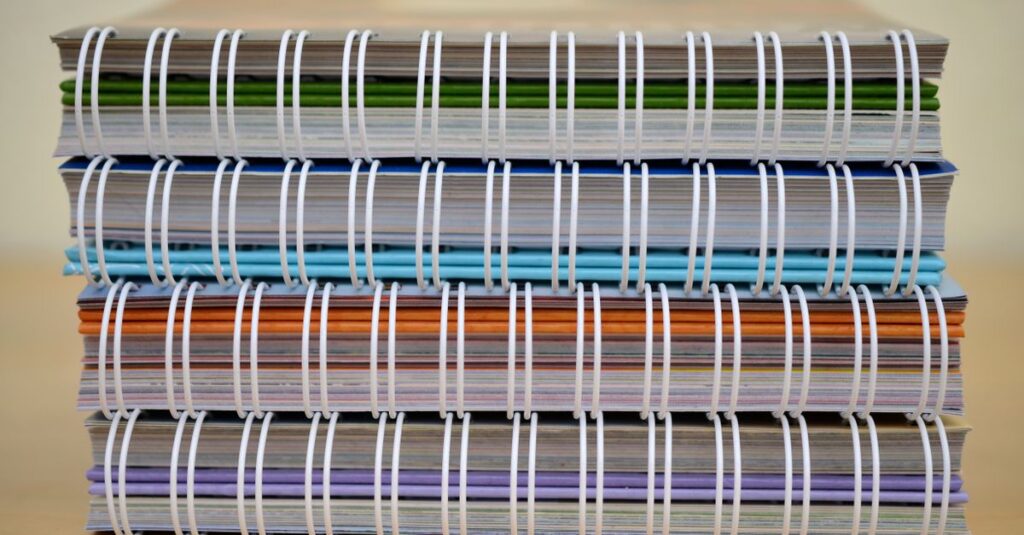
2. The Binding. This is what kills notebooks. A diary that sheds pages in a month is a disaster. For heavy-use, spiral binding is king — it lays flat. For a more formal, book-like feel, perfect binding (like a paperback) works, but the glue must be strong. Stitched binding is the classic, most durable for thick diaries. Ask your manufacturer which they recommend for your use case. If they don’t ask you about use, walk away.
3. The Print & Personalization. This is your brand on display. Is the logo crisp? Is the text readable? On the cover, you can go fancy — foil stamping, embossing. Inside, clarity is key. A poorly printed calendar or company message looks cheap. And the pen — test the sample. The imprint should be clean and durable, not a sticker that peels. The ink should start instantly, no scratching.
Look, I’ll just say it. The cheapest quote will fail on at least one of these points. Probably the binding. Your brand deserves better than a pile of loose pages.
Nine times out of ten, the problem isn’t the idea of customization. It’s the execution.
Frequently Asked Questions
What is the minimum order quantity for custom diaries and pens?
It varies a lot by manufacturer. For a dedicated run with your custom design, most serious factories (including ours) have a minimum of 500-1000 units for diaries. For pens, it can be lower, around 300-500. The reason is setup cost for printing plates and molds. For truly bulk orders — 10,000+ — the per-unit cost drops significantly.
How long does it take to produce a customized diary order?
From final approved design to delivery at your warehouse, plan for 4-6 weeks. This includes paper sourcing, printing, binding, and finishing. The first step — getting a physical sample approved — is crucial and can take a week itself. Don’t rush it. A good sample saves a bad bulk order.
Can we customize the inside pages of the diary, not just the cover?
Absolutely. This is where the real utility is. You can print your company’s calendar, contact lists, project templates, values statement — anything. We do this all the time for corporate clients. The inside pages are your chance to be genuinely helpful, not just branded.
What’s the difference between a customized diary and a private label notebook?
Good question. “Customized” usually means you provide the design for a standard diary style. “Private label” or OEM means we manufacture the entire product to your unique specifications — size, paper, ruling, cover material, everything — and put your brand on it as if you were the maker. It’s a deeper level of partnership, common for distributors building their own stationery line.
Do you export custom diaries and pens internationally?
Yes, regularly. We ship bulk orders to the Gulf, Africa, and other regions. The key is understanding local preferences (like A4 vs Crown size) and ensuring sturdy packaging for the long haul. The process is the same, just with more paperwork on our end.
The conclusion: It’s about being useful
So, what’s the point of all this? It’s not that you must order customized diaries and pens. It’s that if you’re spending money on branding, you should want that money to work every single day. Not just on day one.
A diary and pen set does that. It turns your brand into a daily habit. A trusted tool. In the hands of your employees, your clients, your partners.
I don’t think there’s one magic branding solution. Probably there isn’t. But if you’ve read this far, you’re already looking for something that lasts, something tangible in a fleeting world. That’s the whole point. It’s okay to want your brand to be more than a logo on a screen.
It’s okay to want it to be the thing someone reaches for when they have a good idea.